

This Popular American Salt Isn't As Common Outside The US
We may receive a commission on purchases made from links.
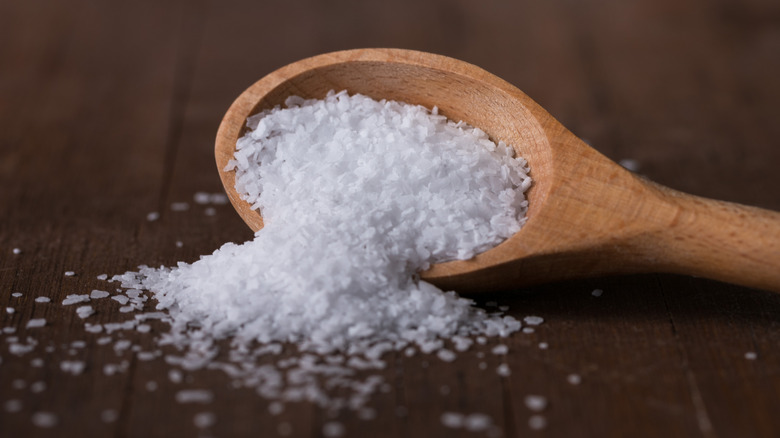
Chefs swear by it because it's inexpensive, easy to pinch, and tastes pure as opposed to metallic. Its coarse, flaky crystals make it perfect for seasoning meat or finishing a salad by hand. It even skips the additives found in many table salts. Given all that, you'd think everyone in the world cooked with kosher salt. But, as it turns out, this popular American favorite is not so common on supermarket shelves outside the U.S.
In the United Kingdom, cooks reach for flaky sea salt like Maldon. Across Europe, finely milled sea salts fill grocery shelves. Asia leans heavily towards rock salts and salts high in minerals. Long story short: In most parts of the world, kosher salt simply isn't a thing. So what exactly is kosher salt and how did it become an exclusively American favorite?
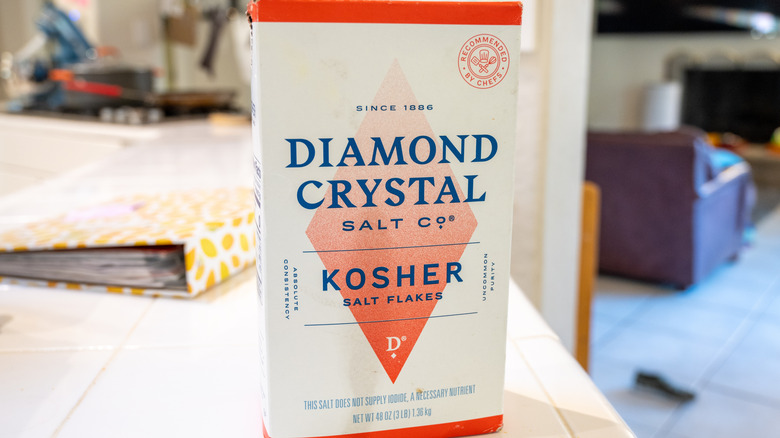
For starters, it's a distinctly American product, born from the Jewish practice of koshering meat. The larger crystals worked better for drawing out blood, and salt companies began marketing it as koshering salt to Jewish communities. Over time, brands like Diamond Crystal and Morton popularized it for general kitchen use. The other uniquely American factor in its popularity was iodine — or rather, the lack of it. Iodine fortification became widespread in U.S. table salt during the early 20th century to combat deficiency-related diseases. While it served a public-health purpose, it also gave salt a faint metallic taste. Kosher salt, which remained un-iodized, offered an alternative and became the chef's choice over time. In many other parts of the world, however, iodine fortification was never as common — so there was no need for a separate, additive-free option.
Substitutes for kosher salt
That's not to say kosher salt isn't in demand overseas, especially among Americans living abroad, who find themselves missing it when cooking with local salts. As one Redditor lamented, "I've been staying in the UK for a while and kosher salt just doesn't seem to be a thing here. There's table salt and sea salt, and of course fancy things like pink Himalayan ... But I find myself missing some good old kosher salt when I'm cooking," they posted. The demand isn't driven just by nostalgia. Nearly every recipe on American cooking websites includes kosher salt, leaving a lot of cooks abroad searching for substitutes.
Now, in chemical terms, all salt is just a combination of sodium and chloride. The difference between table, sea, and kosher salt is based on the presence or absence of additives and the process of extracting the salt from saline water. And as long as it doesn't contain additives like iodine or anti-caking agents, any flaky sea salt can stand in for kosher. The complication, however, lies in texture and intensity. Not all salts are created equal by volume or feel: Diamond Crystal salt's light, hollow flakes measure very differently from Morton's denser, crunchier grains, and both behave differently from most sea salts. It's why the instruction "season to taste" still matters more than any precise teaspoon measure, especially when the salt on your shelf isn't the one a recipe writer had in mind.