

Can You Put Aluminum Foil In The Microwave?
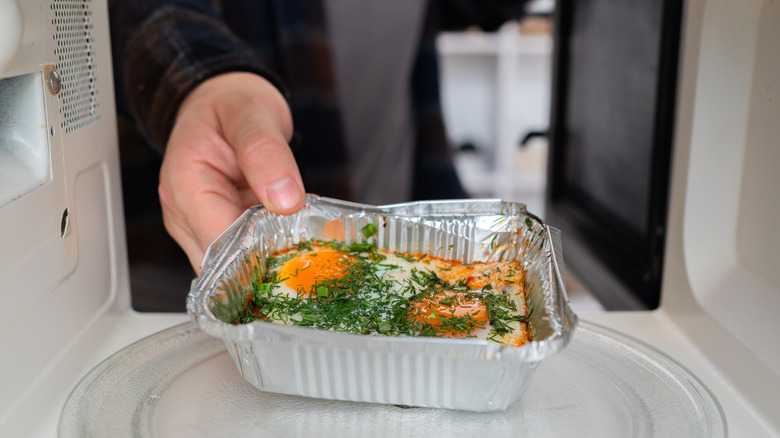
When heating leftovers in the microwave, your food's container falls into one of two broad categories: microwaveable and non-microwaveable. However, it isn't always clear which materials can withstand the heat, and even worse, many aren't labeled with clear microwave instructions. Many home cooks store a good amount of leftovers in aluminum foil, either in a well-wrapped pack or atop an open bowl or piece of bakeware. They're left wondering if it's safe to simply place the whole thing in the microwave, or if foil warrants a transfer into another container.
The simple answer is yes, you can technically microwave aluminum foil, as long as the manufacturer clearly indicates that your model can handle the foil in the device's manual. However, there are specific conditions that need to be met. Most importantly, the foil needs to be kept as flat as possible. When foil is bent or wrinkled, a phenomenon known as "arcing" occurs. Arcing causes sparks to ignite on the surface of the foil, and these sparks could lead to a fire or even damage your microwave oven. Furthermore, if you cook food wrapped entirely in foil, the machine's radio waves are reflected in a new direction and do not actually penetrate the food inside.
You'll also need to be careful with how you place the foil inside your microwave. Make sure to keep its edges at least one inch away from any of the device's walls, and verify that the turntable is working and spinning to prevent overheating any single area. As you can see, with such strict parameters on how you can microwave foil, there aren't many other uses than placing a flat sheet on top to cover your food. Therefore, we suggest you scrap the idea and move your food to a microwave-safe container.
The best alternatives to tin foil in the microwave
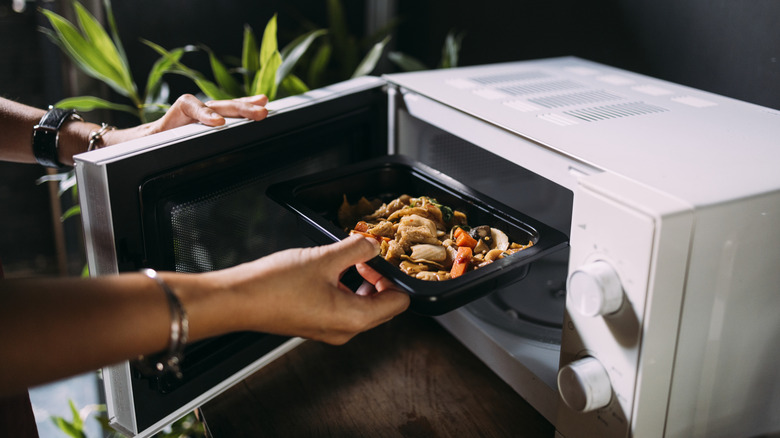
Finding an alternative to aluminum foil is as easy as looking around your kitchen. If you don't already have microwave-safe containers on hand, look for an inscription or sticker on the bottom of your plates and bowls to see if they indicate they are safe for use in your microwave. Check the manufacturer's website for confirmation if you can't find information on the item itself.
Having a working knowledge of what can and can't go in the microwave helps in a pinch when there isn't a clear label. Glass, ceramics, paper plates, and paper towels generally do well when heated. Some exceptions include crystalware and handmade pottery. Some plastic containers are microwavable, but not single-use or to-go plastic, unless there's a marking stating otherwise. Avoid placing styrofoam, cardboard, and metals (except for properly placed aluminum foil) in the microwave.
If you're set on having the flexibility to microwave metals, consider opting for a dual-mode device with a convection setting. These devices have an extra heating element and fan that can safely reheat, roast, or broil dishes with the touch of a button. They can handle baking sheets as well as aluminum foil without issue — just remember to select the "convection" microwave setting to disable traditional electromagnetic heating.