

The Only Use For Extra-Virgin Olive Oil In A Pasta Dish Doesn't Involve Any Cooking
We may receive a commission on purchases made from links.
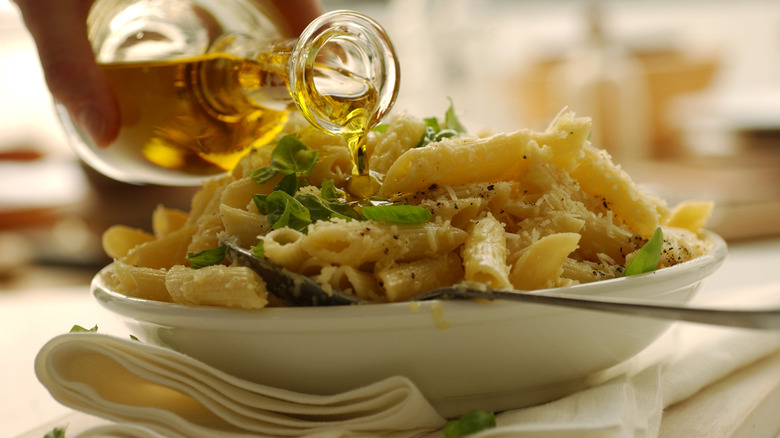
For many home cooks, olive oil is the first thing that hits the pan when making pasta. Whether it's sautéing aromatics like onions and garlic or pan-frying proteins, such as meatballs and crispy chicken, olive oil is a kitchen staple. But according to Sarah Grueneberg, chef and owner of Monteverde in Chicago and author of "Listen to Your Vegetables," that's not how extra-virgin olive oil (EVOO) should be handled. For her, its best (and only) job should be for a finishing touch.
"I like to finish almost every dish I cook — meats, fish, veggies, pasta, etc — with EVOO," Grueneberg reveals. "Not cooking with it preserves the flavor components of your oil, and when it's heated, you lose the fruity flavor and components that make EVOO sing." Extra-virgin olive oil is prized for being packed full of complex flavors, which, depending on the brand and source, can be buttery, floral, peppery, or even grassy. And those more subtle notes are what help it stand out, especially compared to most cooking oils, like vegetable oil or canola oil.
But while these unique flavor compounds are delicious, they're also volatile, meaning they'll break down at high temperatures. So, instead of thinking of extra-virgin olive oil as a fuel for all things frying and sautéing under the sun, try reframing it as a refined pasta topping, not unlike a high-quality Parmigiano-Reggiano or fresh-grown herbs from the garden. When left uncooked and drizzled atop a pasta dish, it instantly creates more aroma, depth, and balance, tying the dish's flavors together.
How to pick the perfect olive oil for your pasta
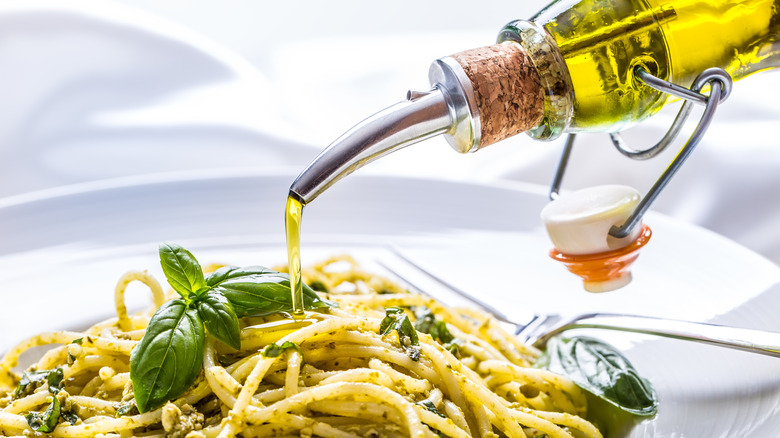
It's easy to develop the habit of exclusively using extra-virgin olive oil in the kitchen. But if it loses precious flavor compounds when heated, what should you use instead? Grueneberg suggests opting for something far more costly and simple in composition when it comes to cooking on the stovetop. "I look for olive oil that's moderately priced and in a can, and be sure to look at the ingredients list and make sure whatever oil you choose only has oil and no additives," she suggests. "Be careful of 'light olive oil,' as that product is often cut with cheap vegetable oil."
Though they might sound the same, olive oil and extra-virgin olive oil have some major differences. Notably, standard olive oil has a high smoke point, making it appropriate for standard kitchen operations. On the other hand, EVOO is cold-pressed, giving it a low smoke point. In addition, it isn't treated by any chemicals. If you're in need of a quality extra-virgin olive oil, Grueneberg recommends conducting a thorough inspection of the packaging. "For a finishing oil, choose [a] product [that's in] a dark-colored bottle," she explains, adding that exposure to light is bad for oil. "A can or dark-colored bottle helps preserve the quality of oil. Also, look for a vintage date or use-by date; after pressing, oil is usually good for 2 years."