

The Easiest Way To Make Soups And Stews Less Salty
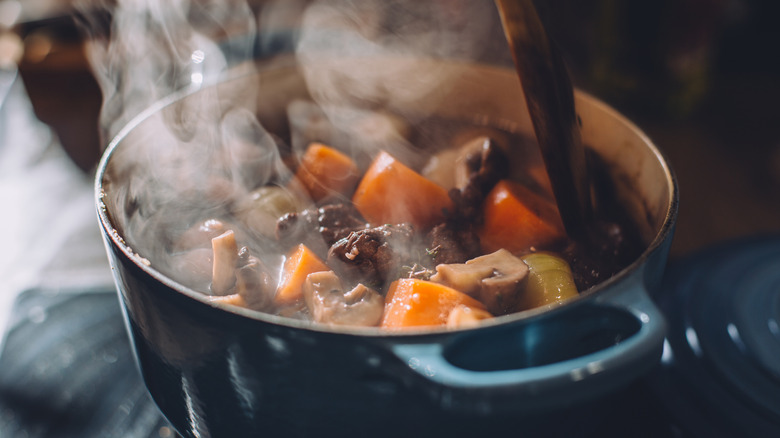
It's happened to the best of us, that tragic moment when you're leaning over a soup you've been building, layering, and simmering. It looks and smells amazing until tasting reveals that it's crossed the invisible line from seasoned to salty. Don't cry; those tears would only add more salt. You may have heard some old-timey recommendations that send you searching for a quick fix; maybe you could add a potato, sprinkle in rice, or stir in sugar. But salt isn't a flavor that can be masked or neutralized. The only way to make an over-salted and hearty stew taste less salty is to give the sodium more room to spread out, and the only way to do that is by adding volume, namely water.
With other flavors, you can sometimes balance one with another. But salt is not something you cancel; it's something you have to dilute. Think of it like dye in water. A single drop of food coloring turns a glass blue, but the same drop in a bathtub would look barely tinted. Likewise, sodium disperses through the liquid until every spoonful has the same concentration. When you add more water or other cooking liquid — such as broth, cream, or wine — you lower the ratio of salt to liquid.
So, why does dilution work when other fixes don't? Sodium dissolves evenly into liquid, which is why every spoonful of soup tastes the same once it's stirred. Adding more liquid doesn't remove the salt, but it lowers its concentration in each bite. By contrast, tricks like tossing in a potato or bread don't change the chemistry. They may soak up some salty broth, but when you eat the starch, the salt will still be there, saltily.
Dilution is the solution, just don't over-stew it

Understanding the ratios of volume, biologically and culinarily, helps explain why over-salting sneaks up during long cooking. As water evaporates, the sodium left behind becomes more concentrated. Salt is essential, and every mammal needs sodium to regulate nerve signals and muscle contractions. When the balance tips too low, the body craves it; when it tips too high, the body pushes back. On the tongue, sodium ions slip through epithelial sodium channels in receptor cells, firing a very specific signal to the brain: salty. Too much sodium at once can throw off your body's fluid balance by pulling water from your cells and raising blood pressure. An aversion to overly salty food is the body's way of saying, "Stop, now!"
Bitterness, which can be broken with sweetness, often signals poison in nature, so sweetness evolved as its counterbalance, reassuring us that calories are safe. That's why cooks pair bitter greens with honey or temper chocolate with sugar. But sodium doesn't have a partner taste; it can't be balanced with something opposite. Once the ratio is off, no amount of sweetness or acid can cancel the signal once those receptors are firing. The only true shift comes from adding more liquid or bulk, lowering the ratio until the receptors calm down.
If you cook, you will make mistakes. Having to cope, to figure it out in the heat of the moment, builds both character and kitchen skills. Try to see it as a pivot into a happy accident. You thought you were making potato leek soup, but surprise! Now you get to have rich, creamy vichyssoise.
Water you waiting for?

What's the practical takeaway when the broth tips too far? The first line of defense is, obviously, to add less salt to begin with. Add small amounts first, then taste to see if it needs more before adding another increment. But if you've already played fast and loose with the salt shaker, then the batch you're making either just got bigger or has to be thrown out, so you might as well embrace the extra volume.
Add basically anything that isn't also salty that will create more volume: water, unsalted stock, or a handful of unseasoned beans, noodles, or rice will all soak up the broth and dilute excess sodium. When you add a dry ingredient, you'll naturally need to add more cooking liquid. Then, taste and adjust with herbs, acid, or fat to rebuild flavor without reintroducing salt. Sometimes, to undo a mistake, you have to redistribute it. You may not be able to erase the salt once it's in, but you can spread it thinner.
If you know a dish is heading into long simmer territory, season lightly at the start and salt more precisely at the end. As water evaporates during cooking, sodium becomes more concentrated. What tasted balanced in the first hour of a braise can taste off-puttingly brackish by the third. Leaving wiggle room for final seasoning avoids the fix-it stage entirely, as sodium doesn't vanish; it spreads. In this case, a cook's only real magic trick is making more soup. A pot that started as dinner for four stretches to six, leftovers included, and no one has to know the adjustment came from a slip of the wrist.