

Why This Midwestern Fruit Has A Banana Pudding Flavor
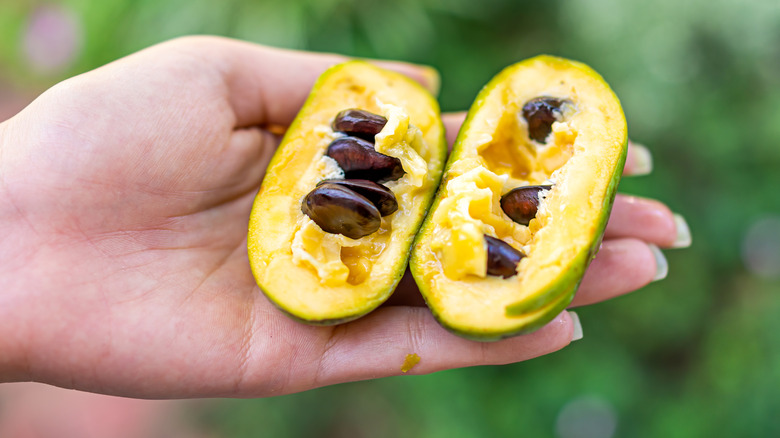
The largest fruit native to the U.S. is one that many Americans have never heard of, and even fewer have tasted. It grows on trees with a range starting at the Midatlantic coast and stretching westward to Eastern Kansas. Within this band, the trees can be found as far north as Michigan (and even Ontario, Canada) and as far south as Louisiana. Despite its prevalence in 20 states, as well as its deliciously tropical flavor, the pawpaw is a delicacy that you aren't likely to find in any store. So, how is it that a food that is often described as tasting like banana pudding, with tangy notes of passion fruit, mango, and pineapple wound up growing throughout Appalachia and the Midwest? As it turns out, those pawpaw trees are something of an evolutionary deviant.
When you look at the fruit's relatives, it all starts to make sense. Pawpaws, the Midatlantic's tropical fruits, are members of the Annonaceae family, also known as the soursop family. If you've tasted soursop fruits themselves or related varieties, such as cherimoya or custard apples, you may have noticed that all of those grow in tropical climates. But the pawpaw could not be restrained, and is the unique member of that family that evolved its way northward into the temperate climates of the Eastern U.S., bringing tropical flavor to folks in much chillier country.
How to get your hands on pawpaw fruit
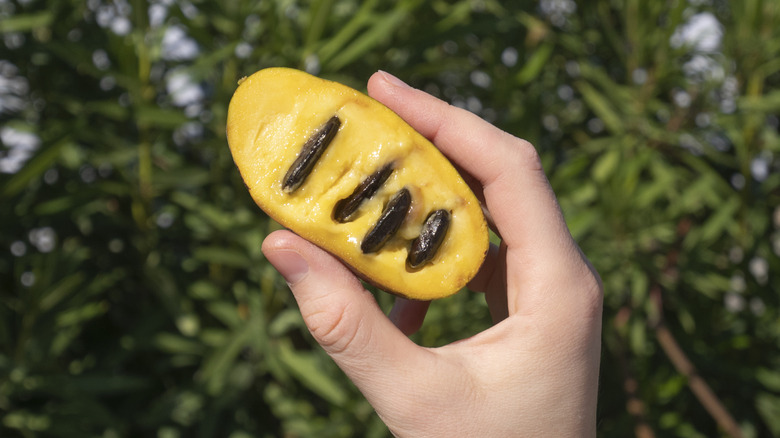
Now, if you're starting to feel a little bit disappointed that you've made it this far in life without ever tasting a pawpaw fruit, you certainly aren't alone. The green fruits, with their large black seeds and custard-like flesh, are worth the hype. They were an important Native American food, and were also beloved by such famous American figures as George Washington, Thomas Jefferson, and Lewis and Clark. Unfortunately, they can also be pretty hard to get your hands on.
The combination of a delicate, short-lived fruit and a limited season means that pawpaws have never been viable for large-scale commercial production. And that means they are unlikely to ever show up in your local big box grocery store. There are academic institutions researching how to better grow and transport pawpaws in an attempt to bring them to the masses, but for now you will have to look on a smaller scale.
Pawpaw fruits begin to ripen in late summer and continue into early autumn. During this time, you may be able to find them at a local farmers market. The fruit is very popular, though, so you may need to arrive early or else find the lot already sold out. Alternatively, you can head into the woods yourself, for a bit of good old-fashioned foraging, as the trees are quite plentiful in many parts of the Eastern U.S. If you're a patient sort, the final option is to plant the trees yourself. You'll be looking at a few years' wait before they produce their first custardy crop of fruits, but once they start, you're likely to be quite popular with the adventurous eaters in your neighborhood.