

What's A Slow Or Moderate Oven? Decoding Oven Temperature Terms In Vintage Recipes
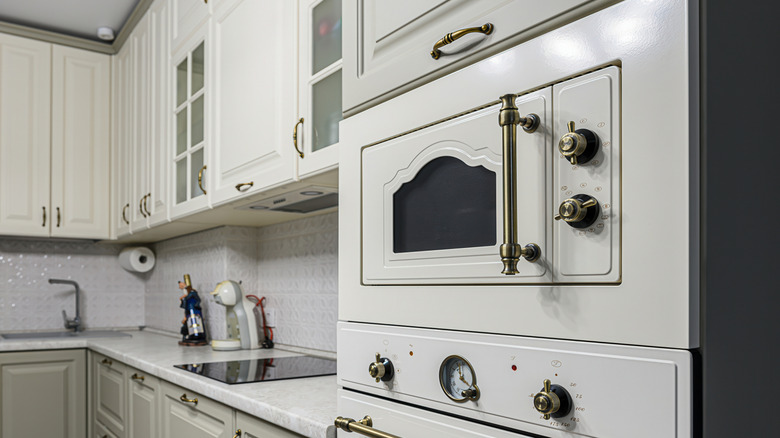
Vintage cookbooks can be treasure troves of yesteryear recipes, some delightful and others downright perplexing. That's especially true when it comes to assumed knowledge that's not-so-assumed decades later. One of my favorites is vague cooking directions such as "bake in a slow oven," a "moderate oven," or a "quick oven." Perhaps home chefs just inherently knew such things, or industry-wide oven temperatures were inconsistent? Depending on the time period, chefs may have even been cooking with highly unpredictable wood or coal.
Regardless, I'm happy to say there was actually a method to the madness, though subjective per the interpreter. Some beg to differ on oven temperature terms, but generally, a slow oven meant setting the knob at 250 to 325 degrees Fahrenheit, while a moderate oven inched it up a bit, reaching 325 to 400 F. Consequently, a hot oven (also called a quick oven) topped out at temps between 400 and 450 F.
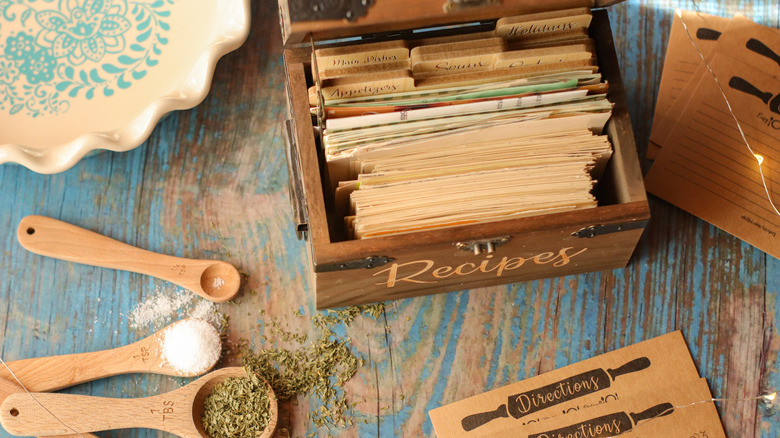
The charm never ends when digging around the culinary past, including handwritten recipes on index cards, filed inside dedicated recipe boxes and traded between friends and family. Church socials, Tupperware parties, and bridal showers inevitably involved revealing Aunt Betty's or Grandma's cobbler or baked chicken recipes — in fact, it was standard protocol for everyone to gift a bride-to-be with their most cherished family recipe. It also went deeper than oven temperatures — how about a "saucer" of flour or a "smidge" of baking powder?
Intuitive measuring by association
With no internet and definitely no artificial intelligence, chefs in past decades understood unspoken cooking terms. Automatic timers and kitchen scales were far less common, so measurements routinely referred to household items, such as a "wine glass full" or "half a coffee cup" of liquid in a recipe. As for the "saucer of flour," that would intuitively be interpreted as a standard-sized teacup saucer holding a slight mound of flour. A smidge is something resembling a small pinch between two fingers,
Then there are the ambiguous references to using "just enough" of something to achieve a desired result, like "enough flour to stiffen your dough" or "a knob of butter," meaning enough butter for your purpose, like an adequate amount to butter a baking or frying pan. If you see vintage recipes stating "bake until done," or "cook until it smells done," good luck. But it's true that when cooking a particular dish often enough, you do actually learn what "done" smells like.
An endearing term is to "use butter the size of a walnut." Presumably, walnuts were common enough pantry items to serve as a measuring device equivalent to a tablespoon or two. When you see the curious but vividly understandable, "beat to drown the band," just beat that batter or butter hard and fast. And "sweet milk" is standard whole milk as opposed to "sour" buttermilk. These phrasings represent an era when cookbooks assumed a chef's familiarity, in a hands-on way — as well as an understood cooking camaraderie shared through written recipes.