

The Small Appliance Gadget You'll Want In The Freezer During A Storm
We may receive a commission on purchases made from links.
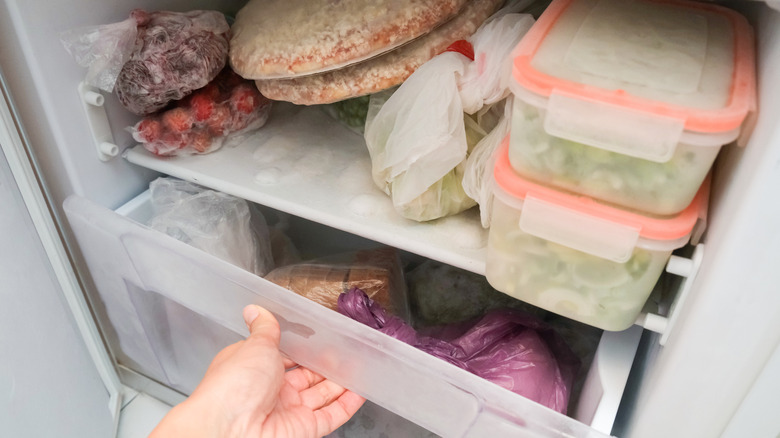
We've all been there. There's torrential rain, thunder, and lightning, and inevitably, you've just done the biggest grocery shop of the month when the lights flicker off. Your fridge and freezer are suddenly ticking time bombs. In these cases, you need to know what to do with frozen foods when your power goes out. But there's a surefire way to know whether your food is still being kept at a safe temperature or not — an appliance thermometer.
They're cheap, easy to pop into your fridge and freezer, and worth it for the peace of mind it provides. A 2-Pack of Analog Refrigerator Freezer Thermometers will run you just under $7 on Amazon. According to the USDA, you should place an appliance thermometer between food packages in your freezer and wait five to eight hours for the most accurate temperature reading. Interestingly, the USDA also recommends putting your fridge thermometer in a glass of water in the middle of the refrigerator to get the best reading. Thus, you'll want to make sure you get your appliance thermometers up and running immediately.
This brings us to our next point: While they are extremely helpful in a storm to gauge whether or not your food is still safe, appliance thermometers can and should be used at all times. You could use something like the quarter trick to tell if your food is safe after a power outage, but wouldn't you rather rely on the certainty a thermometer provides?
The ideal safe temperatures for your fridge and freezer
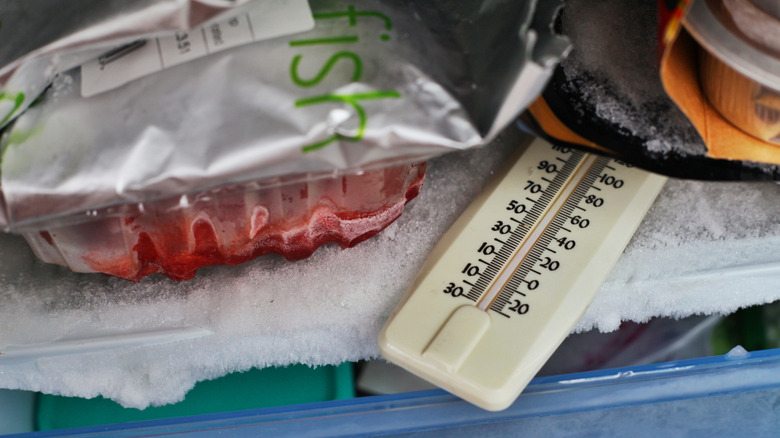
Food in your freezer should be stored at a temperature of 0 degrees Fahrenheit or below, and your fridge temp should ideally be around 38 to 40 degrees Fahrenheit. So, if you've employed your appliance thermometers ahead of time and the power goes out, check them immediately when the power goes back on.
If your freezer thermometer still reads 0 and your food is solidly frozen, you can be sure that it's still safe to consume. Likewise, if your fridge thermometer reads no more than 40 degrees Fahrenheit, eat away! If, however, your freezer thermometer is higher than 0 degrees Fahrenheit or your fridge temp is creeping up over 40, it's time to throw out whatever's in there and start over. That can be super frustrating, but it's better than making yourself sick by consuming unsafe food.
There are different tips for protecting perishable foods from summer power outages, like placing freezer packs throughout your freezer and keeping the freezer door closed as much as possible. A freezer full of food can maintain a safe temperature for between 24 and 48 hours, depending on just how full it is. But the only way to know for certain whether your freezer stash is still safe after a power outage is to consult that inexpensive thermometer you smartly placed ahead of time because you — yes, you! — are a forward-thinking genius.