

What Is Marmite, And What Does It Taste Like?
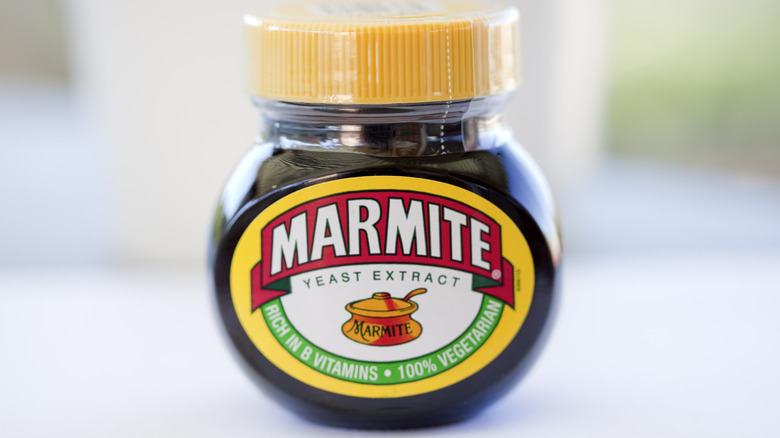
A classic British condiment with a unique taste and the bold branding to match, Marmite has been part of the U.K. food landscape for over a century. This sticky, dark brown spread is made from yeast extract, and it's known for its intense savory flavor. Marmite certainly has a loyal fan base, and these colorful jars sit proudly in home pantries across the nation. But, this spread also famously divides opinion, with some finding its unique taste less than appealing. However, these love-hate opinions have long been the basis of the brand's marketing. And clearly, it's working, because the company produces around 50 million jars of the stuff each year.
Spread onto buttered toast is one of the most popular ways to enjoy Marmite, but it's far more versatile than you'd think. You can use it to enhance a wide variety of both sweet and savory recipes, where it delivers a punchy hit of salty, umami richness. It's possible to get hold of a jar in the U.S., too, and a quick browse online will reveal a whole world of Marmite-flavored snack products. So, if you're intrigued by this humble condiment, join us as we delve into everything from how it's made, to where it came from, and how best to use it in your everyday cooking.
How is marmite made?
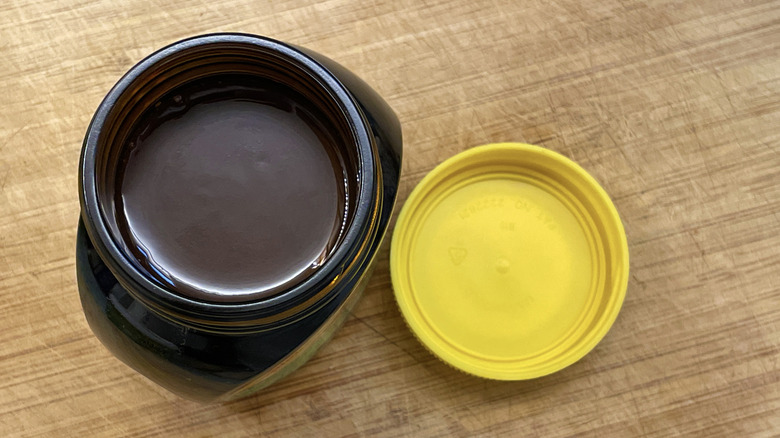
Marmite is made with a liquid yeast mixture, which is a essentially a by-product created during the beer brewing process. Brewers use the live yeast to convert sugar into alcohol, but as this occurs, the yeast cells proliferate, leaving a surplus of around seven times the original amount. However, this doesn't need to go to waste, because it serves as the perfect base for transforming into Marmite.
Step one is heating the liquid yeast in large vats, which breaks down the live cells. Next, it's added to a centrifuge, which uses rapid spinning to separate the mixture into two key components, one of which is a runny, brown-hued yeast extract. To thicken it, the extract is heated to evaporate some of the water content, and the result is a far thicker, stickier product that resembles the familiar spread much more closely. But, there's a final key step to the Marmite-making process. A medley of top-secret flavorings is essential in creating that signature taste, which according to the label, include salt, vegetable juice concentrate, and celery.
What does it taste like?

So, we know it packs a savory punch, but other than saltiness, what exactly does this spread taste like? Well, since it's also made with yeast, Marmite shares plenty of sweet, malty flavor notes with beer. This is thanks to the yeast's close contact with malted grains during the brewing process, such as barley, wheat, and rye. And, as the liquid yeast mixture gets reduced into a thick, sticky spread, its flavor becomes significantly more concentrated, giving it an unmatched depth.
Glutamate also plays a key role in the spread's taste. This is an amino acid that gets produced naturally as the yeast is heated and broken down during the production process. It's also what's mixed with salt to make MSG (or monosodium glutamate), which is commonly added to snacks and takeout foods to enhance their savory flavor. Marmite does not disclose the exact blend of flavorings added to the product, but we know there's also celery and vegetable juice concentrate in there, which further build on the umami-rich profile. Despite the fact that it's completely vegan-friendly, some liken the condiment's taste to that of a meaty broth, with some similarities to soy sauce.
Where did it originate?

Surprisingly, the creation of Marmite was not intentional. In fact, it was an accidental discovery by German scientist Justus Liebig. In the late 1800s, he realised that brewer's yeast developed a delicious, umami-rich flavor when concentrated. Knowing he was on to something, Liebig tweaked the recipe with the addition of vegetable extracts, and in 1902, the Marmite Food Company was born. The production hub of choice was Burton-upon-Trent, a town in Staffordshire in the U.K. This was an ideal location for producing the spread, since there were multiple breweries in the area from which the yeast by-product could be obtained.
The origin of the name stems from original packaging of the product, which was in French earthenware pots of the same name. However, by the 1920s, the product was being sold in glass jars, with the same distinctive red and yellow label we see on supermarket shelves today. Throughout the decades, Marmite has remained a staple in Britain, and even formed part of the ration packs distributed to soldiers in World War I. Today, the original factory in Burton-upon-Trent is still thriving, with the majority of the products it produces being sold within the U.K. The spread is also exported to other countries, including Australia, New Zealand, South Africa, and Canada.
Ways to use Marmite
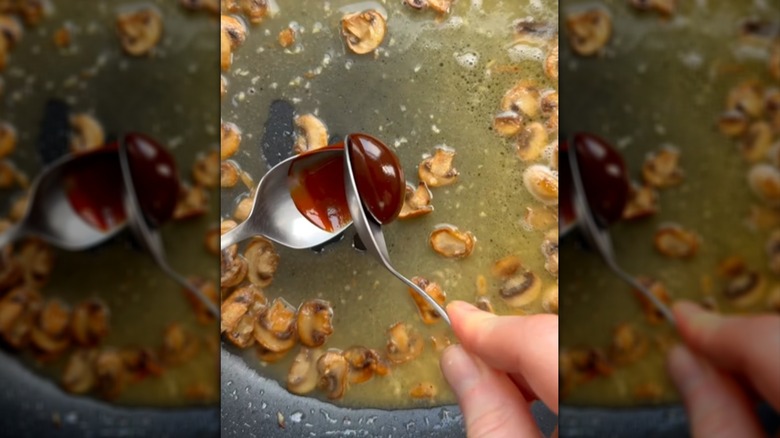
It might be a beloved toast-topper, but this certainly isn't the only approach to consider when it comes to using Marmite. There are countless other ways to incorporate this flavor-packed spread into your cooking and baking, whether you're after a subtle boost of umami, or want to make it the star flavor.
Marmite is the perfect tool for amping up the savory richness of various home cooked dishes, from hearty stews and soups to casseroles, marinades, and sauces. Try adding a spoonful to a beef stew to enhance its meaty depth, or incorporating it into the meat and veg filling of a cottage pie for a satisfying finish. Essentially, you can use it much like Worcestershire sauce. Marmite and cheese also make a rather excellent pairing. You can smear the spread generously into a grilled cheese sandwich, swirl it into cheddar muffins, or add it to a cheesy pasta sauce, perhaps alongside some sauteed mushrooms and garlic. In fact, spaghetti with Marmite is allegedly one of Nigella Lawson's favorites!
This condiment is great for enhancing roast potatoes, too. Just add a dollop to the cooking water during the parboiling stage, and your roasties will come out gorgeously golden, crisp, and infused with savory flavor. And, you can even use Marmite in sweet recipes, such as cakes, cookies, and brownies. In desserts, Marmite contrasts the sweetness of ingredients like white chocolate and caramel beautifully.
Marmite vs Vegemite

Vegemite is Marmite's Australian cousin, and it's been produced there since 1923. It was developed by Cyril Callister for Melbourne-based company Fred Walker & Co. The company had seen Marmite's success in the U.K., and sought to create its own version. Today, Vegemite is widely considered a staple in Australia. There's much debate between Brits and Aussies over which condiment reigns supreme, but we reckon this likely comes down to which version you grew up with in your kitchen cupboard.
Looks-wise, the two spreads are pretty similar, but what makes Marmite unique from Vegemite? The two spreads are both forms of yeast extract, and share a bold taste, thick texture, and dark coloring. However, Vegemite is considered to have a slightly more bitter, salty flavor than Marmite, which is balanced with notes of sweetness. The Australian version also features additional flavorings, including onion and spices. It's thicker in consistency, too. While both products are ideal for spreading, Marmite is smoother and more pourable, which makes it easier for incorporating into broths and sauces. Vegemite, on the other hand, holds its shape better when spread atop crackers or toast.
There are also some differences in the nutritional profiles of the two spreads. Both are a great source of essential B vitamins, but Vegemite contains 30% more vitamin B1, 20% more vitamin B2, and 38% more vitamin B9 than Marmite. However, Marmite is richer in B3, and also B12, which is not present in Vegemite at all.
The brand is known for its famous slogan

In 1996, Marmite adopted the iconic slogan, "You Either Love it or Hate it", which was inspired by the divisive nature of the product. Rather than ignoring the fact that many Brits admitted to loathing the taste of Marmite, the brand instead played on this realization. This created intrigue among the haters, while building comradery among the equally prevalent Marmite lovers. It was a marketing ploy that sparked conversations, and clearly ended up being a major contributor to the brand's growth, because the slogan is still in use today. In fact, the word Marmite has taken on a whole new meaning in British culture, frequently being used to describe someone or something that's famously loved and hated in equal measure.
Marmite even went as far as to release its "Marmite Mind Control" campaign in 2019. This included a comedic TV advert which playfully showed Marmite haters being converted into fans through hypnosis. Limited edition jars were also released, with labels that featured hypnotic patterns and the strapline, "You Don't Hate it, you Love it!". We can't help but wonder just how many haters have been converted over the years.
Is Marmite nutritious?

Marmite is certainly unique in terms of its ingredient make-up, but what does the nutritional profile look like? While the spread is relatively low in carbohydrates and fat, its standout quality is the impressive source of B vitamins. These include B1, B2, and B3, which are vital for maintaining a healthy nervous system in the body, plus vitamins B9 and B12, which help us to create red blood cells and release energy from the foods we eat. In fact, a typical eight-gram serving of Marmite contains a whopping 76% of the recommended daily intake of B12, and 56% of B1. University of York even conducted a study that showed how consuming Marmite daily can support the production of a neurotransmitter called gamma-aminobutyric acid, which may help to reduce anxiety.
It is however important to be mindful of Marmite's relatively high salt content, which sits at 14% of the recommended daily intake per portion. Consuming too much salt can lead to elevated blood pressure, which can have negative impacts on heart health. The brand does sell a reduced salt version of the spread, which brings the level down to almost half that of the original. The protein content of Marmite is also higher than you might think, given the generally modest serving size. An eight gram portion provides 2.7 grams, which is around 5% of your daily intake from just a simple swipe on your morning toast.
How to store Marmite
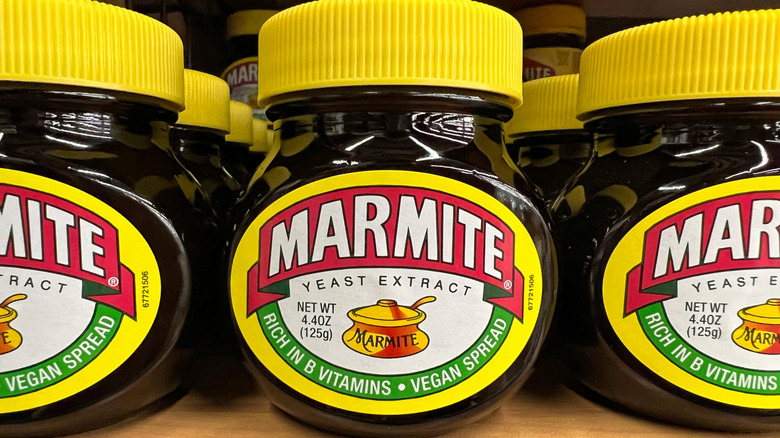
How a jar of Marmite is stored is key to its texture and spreadability. Some people believe that keeping the condiment in the fridge is the best way to keep it fresh for longer, but this is very much a myth. Refrigerate your Marmite, and it'll become hard and stiff in consistency, which of course does not lend itself well to spreading. Therefore, storing jars in the pantry or kitchen cupboard at room temperature is preferable.
In an interview with The Daily Mail, Marmite Quality Specialist St. John Skelton confirmed that storing Marmite out of the fridge does not compromise its freshness. In fact, the product label itself states than an opened jar will keep well for up to 18 months. Skelton explains that this time frame is based on the vitamin content of the spread, which depletes after the 18 month window. However, thanks to its high salt content, Marmite is generally safe to eat well past its best before date. Skelton even goes as far as to say that a batch made in 1945 would be still be perfectly fine to consume today (we're going to assume he means an unopened jar!).
Where to buy Marmite in the US

It might have its roots in England, but if you look in the right places, Marmite is surprisingly easy to get your hands on in other parts of the word. In America, Marmite is available in many large grocery stores such as Publix, Kroger, and Wholefoods, where it's generally stocked in the international or British food section. So, you don't have to travel across the pond to get your fix. You can also pick up jars of Marmite online, from places like Amazon, Ebay, and speciality British stores.
Despite the popularity of Vegemite in Australia, Marmite is available for purchase there too, likely thanks to demand from British expats. However, it's sold under the name "Our Mate", due to a trademark conflict with the company Sanitarium that owns the distribution rights for the product in this part of the world. Marmite is also widely available in Ireland, Singapore, South Africa, Malaysia, and Sri Lanka.
Are there other Marmite-flavored products?
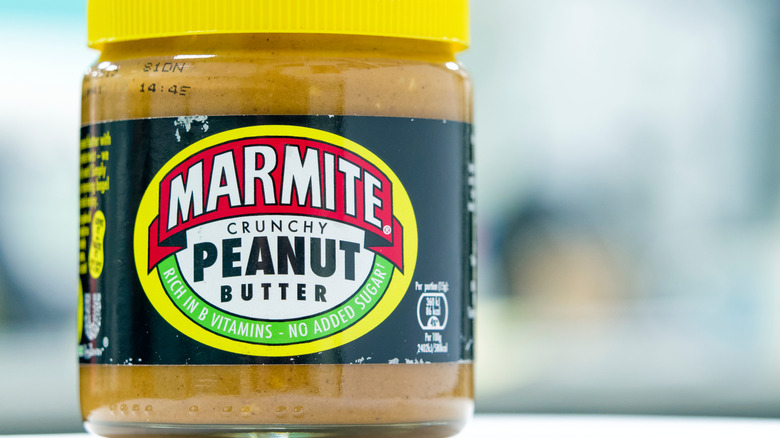
If you thought that distinctive savory taste could only be enjoyed in the form of the original spread, think again. Since its launch in 1902, Marmite has released a whole host of other products that are infused with that moreish umami-rich flavor. Some of these have been produced by the brand itself, while others have been in collaboration with other food manufacturers. One of the most popular of these creations is Marmite cheese. Produced alongside British cheesemaker Ilchester Cheese, these individually portioned bites see sharp cheddar blended with Marmite and branded with those familiar red and yellow colors. Another kitchen staple that's been given a makeover by Marmite is peanut butter, which comes in smooth and crunchy versions. Here, the yeast extract adds a rich hit of saltiness that complements the nutty base beautifully.
Other snacks available in the U.K. include Marmite-flavored popcorn, potato chips, and oven-baked peanuts. You can even find pizzas topped with the stuff. And, alongside its original jars of spread, Marmite has released some twists on the classic version, including a product enhanced with truffle, and Marmite XO, a variety that gets aged four times longer than regular Marmite, for maximum flavor.