

It's True, Many British Beers Actually Rely On Fish Bladders To Get The Finished Product
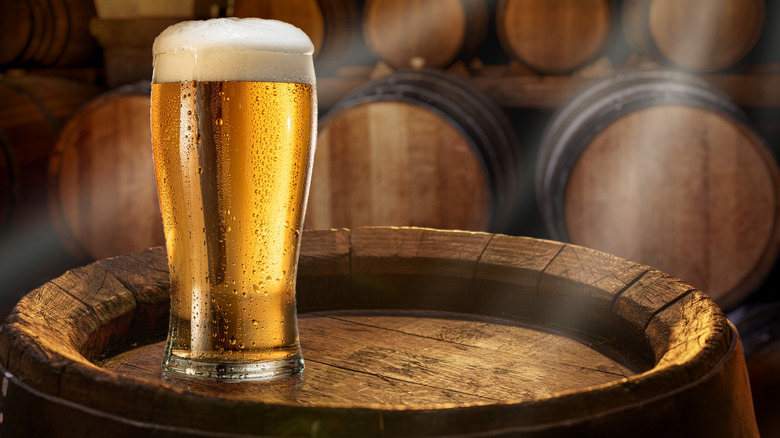
Fish and beer have a longstanding relationship. Beer-battered fish, fish and chips with a frosted pint; these combos are popular and a crowd favorite. But there's another collaboration between fish and beer that most people are unaware of — unless they know to look for it. We're talking about isinglass (or fish bladder), and no, you can't taste it in your ale. However, small traces of it are probably in your glass, depending on the brewery, and it's largely the reason for your beer's crisp, cloudless appearance.
For hundreds of years, isinglass has been used as a clarifying agent for not just beer, but also natural wines, hard cider, and other alcoholic beverages. In the fermentation process of beer, yeast and other particles are present in the cask, making the alcohol cloudy. While this sediment will settle naturally over time, breweries use isinglass as a "fining" to speed up the settling process. While vegan options now exist, isinglass is still widely used in some locations, including the United Kingdom.
What is isinglass and what are its uses?
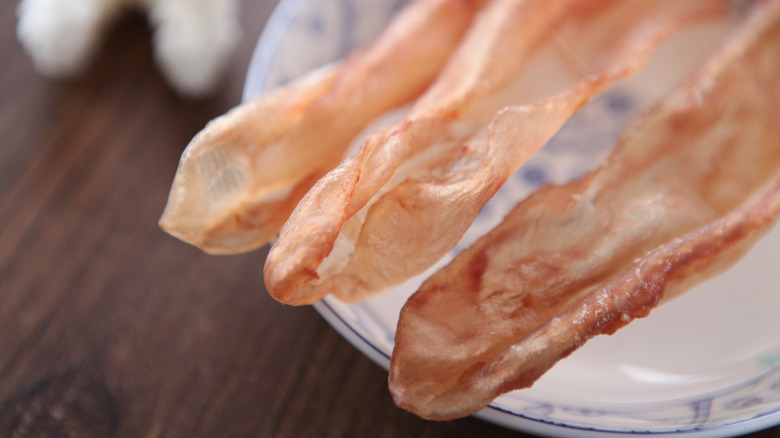
Isinglass is made from the lining of a fish's swim bladder. The swim bladder is used to control a fish's buoyancy as it changes depths in the water. Once the bladder is harvested, it is dried and cleaned afterward producing a film. The film is then heated so that it forms a sticky substance — a collagen that has ended up as a key ingredient in multiple industries.
The isinglass collagen has protective properties and has been used in medical dressings, adhesives, and glues as well as a preservative for art. It's even been used by performers to coat the bottoms of their feet in order to pull off walking on hot coals. In terms of food, isinglass has been used both as a gelatin ingredient and as a preservative that keeps bacteria out and moisture in.
While the exact origin of using isinglass to clarify beer is unclear, one theory suggests that a fisherman used the swim bladder of a large catch to store his beer or wine (similar to how wine used to be kept in a skin). It's known that throughout history beer used to be more acidic, and that acidity would have caused some of the collagen from the bladder to dissolve into the beer, clarifying it. The difference in clarity would've been noticeable when poured. Another theory looks at the research of Pierre Pomet, who was cited in published works on isinglass in the late 1700s.
The history of isinglass in beer
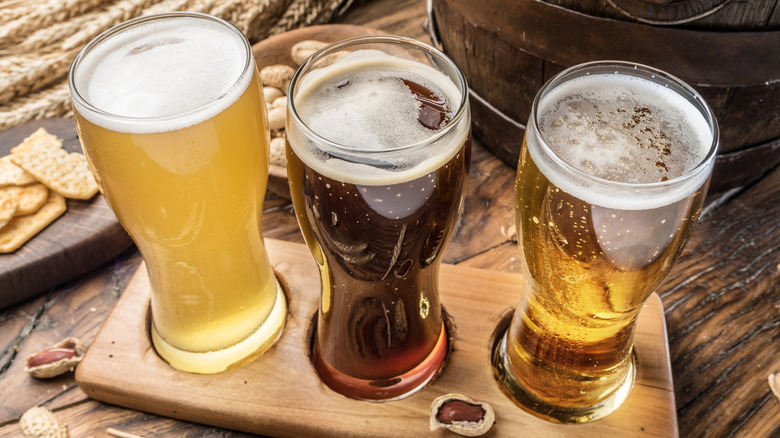
In the 17th century, isinglass film began to be placed in layers at the bottom of vats for malt beverages. The yeast particles and sediment attached to the film and when the liquid was clarified, the film would be removed from the container. By 1761, British breweries were importing a significant amount of Russian isinglass to craft their beer with this process, which is still used today.
Today, isinglass is still used primarily for cask-conditioned ales, though some brewers also turn to isinglass to clarify beer without the use of filtration. There is growing debate about the use of isinglass as well as finings in general, however, as more and more brewers are preferring to avoid additives if they're not necessary. There's also a growing belief that with the clarification that isinglass brings, it may also be filtering out some of the beverage's taste. A certain level of haze in a drink is not as off-putting as it once was as many realize cloudiness doesn't necessarily mean that the pint is bad.
While very little isinglass makes its way to the glass, the use of the animal byproduct still turns away most of those following a vegetarian or vegan diet. Generally, British beers that market themselves as "real ale" cask beers still use isinglass, gelatin, glycerin, or casein in production. Of the 20 most popular beer brands from the United Kingdom, Marston's, Theakston, Sharp's, and Greene King largely still use isinglass, according to Barnivore, a vegan alcohol guide.