

9 Foods People Ate During World War II
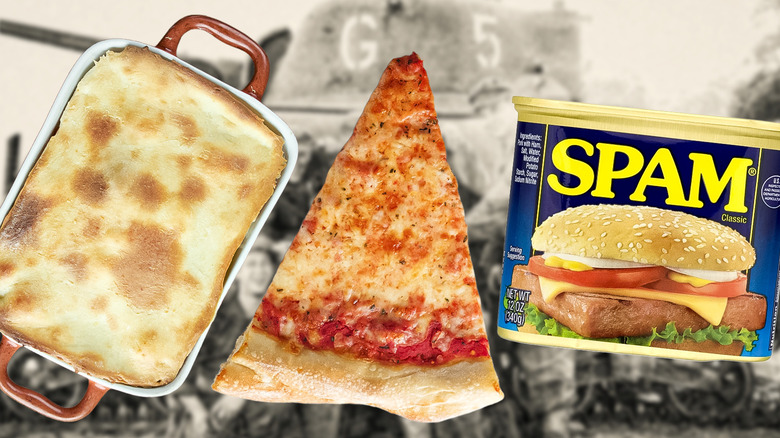
If you head to an American grocery store today, one thing is pretty much guaranteed: you'll be met with shelves full of fresh, canned, and frozen food. There are no major restrictions; if you want it and you can pay for it, it's yours. But there was a time when a full grocery store wasn't a guarantee. During World War II, the global food system was under huge strain, as countries struggled to produce enough food for troops and civilians. This led many countries to introduce rationing, of course, which helped to make sure there was enough food to go around.
But rationing had a major impact on dinner tables. People had to adapt to a new way of eating, and this led to the creation of many new recipes. In Italy, pizza fritta became popular, while the Dutch ate tulip bulb soup, and Brits munched on boiled parsnip and sugar sandwiches. Yes, you read that correctly. Keep reading to learn more about the different foods people ate to get by from 1939 to 1945.
1. Pizza

Pizza was, of course, eaten long, long before World War II. In fact, research suggests that an early version of the recipe was probably eaten in ancient Rome. The pizza we are familiar with today, though, smothered in tomato sauce and mozzarella cheese, originated in the Southern Italian city of Naples. Legend has it that American soldiers stationed in Italy during the Second World War fell in love with pizza. When they returned to the U.S., veterans were said to have wanted more of the pies, so demand for pizza allegedly boomed.
Many experts dispute this, however. Pizza was already in the U.S. long before the war. In fact, the very first American pizzerias opened in the late 1890s and early 20th century. At first, the restaurants catered to fellow Italian immigrants, but over the decades, pizza's popularity started to spread across the U.S. Not just because of soldiers, but also because pizza was simple and cheap to produce, which led to an increase in pizzerias run by people of many different backgrounds.
It's true, though, that American soldiers probably ate some pizza in Italy during World War II. They came back to the U.S. with a taste for oregano, in particular, which, of course, is a Southern Italian herb commonly added to pizza. In fact, research suggests that sales of oregano in the U.S. soared between 1948 and 1956. However, it's important to note that food was scarce in Italy during this time, so pizza probably wasn't a regular occurrence for the soldiers.
2. Pizza fritta

World War II was a difficult time in Naples' history. The city was destroyed by air raids, and there was little access to water, electricity, gas, and food. This meant that pizza, which was once a staple street food for the poor, was hard to come by. So, Neapolitans got creative, and they started making pizza fritta.
Pizza fritta, often referred to as the "cousin" of traditional Neapolitan pizza, likely wasn't invented during the war. Its roots likely go all the way back to the 16th century, but it did gain a new identity in Naples during this period. Like pizza, the dish is a very simple street food. It usually consists of fried dough topped with whatever ingredients are available. During the war, this was usually vegetables like broccoli or low-cost seafood like anchovies. Pizza fritta is deep-fried in oil, and this suited wartime Neapolitans, considering most of the ovens in the city had been destroyed by bombings.
You can still find pizza fritta in Naples. Today, the toppings have been upgraded to include everything from ricotta to prosciutto to the classic combination of tomato sauce and mozzarella.
3. Tulip bulbs

When you think of tulips, you probably think of one country: The Netherlands. Throughout the spring, the Dutch countryside is full of vivid, bright, colorful tulip fields. Today, they're a major attraction, drawing in millions of tourists every year. But while tulips are, without a doubt, beautiful to look at, they also served another valuable purpose during the World War II: sustenance.
Yep, tulips are edible. Well, parts of them are, anyway, including the petals and most of the bulb, but the germ should always be removed. In fact, without careful preparation, tulip bulbs can be poisonous and can even cause intestinal blockages. If you're not experienced with eating edible flowers, it's best to consult an expert before you start munching away on tulips.
However, Dutch people during the war didn't have the luxury of choice when it came to food. Tulips were edible, available, and so they were eaten, especially during the Dutch famine, which became known as the Hongerwinter and lasted from 1944 to 1945. One of the most common ways to eat tulips was in Dutch tulip bulb soup, but the flowers were also dried, powdered, and added to bread, cooked into rösti, pickled into sauerkraut, and even baked into cookies.
4. Mock banana

Back in 1633, botanist Thomas Johnson became the very first person in England to sell bananas. But it wasn't until the late 19th century that the fruit really started to rise in popularity. Ultimately, people loved them because they were sweet and sugary, like candy. But during the World War II, tropical fruit, which had to be transported on refrigerated ships, simply wasn't a necessity, and imports were banned. Bananas were officially off the table, and Brits were devastated.
In an attempt to recreate some of the candy-like goodness of bananas during the war, many Brits started to make mock banana. Instead of the sweet yellow tropical fruit, Brits made sandwiches with boiled parsnips mixed with caster sugar and banana essence. The taste, of course, wasn't quite the same, and people were thrilled when bananas finally made their return to the U.K. In fact, in 1945, there was even a parade held in honor of the first shipment after the war.
Mock banana wasn't the only food Brits attempted to replicate during World War II. Other wartime recipes included mock goose (made with lentils) and mock fish cakes (made with potatoes, beans, and anchovy paste).
5. Spam

One food American soldiers could always rely on during World War II was Spam. The tinned, processed meat, made with ground pork, ham, salt, sugar, potato starch, and sodium nitrite, first hit the American market in 1937. But during the war years, it became a reliable staple for American households and soldiers alike. It didn't need to be refrigerated, it was affordable, and it was pretty easy to prepare.
During the war, it's estimated that Allied troops consumed over 100 million pounds of Spam (which, fun fact, is a shortened version of spiced ham). By the time they came home, soldiers were sick of Spam, which is why sales of the processed meat actually dipped in the U.S. after the war.
American troops helped spread Spam around the world, because everywhere they were stationed, they would hand it out to the locals. In fact, to this day, Spam is a staple ingredient in Korean, Filipino, and Hawaiian cuisine. World War II rooted Spam musubi, for example, is a popular Hawaiian dish made with Spam, rice, and nori seaweed.
6. Dried eggs

The perfect accompaniment for a can of Spam? It's dried eggs, of course. Like the processed meat, powdered eggs were cheap to buy, and they were incredibly long-lasting. In fact, dried eggs can last in the pantry for up to 25 years, while a fresh egg will only survive a few weeks in the fridge.
In the U.K., powdered eggs were still rationed during the World War II, but not as tightly as fresh eggs. One person could have one fresh egg a week, for example, while one packet of powdered eggs (the equivalent to 12 fresh eggs) was allowed every month.
Powdered eggs may not have been appetizing (and were apparently quite rubbery and soggy), but they were incredibly useful. When mixed with water, they could be used in a variety of different recipes, like pies and pastries, just like a fresh egg. Demand for powdered eggs grew, and throughout the war, around 25% of all fresh eggs produced in the U.S. were turned into powdered eggs and sent overseas to Allied nations.
7. Meatless meatloaf

Americans weren't exempt from rationing during World War II. In order to support troops and Allied nations, the U.S. government had to set restrictions on certain foods, including meat. Meatless recipes became more common, as meat was reserved for soldiers fighting overseas. One popular recipe? Meatless meatloaf, which replaced the classic ground beef filling with ingredients like mashed up baked beans and vegetables.
This doesn't sound so strange to us today. But back then, Americans were used to eating a lot of meat. In fact, by 1900, research suggests that the average person in the U.S. consumed roughly 100 pounds of beef every year.
Now, meat consumption is still high in America, but more people are reducing their intake. Not because of war rationing, of course, but for environmental, animal welfare, and health reasons. Today, you're just as likely to come across a plant-based meatloaf made with ingredients like chickpeas, mushrooms, onions, carrots, and bell peppers.
8. Bubble and squeak

Bubble and squeak is a classic British dish. It's usually made with leftover potatoes and cabbage, which are fried together with butter. Fun fact: The strange name comes from the sound of the ingredients in the pan as they cook.
Sometimes, bubble and squeak is made with meat, but usually, it's vegetarian. And that's probably all down to World War II. The original recipe from the 1800s actually included beef, but during the war years, meat was far less accessible. In fact, most ration books typically allowed for only 4 ounces of bacon and ham, plus two chops of meat a week. So, it makes sense that, at this time, the beef in bubble and squeak was replaced with potatoes, which were far more common and easier to get ahold of.
Now, bubble and squeak is still eaten across the U.K., but it's often reserved for Boxing Day, on December 26. It's still usually made with cabbage and potatoes, but recipes have gotten more lavish over the years, adding in vegetables, herbs, eggs, tomatoes, and anything else that adds flavor or needs using up.
9. Lord Woolton pie

Another British wartime dish that revolved heavily around potatoes was Lord Woolton pie. To create the filling of the simple savory pie, potatoes were usually diced and combined with vegetables like rutabaga, cauliflower, carrots, spring onions, as well as oatmeal. Everything was cooked in water, sprinkled with parsley, and then covered in pastry. Some recipes swapped the pastry for a potato topping, similar to a simple shepherd's pie recipe.
And as for the name, no, the pie is not a member of the British nobility. It was actually created by a chef at London's Savoy Hotel and named after Lord Woolton, who was Minister of Food during World War II. Lord Woolton is widely credited with helping to reduce food waste and keep vulnerable Brits fed during the difficult years of rationing.
Lord Woolton pie was a success, becoming a staple dish in many households. This was largely thanks to its versatility, as the recipe could be easily adapted to use up whatever vegetables were on hand.