

What Exactly Is Lemon Zest? (Not To Be Confused With The Peel)
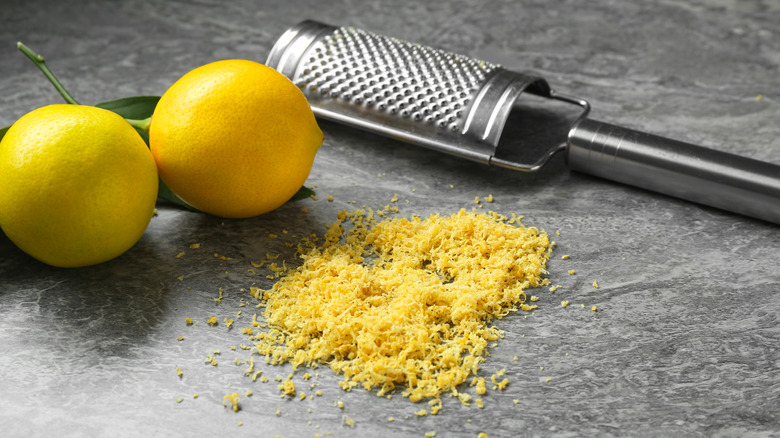
If you've ever been cooking and been confused at the terms "lemon zest," "lemon rind," or "lemon peel," you aren't alone. These terms all sound similar and are used in comparable recipes, but they indicate different things and it's important to understand the differences when cooking and baking.
Lemon zest is only the outermost layer of the lemon, which is bright yellow in appearance. It's flavorful and full of oils, which is why it's so commonly used in cocktails and baked goods like lemon bars. The rind, meanwhile, is both this layer and the white layer underneath it, which is more tough and bitter. The peel is pretty much interchangeable with the rind, though the term usually means you want to use the entire outer jacket of the fruit rather than cutting up the outside. These are less commonly used in recipes, though the rind is useful in things like stews, which are simmered over long periods of time. The zest by itself would not hold up well to this treatment, so the rind is used instead. The entire peel is used even more rarely, really only appearing in marmalade recipes and a few select cakes, although Tasting Table does have a recipe that can turn lemon peels into a sweet and tangy paste.
How to know which part of the lemon you should work with

With these tips in mind, it should seem straightforward when cooking a recipe involving lemon; use the outer layer if it says zest, add the inner white layer if it says rind, or throw in everything but the flesh if it says peel. However, this is unfortunately not the case. While these are the technical definitions of the terms, colloquially, you'll often see them used interchangeably. That means a recipe might call for the peel or rind when it really requires the zest.
As a general rule, zest is used when you just need small amounts of lemon flavoring, and it's often used as a garnish. If you see lemon peel mentioned in a recipe for lemon bars or listed as a garnish for a vodka martini, the author most likely means zest. If the recipe comes with pictures, looking at these can help; zest is often either in a little twirl or small, grated flakes, whereas the peel will often be included whole or even alongside the flesh.
Though zesting a lemon is a little more complicated than simply throwing the peel in, it isn't overly difficult. There are ways to zest the fruit even if you don't have an actual zester, and even if you don't have whole lemons, you can often substitute lemon zest for extract.