

Why You Should Avoid Ordering Chicken From A Restaurant, According To Anthony Bourdain

Of all the many craveable dishes that Anthony Bourdain sampled around the world, other than Hainanese chicken and rice, chicken wasn't often at the top of his favorites. Bourdain first warned the public about ordering chicken in restaurants in his 1994 essay, "Don't Eat Before Reading This," published in The New Yorker. A pre-cursor to his seminal restaurant tell-all "Kitchen Confidential," Bourdain called out a number of highly questionable practices in the restaurant industry, like how brunch is prepared or serving four-day-old fish. Bourdain preferred pork over chicken, as he claimed most restaurant chefs did, for its versatility, but they were forced to add the most boring "America's favorite food" to the menu for patrons who were indecisive about what to order. Chefs can be creative with pork, which can taste differently depending on its preparation. But chicken, as Bourdain opined, will always just taste like chicken.
Perhaps, more importantly, though, Bourdain believed that pig farmers were more scrupulous than chicken farmers in raising their livestock. He scoffed at the public's perception that pigs are filthy: "These people have obviously never visited a poultry farm," he wrote. Chicken spoils quickly, and if improperly handled, it can spread salmonella to other foods. On the other hand, contracting trichinosis by eating rare pork almost never happens. "You're more likely to win the Lotto," he argued. A 2024 report published in the "Food and Parasitology" journal supports Bourdain's contention. In a research study of over 3 million pork samples from 12 processing plants, no Trichinella was detected.
Is European chicken better than American chicken?
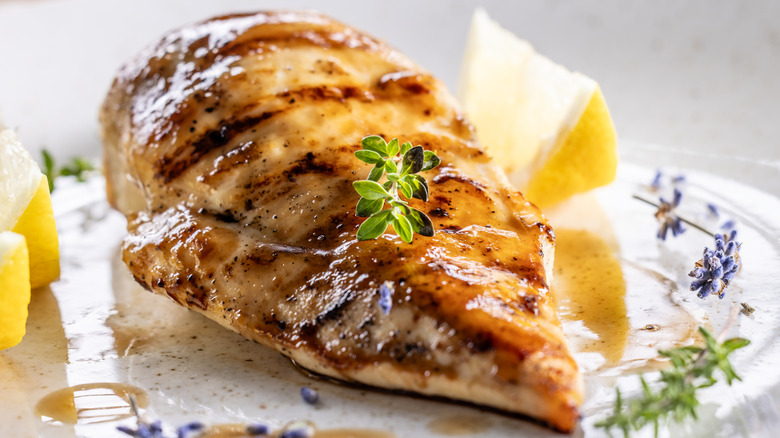
Another little culinary bomb that Bourdain dropped was that most chefs considered European varieties of chicken to be better that American-raised chicken. When bought in supermarkets, the latter could be "slimy and tasteless." Around the time Bourdain wrote this 1994 essay, it was standard practice to wash processed chicken carcasses in a chloride-dioxide solution, the strength of which allegedly decreased salmonella from 14% to 2%. On paper, this seems like a good idea. However, it also meant that by regularly eating chicken you were consuming chlorine. This sparked concerns that the chemical would accumulate in the body and lead to health issues. In 1997, the European Union and the U.K. took the step of banning all imports of American-raised chicken. The general perception is that the anti-bacterial treatment is compensating for unsanitary conditions that are prevalent in U.S. chicken farms.
Today, however, chlorine washing is not as common. Instead processed chicken is dipped in a cold bath of water and peroxyacetic acid, an organic, peroxide-based antimicrobial agent that's also used for sanitizing hospitals and pharmaceutical plants. During recent tariff negotiations, President Trump complained about the ban, but Europeans and Britons are still grossed out by American chicken, and the restriction remains in place. Bourdain had disdain for supermarket chicken, but times have changed, and as long as you can decode the labels on grocery-store chicken or spend a little more for a heritage bird, you could certainly cook many chicken recipes that are restaurant quality.