

Which Types Of Wine Have The Least Amount Of Sugar?
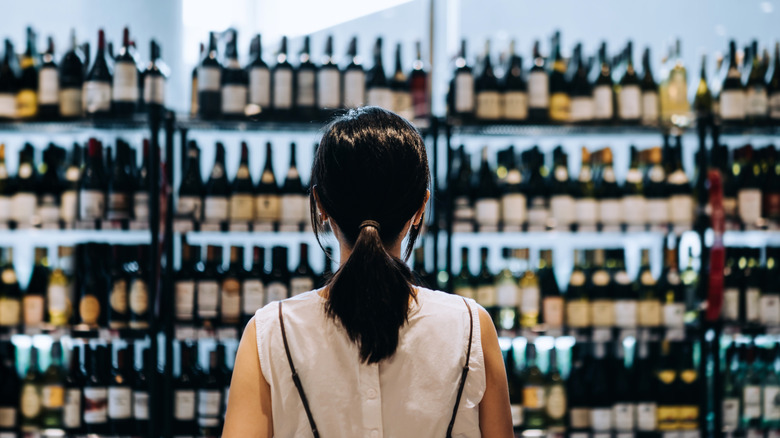
Trying to cut down on sugar but still want to enjoy a glass or two of wine? There are a few broad rules you can stick to if you're trying to be a bit healthier. First, look at the alcohol content. Ever wondered why grape juice is sweet and most wine isn't? It's because most of the sugar in the grapes used to make wine becomes alcohol, with the sugar leftover referred to as "residual sugar" in wine tasting and wine making circles. When there's a lot of sugar leftover, there tends to be less alcohol, while stronger wines are often dry and low in residual sugar (this is just a rule of thumb, and there are exceptions like dessert wines, so don't assume something sweet is weak).
Unsurprisingly, wines that taste sweet also tend to be higher in sugar (up to 30 grams per liter), while dry wines are the lowest sugar options (up to 10 grams per liter). High-sugar wines include dessert wines and ports, as well as heavy reds that some people might describe as jammy. Cheaper (mass produced) wines also contain relatively high levels of residual sugar. If you're partial to a bone dry tempranillo or cab sauv, you're in luck.
This is complicated in the US, however, where people tend to consider wines dry when most drinkers (and experts) would place them closer to medium on the dry-to-sweet scale. This is because people aren't great at tasting sugar. The more sugar we have in our diets the more our taste buds are dulled to sweetness. Checking sugar levels via a tech sheet produced by the vineyard is the best way to be sure of how much sugar you're getting.
How sugar in wine is measured
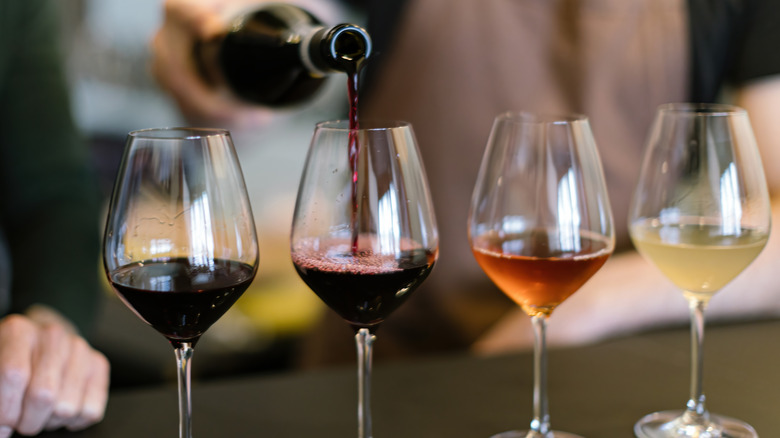
Residual sugar in wine is measured in grams per liter. Divided by 10, this roughly corresponds to the sweetness percentage sometimes used to describe the flavor of wines, so a wine with 15 grams per liter of sugar will have a sweetness of 1.5%. Unless you're thinking about buying a vineyard or becoming a somelier, you probably just think of wine as "dry", "medium", or "sweet". Here's how those descriptors match up to sugar levels.
Dry wine has up to 4 g/L of residual sugar, medium-dry has up to 12 g/L, and medium sweet has up to 45 g/L. Sweet wine contains more than 45 g/L, with the sweetest clocking in with a whopping 200 g/L. Fizzy wines and champagnes use a different measurement system, ranging from brut nature, the driest, with 0 to 3 g/L of residual sugar to doux with 50 or more g/L. The sweetest you're likely to encounter in most situations is demi-sec, which contains 32 to 50 g/L of residual sugar.
Before you swear off all wine but the driest, remember that these numbers are all per liter. Wine is served in 125 to 250 ml pours, and dessert wine comes in even smaller measures. Even after a bit of overindulgence, you are very unlikely to consume the amount of sugar in the standard g/L measurement, and if it ever happens you'll probably be more worried about hangover cures than how much sugar you imbibed (sorry, it looks like there's no real cure for a hangover)!
When added sugar in wine isn't really added sugar
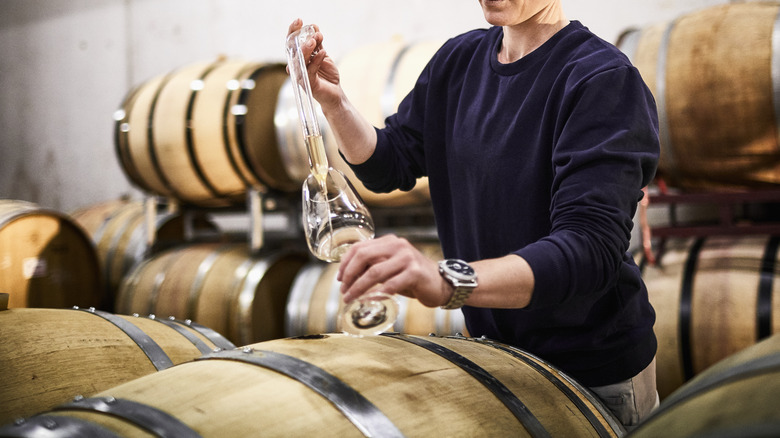
Occasionally, you might hear about sugar being added to wine in the process of making it. This isn't necessarily a bad thing, and doesn't mean the wine will have a higher level of residual sugar once it's bottled and ready to drink.
During fermentation, sugar is converted into alcohol. It stands to reason that if there's not enough sugar, there won't be enough alcohol, and the musk (grape juice) that vintners leave to ferment will never become wine. At least, not good wine. This is why sugar is sometimes added to musk in a process called chaptalization. Chaptalization is essential in colder climates such as the Northern US and European wine making havens like Bordeaux and Burgundy because without hot summers, grapes may not be sweet enough at harvest time to produce a good product. The chaptalization process is illegal in California, however, so wine makers in the golden state do add grape concentrate to their fermenting barrels.
As it's an essential ingredient in the wine making process, avoiding sugar in wine completely is very difficult, but one of the best ways to make sure you don't get too much is simply to drink less wine! Switching to something dry is great, but you can also have one glass instead of two, buy fewer higher-quality bottles, or make that glass or white or rose into a spritz.