

Which Country Consumes The Most Sugar?

Ah, sugar — love it or hate it, it's undeniably one of humankind's most beloved food substances (just behind coffee, among the most traded foods in the world). It's the flavor base of everything from chocolate bars and morning cuppas to a glorious crème brûlée. Have you ever wondered just how in love we are with sugar? Let's run through the numbers: every year, we produce millions of tons of the stuff (in 2024, according to the USDA, the world churned out just over 180 million tons of sugar). The country that consumes the most of all these sugars, as it turns out, is the United States.
According to WorldAtlas, each American consumes about 126.4 grams of sugar daily, or, to put it into perspective, that's everyone having the equivalent of five-and-a-half buttery sugar cookies each and every day. If you take a close look at the average American's diet, this statistic isn't very surprising. Sugar in its various forms can be found in nearly everything we eat, from white, processed bread used for morning BLTs to the few harmless chocolate cookies after a hearty dinner.
However, according to Associate Professor of Family Medicine at the University of Colorado, Bonnie Jotberg, the main culprit behind massive sugar intake is beverages, such as sodas, energy drinks, and "specialty coffee" (think super-sweet frappuccinos). They come loaded with sugar, which rocketed Americans' daily intake well above the recommended daily intake. According to the American Heart Association, men should consume no more than 36 grams, and women should consume no more than 25 grams of sugar per day. As you can see, we're overshooting the limit by a lot, and this has raised alarm bells among public health experts for years.
America isn't the only country with a sugar problem
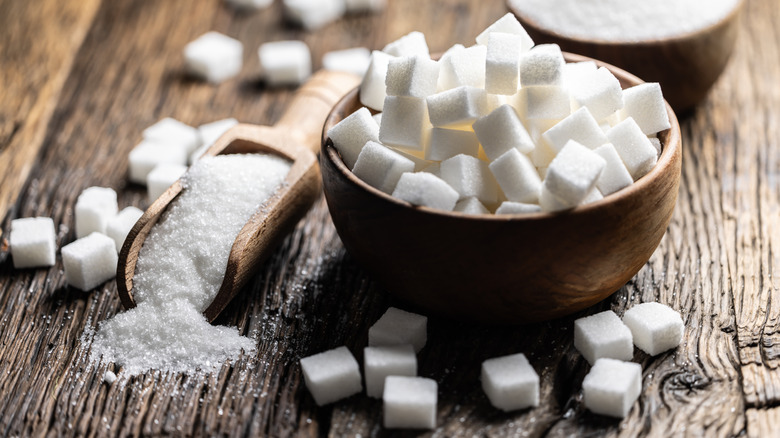
While the U.S. leads the pack, many other countries aren't far behind. Germany comes in second with daily sugar consumption of 102.9 grams per person, per WorldAtlas. The Netherlands follows closely at 102.5 grams, with Ireland at 96.7 grams per day. The point is — sugar is becoming a problem everywhere. According to the OECD, global sugar consumption has exploded and is expected to rise 1.2% every year.
By 2034, the world will be consuming about 202 million tons of sugar, and, in fact, the vast majority of it won't be in America. Instead, it will be in developing countries in continents such as Asia and Africa. A richer populace came with greater access to commodities like fast food and sugary beverages, which, combined with marketing drives by food corporations, can only lead the chart to go up, up, and away.
The situation, oddly enough, is slowly reversing in countries such as the U.S., where people are actually eating less sugar. However, this isn't exactly good news: according to Business Insider, while Americans are gradually losing interest in sugar, we're not yet ready to give up overly sweet snacks. Instead of cane sugar, people are increasingly turning to artificial sweeteners, such as stevia, sucralose, and aspartame. While considered "safe" for consumption, these substances aren't necessarily the answer to America's toxic relationship with sweets.
How exactly did we get here?

There was a time when the American diet wasn't so sugary. Before World War II, the vast majority of Americans ate rather wholesomely. However, due to a variety of factors, ranging from governance to economics, the population's diet underwent rapid changes over the next couple of decades. Fast food chains like McDonald's started to proliferate throughout the country in the '60s. From having meals at home, it's become a lot more convenient to eat processed burgers with a side of Coke. Then, in the '70s, the icon of global obesity was synthesized for the first time: high-fructose corn syrup. Sweeter and able to stabilize the shelf life of anything it's added to (while being much cheaper than cane sugar), food producers added it to any product that needed a touch of sweetness.
But perhaps the worst turning point came in the '80s, when the USDA and the Department of Health released the "Dietary Guidelines for Americans" — the now-famous Food Pyramid. The early version advised people to avoid foods with too much fat, and everyone started buying food with low fat content. Food companies obliged, but soon found out that by drawing out fat, you'd be taking away the flavor. The solution is the fine-print you'll still find on many ingredient lists today: "With added sugars" — that, according to Sarah Nelson, a nutritionist in an interview with the CofC Capstone, was when we really started loading up on the sugars. As awful as it may all sound, diet is something that you can adjust. By accounting for how much sugar you eat and making a meal plan, you can avoid being part of the statistics. It's unlikely that you can change the national average on your own, but every bit helps!