

Here's When You Should Absolutely Give Wood Kitchen Floors A Hard Pass
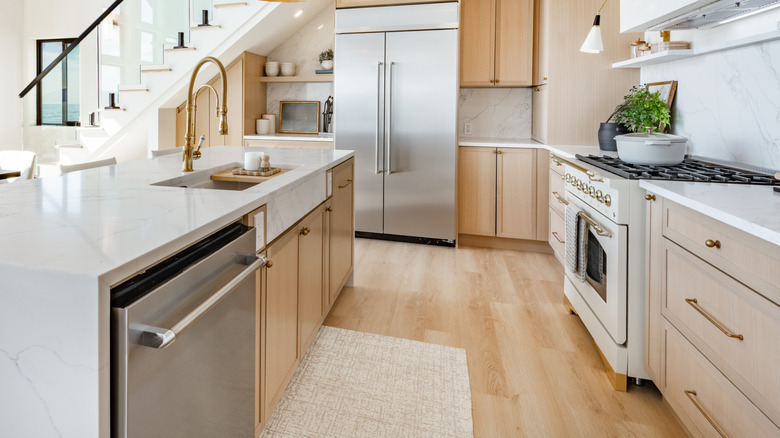
Wood floors have held sway amongst designers, builders, and homeowners for generations, harkening back to the early days of American homes. Wood was abundant, natural, and readily available long before the boom of affordable synthetic floor materials in the mid-1900s. While wood floors, especially hardwoods, unquestionably bring warmth and beauty into your kitchen, they aren't always the most practical choice — starting with the cost. When building or remodeling on a tight budget, it's best to give wood floors a hard pass.
To install solid wood floors, you're looking at a cost of roughly $5 to $20 per square foot, including materials and labor. That's an average range, as those prices can vary widely based on location, the quality of wood, installation methods, and how much contractors in your area charge. But using that average range, a 200-square-foot kitchen floor could run between $1,000 and $3,600, which is considerably more than other flooring materials.
Price can also vary depending on how you define "wood" materials. For example, bamboo often gets lumped into a "wood floor" category, though it's actually a woody plant processed into floor planks. Bamboo floors can cost as low as $2 to $6 per square foot. Conversely, solid hardwoods, such as oak, maple, hickory, and cherry, can skyrocket to $25 per square foot or more. So, if price is a major concern, wood floors are best left to future kitchen aspirations. Though disappointing, it helps to realize that cost isn't the only downside to wood floors in this busy ground-control room of your home.
Other considerations for kitchen wood floors
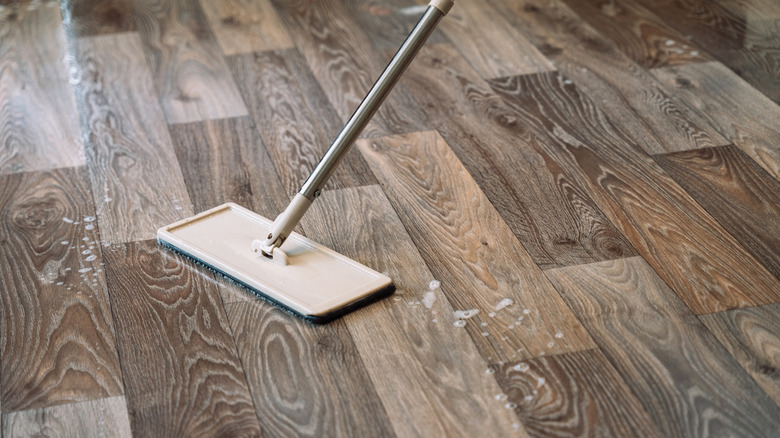
Other than cost, there are everyday implications when choosing wood floors in a kitchen. In the rough-and-tumble world of daily activities, kitchen accidents are waiting to happen. Solid hardwood isn't naturally water- or moisture-proof, so it can be affected by things like spills, steam, and humidity — potentially causing floors to warp, swell, or cup, especially near sinks, cooktops, and dishwashers. If water sits too long on wood flooring, you could be looking at the expense and headache of refinishing, repairing, or even replacing portions of the wood.
Kitchens get a lot of foot traffic, leaving wood floors vulnerable to scratches and scuff marks from dropped utensils and dishes, chairs sliding back and forth, and the whirlwind activity of kids and pets. Scratches and dents easily show up on the wood, and the consistent activity can wear down the finish, thus requiring more maintenance, cleaning, and resealing as the years go by. Since wood floors, particularly hardwoods, can last 50 years or more, that's a consideration not only for yourself but also for future generations.
Some of these concerns could be alleviated with engineered wood floors, which are often more cost-efficient and easier to maintain. They also tend to be less prone to damage from inevitable moisture and humidity in kitchen environments. For a deeper look at kitchen remodeling, dive into some of the pros and cons of kitchen flooring materials and some other crucial tips for affordable kitchen renovations.