

Why Europeans Hold Forks Differently Than Americans

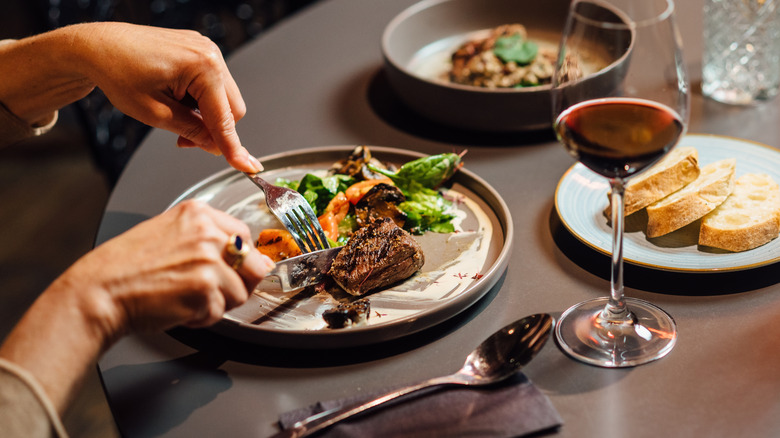
For jet-setting Americans on a grand European holiday, there's an all-too-common cultural faux pas that can give away your tourist status faster than any souvenir T-shirt ever could. Perhaps it's at an elegant steak dinner, with a melt-in-your-mouth filet mignon paired with a full-bodied Chardonnay, or at a casual lunch on a sun-soaked piazza, enjoying a family-style Margherita pizza. You start eating the way you always have: with your fork in your left hand, and knife in your right. After cutting the food, you set the knife down, passing the fork over to your right hand, where you lean in to take your bite. Across the table, though, you notice the bewildered glances of your European dining companions, who never once let their forks leave their left hand.
Though it might seem like a small difference, the way we hold and use our forks is actually rooted in centuries of intercontinental culinary tradition. Forks are a relative newcomer to the dining table, compared to knives and spoons. As such, both Europeans and Americans independently developed their own fork-based customs and behaviors. Neither dining style is "wrong" per se, especially in the United States, where either method is considered proper and acceptable. However, Americans traveling abroad may realize that international dining etiquette rules usually favor the European, or "continental," method, which lacks any fork-hand switching. Not only that, when transferring the food to their mouths, Europeans tend to keep the fork's tines down at all times, whereas Americans keep them upward.
How did the cut-and-switch method develop in the United States?
Nowadays, it's hard to imagine a world without forks. But, as previously mentioned, they're a pretty recent invention. Technically speaking, they've been around in Europe since the 11th century, but for many, the utensil was considered an expensive (and unnecessary) luxury item, exclusively used by the rich. In addition, some Europeans, especially the British, considered forks to be feminine. As such, at formal gatherings, there was some real judgment of those who used the pronged utensil, especially men. Needless to say, it didn't take off for a while. This is especially the case for Americans, who didn't routinely use forks until the late 18th century, around the time of the American Revolution.
Funny enough, the "cut-and-switch" eating method (also known as the "zig-zag" method) implemented by modern-day Americans likely could have originated from the preferences of the 19th-century French. Back then, the fork was all the rage, and new-fangled etiquette rules sprang up left and right. Interestingly, though, the cut-and-switch isn't popular in France anymore, and hasn't been in over a century. Another theory suggests that Americans learned the cut-and-switch method from the British during the country's colonial period. It's also been speculated that because spoons were originally held by American diners in their right hands, when the fork became popular, it was swapped one for one behavior-wise with spoons, hence why Americans "scoop" up food using the upward-facing tines of the fork.