

The Truth About Lobsters Feeling Pain When They're Boiled
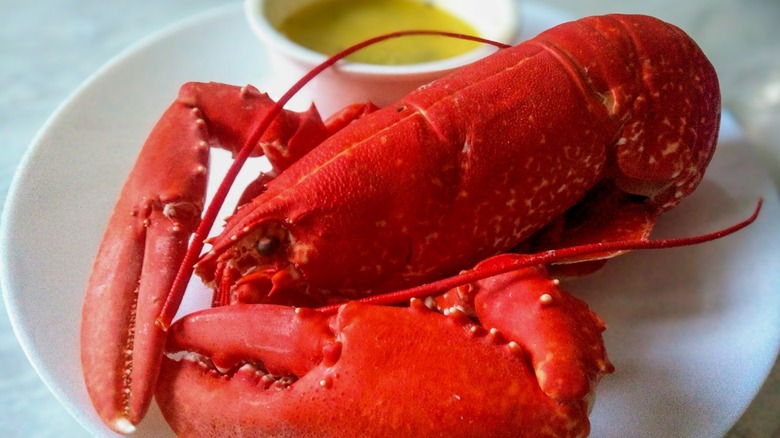
There is a paradox that some people struggle with when they eat meat: It is a contradiction to value the life of animals while still choosing to eat meat. On paper, it doesn't sound logical, but many people live this way. For some, it is simply a matter of distance, as, after all, most of the meat we eat is slaughtered and processed far away. We only get the end product, and so we don't feel a connection to the living animal it came from. One creature that doesn't fit into this mold is the lobster, an expensive delicacy once served to prisoners and one of the few animals sold live in grocery stores. It's also the only animal we're often expected to cook while it's still living. For a long time, boiling these crustaceans alive was justified by the misguided belief that they don't feel pain. However, that is false.
Lobsters do feel pain, and being boiled alive is painful for them. In fact, scientific research supports this. Of the many lobster myths you should stop believing, the false notion that they don't feel pain is not a relic of the Dark Ages. As recently as 1997, experts were telling consumers that lobsters lack a nervous system capable of feeling pain. They said the movements that you see in a boiling lobster are just reflexes. While activists have long claimed it's inhumane, the science was slow to catch up. Research from the University of Gothenburg, using EEG-style measurements, revealed that crustaceans, such as lobsters, crabs, and crayfish, experience clear neurological reactions to painful stimuli. Or, in other words, yes, these animals feel pain.
Is there a humane way to prepare lobster?
Once we understand that lobsters feel pain, finding a humane way to kill and cook them becomes a more complex issue. Switzerland, Norway, and New Zealand have banned the practice of boiling lobsters alive. Storing them on ice has also been banned in Switzerland and Italy, as it has been deemed cruel. In 2022, decapods, like crabs and lobsters, were included in an animal welfare law in the U.K., which recognized them as sentient and capable of feeling pain.
One method that minimizes suffering is electrical stunning. An invention called the CrustaStun emits a charge that kills the crustacean almost instantly. It happens so fast that no pain is felt. Death takes place in 0.3 seconds, while boiling can take as long as three agonizing minutes. However, the device also costs thousands of dollars and may not be a practical option for home cooks or even most restaurants. Some experts recommend chilling the lobster in an ice bath to anesthetize it before cooking. However, recent research from the journal Animals suggests that an ice slurry does not fully work on larger crustaceans, such as crabs or lobsters, which may still experience some pain. Additionally, using plain tap water can cause osmotic shock in marine animals, which may lead to cell rupture and increased pain; therefore, it is recommended to use salt water.
Currently, the most humane, widely accessible method of killing lobsters is known as splitting. After stunning the lobster, a sharp knife should be used to very quickly split the crustacean lengthwise, severing all nerve centers and killing it instantly. Once split, the lobster can be cooked. The method isn't perfect, but it acknowledges the potential pain and attempts to reduce it, which is a step in the right direction.