

How Much Does One Egg Actually Weigh?

We may receive a commission on purchases made from links.
They say not to put all your eggs in one basket. But, that rule applies to how you think about egg weights, too. Nobody wants to deal with the hassle of weighing individual eggs. Yet, most recipes simply call for small, medium, or large sizes. That said, things can get complicated as you scramble for conversions. Fortunately, knowing average egg weights can help you shift between categories in a pinch.
The first rule? Size and weight go hand in hand. What qualifies as a 'large" egg typically weighs around 2 ounces, whereas a medium eggs weighs about 1.75 ounces, and a small egg just 1.5 ounces. Aside from the basic trio, sometimes it's tempting to go even bigger. Extra-large eggs weigh approximately 2.25 ounces – yes, the difference between large and extra large matters. And, what about jumbo sizes? Prepare for a monstrous 2.5 ounces, which offer a whopping 8 grams of protein for 90 calories. Wowzer.
It might seem like lots of information to retain, but keep it simple. As a rule of thumb, there's a 0.25-ounce increase (or decrease) between each sizing category, which can offer some straightforward guidance. So, pick one average weight value to remember, and go from there.
Is it actually worth weighing eggs?
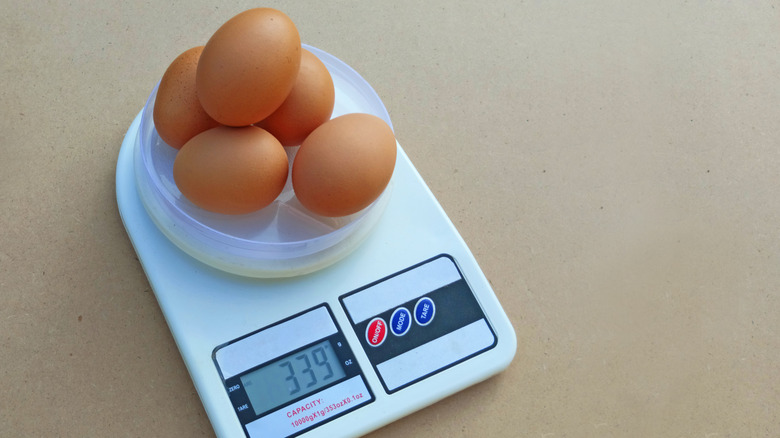
Manually weighing eggs isn't for everyone as meticulously measuring a store-bought dozen won't achieve much, except a boredom-induced migraine. Think of it as a back-up option, however. When working with uncategorized eggs or facing failed recipes, weighing eggs can act as a smart diagnostic approach. After all, precision matters with certain dishes like baked goods.
In any case, it's probably time you brushed up on the best ways to measure important baking ingredients. There are plenty of suitable scales on the market, including some funkier options like the chicken-shaped Incredible Egg Scale from Fall Harvest. After finding a scale, crack the eggs directly into a bowl, and see what measurements you get. Weighing without the shell is an added bonus as you'll discover the exact amount of egg that will be added into a dish, not an inflated weight.
In all honesty, mishaps related to egg weights are rare. When tackling recipes that use up to three eggs, the difference between medium, large, and extra large options is negligible. In fact, in these scenarios, conversion charts suggest sticking to the original number, regardless of size. What about small and jumbo sizes? These are worth converting from the get-go, but medium and large remain mostly interchangeable — even when adding as many as six. So, reserve scales for suspiciously-sized eggs and delicate recipes like cakes, pastries, and yeast-based breads.