

Why Professionals Prefer Gas Stoves Over Electric Appliances
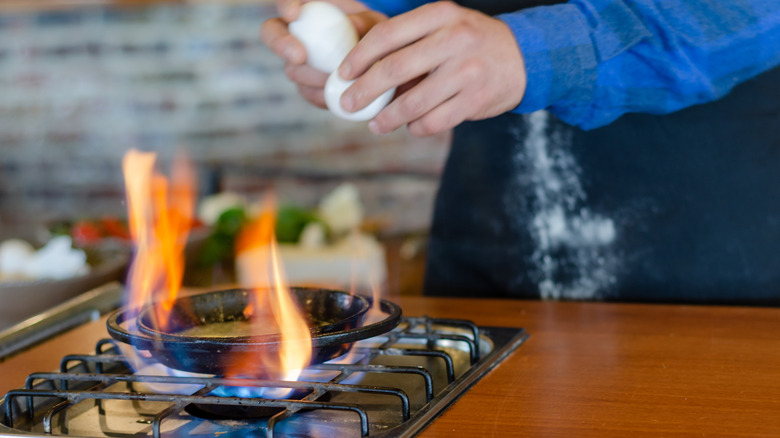
We've heard it for years: Serious chefs always prefer gas stoves over electric models. That seems to be the case whether it's a buzzy restaurant kitchen or a dedicated home setup for self-made chefs. But with American homes and businesses considerably leaning toward electrification in recent years, does that standard still persist? We decided to find out by consulting two experts in the field: Derek Piva, executive chef at The Restaurant at Tu Tu' Tun, and Arnold Myint, executive chef and owner at International Market 2.0. And the answer seems to be yes, gas stoves are typically preferred by professionals, though there are exceptions.
The preference for gas cooking isn't just for tradition or nostalgia's sake — it's deeply rooted in the belief that it performs at far higher levels than electric. Piva confirmed that notion and explained why. "In a professional kitchen, gas is king," he told us in our exclusive chat. "It offers immediate heat control and allows for more nuanced cooking techniques, like using residual or indirect heat to gently hold items, or roasting vegetables like peppers and eggplant directly over an open flame."
Piva maintained that electric stoves are simply unable to replicate that level of flexibility. On the other hand, home chefs have more variables to consider. "For home kitchens," Piva noted, "the choice often depends on what you're cooking and how comfortable you are with your tools — but from a chef's perspective, gas gives you the edge." Having grown up on a Brazilian farm and now practicing luxury "wilderness to table" dining at Tu Tu' Tun on Oregon's Rogue River, we're pretty confident in his cooking convictions. However, our other expert offers a slightly differing, multi-faceted viewpoint.
Gas vs. electric for ovens or stovetops
Arnold Mynt from International Market 2.0, a James Beard Foundation semifinalist in Nashville, admits to being "all over the place" on the topic of gas versus electric stoves. His opinion pivots depending on whether it's the stovetop or oven being utilized — more times than not, he prefers a gas stove over an electric oven. "At the restaurant specifically, working with a gas range allows us to distribute and manipulate heat onto surfaces and cook food with more control," Mynt told us. "Using an electric or induction range just doesn't allow for heat distribution once a pot or pan leaves contact from the heat source."
Even still, he acknowledged that an electric surface is good for holding temperature when simmering water in a pot or maintaining fry oil. "But for sauté techniques, like basting proteins or working a crepe or omelet, gas is the way to go." Electric also wins out when cooking inside an oven — depending on what's cooking. "As far as the oven, roasting a chicken or vegetables is great with either gas or electric," Mynt explained. "But I prefer an electric oven when it comes to baking and executing recipes that need a consistent flow of heat." He has good company in that stance, with Chef Bobby Flay preferring electric ovens for baking as well. For Mynt, that applies whether cooking professionally or at home. "But usually when I'm home," the chef admitted, "I'm ordering delivery. My oven is just an additional storage space for pots and pans."