

Why You're Drinking Florida Oranges But Eating California's
You may not have realized it, but in the past few years, there has been a sea change in the American orange industry as the tides shifted between the two biggest producers of Florida and California. While both states have historic citrus industries dating back to the 19th century, for most of the last century the Florida orange was king. From the 1940s until the mid 2010s Florida was the nation's largest citrus producer, and a huge part of that business was oranges. But while Florida grew the most oranges, you wouldn't usually find whole oranges from the Sunshine state in your local grocery store, even if you were in Florida. And recent challenges to growing oranges in the state have swung the balance in the industry back toward California.
The reason Florida was producing so many oranges was the juice industry. Even at the height of production, 90% of the state's oranges were used for juice and processing instead of being sold fresh. There are a few reasons for this: Because of the wet climate, the oranges grown in Florida are extra juicy, making them a natural choice for processing. However, unlike the navel oranges mostly grown in California, they aren't seedless and are harder to peel by hand. California's Mediterranean climate is also considered ideal for citrus, and it produces very sweet, flavorful oranges. So the natural strengths of each state's oranges led to different uses. But that is not the only thing that has affected orange production recently.
Florida's orange juice crop has been devastated by disease and hurricanes
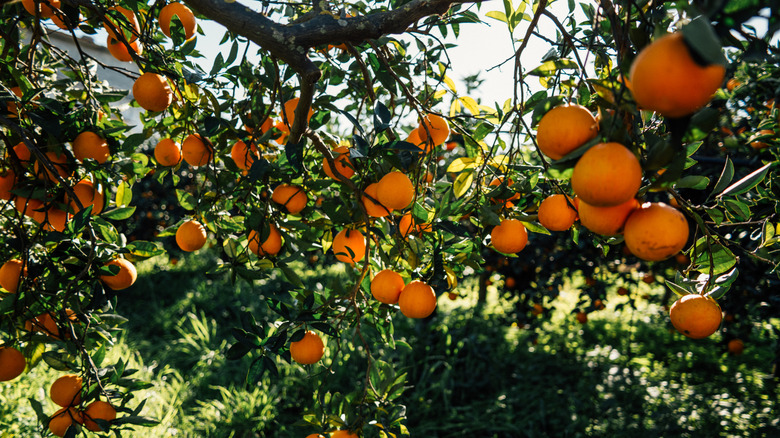
While Florida's oranges were already more suited to juice production, any chance you would have of seeing them for sale in a store has gone out the window with recent drop-offs in production. By 2025, Florida's orange production had fallen a whopping 95% from its highest peak, according to the USDA. Some of this is due to the major hurricanes that have hit Florida's citrus production regions and destroyed trees, but an even bigger issue is citrus greening. This is a disease, also called Huanglongbing or HLB, which is spread by an Asian insect that infects citrus trees, including oranges. The insect spreads a bacteria that feeds on the tree, causing the signature green color and causing smaller more sour fruit to be produced before eventually killing the tree.
The disease first hit Florida in 2005 and has gone on to devastate citrus production in the state, with production dropping by 75% even before other recent disasters. California now produces almost twice as many oranges as Florida. In fact you may not even be drinking Florida oranges anymore. Despite still being mainly used for juice, Florida oranges now make up less than half the juice in most American store-bought orange juice. Instead, the gap has been filled by imported oranges from places like Mexico or Brazil. California citrus production has so far been mostly spared the ravages of greening, but the threat is there. For now, at least, your popular snacking oranges are safe.