

How To Store Vinegar After Opening To Keep It Fresh Longer
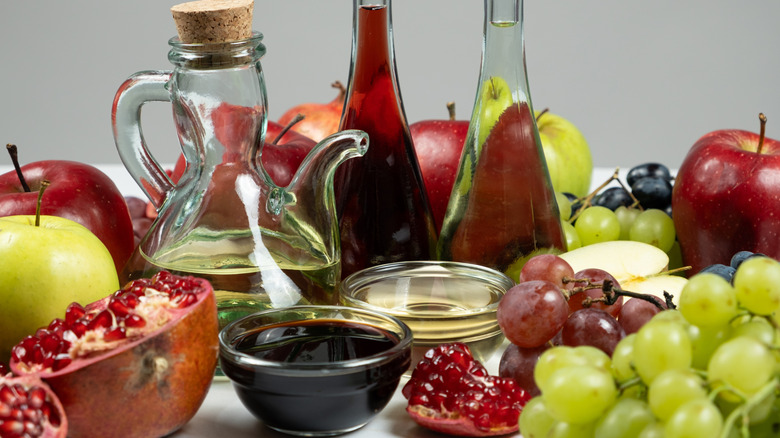
It's true that vinegar doesn't tend to spoil easily thanks to its high level of acidity that prevents the growth of most bacteria. You'd think this means you can just screw on the cap and haphazardly leave it around until you've got a dish in need of its signature tangy edge. As it turns out, that might not be the wisest course of action. Vinegar, while low-maintenance and long-lasting, still needs proper storage for its freshness to be persevered.
One of the most crucial elements in vinegar storage is a cool, dark, and temperature-stable environment. Make sure to keep it out of direct sunlight, and this also extends to the bottle, which should preferably be glass and darkly tinted. Keep it away from high-heat cooking utensils (such as the stove or the oven), or poorly ventilated areas if you live in hotter climates. That said, refrigeration isn't necessary. Since it's a self-preserving product, a pantry or cabinet is sufficient.
It's also important to minimize exposure to other external factors, such as air, moisture, and various forms of contaminants. This means the bottle should always be tightly sealed and free from foreign materials that might introduce new bacteria to the vinegar. This could be a spoon that was previously used for other foods or water dripping in from the outside.
What happens if your vinegar is past its prime?
In a way, time is still vinegar's enemy despite its long shelf life. The longer it ages, the further it's likely to stray from peak freshness (often lasting for two to three years, depending on different types of vinegar). This is why it's better to buy small bottles of vinegar rather than large jugs, as convenient as the latter option might seem. In smaller portions, you can enjoy the vinegar at its best as soon as possible. Waiting around, the strain of air and light exposure will slowly chip away at its depth and complexity.
The changes won't be that subtle, either. Its flavor will start to flatten, and its tangy depth will mellow out. Moreover, its clarity will become clouded, colors gradually paling. Sediments form and float around. Unpasteurized vinegar might even grow a slimy biofilm at the bottom — commonly referred to as a vinegar mother — that can be filtered out but is also safe to consume if left in.
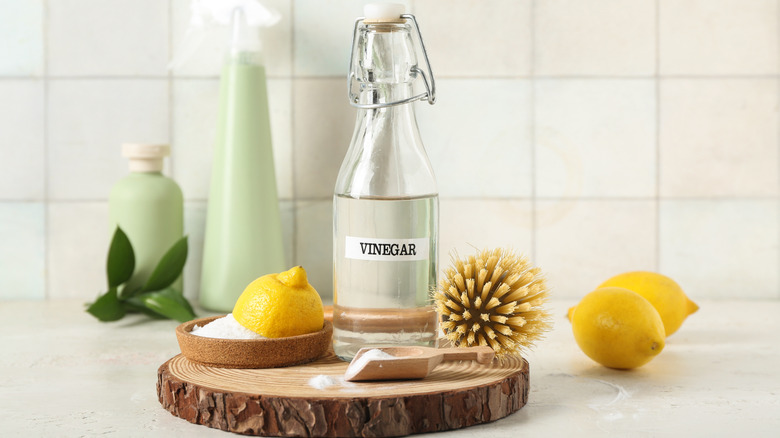
While it's still generally safe to use, vinegar with these characteristics shouldn't be used for pickling or canning, as it could affect the final product. Other than that, cooking with vinegar is still an option, although it probably won't bring the desired flavor intensity. In that case, instead of throwing it out, consider applying it to vinegar cleaning hacks for your kitchen.