

The Crucial Cast Iron Mistake Ruining Your Steak (And How To Actually Fix It)
We may receive a commission on purchases made from links.
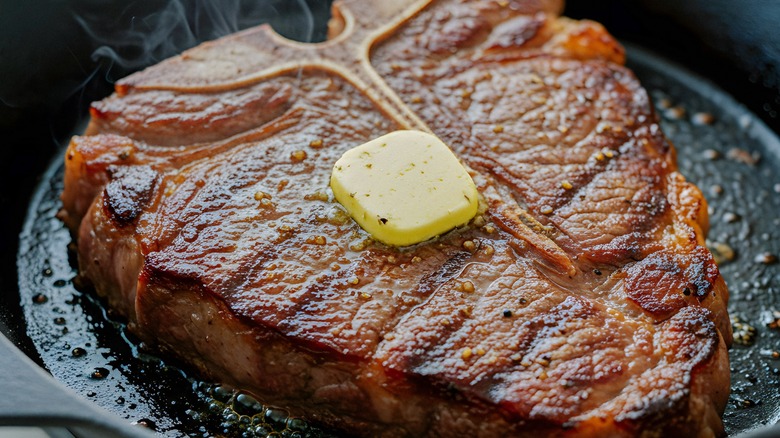
When you're cooking a steak in a cast iron pan, you're probably hoping for that delicious, flavorful sear on the outside. You want the Maillard reaction, that chemical change in sugars and amino acids that causes browning, rich aromas, and more complex flavors. It can be a tricky thing to master; you may have discovered it's far too easy to burn the outside of your steak while leaving the inside raw. Your heat is probably too high, even if you don't realize it.
To get that beautiful sear on a steak, you want to keep your pan temperature between 280 and 330 degrees Fahrenheit — that is the sweet spot for triggering a Maillard reaction. When you go hotter than that, you risk burning the outside of the steak before the inside has a chance to cook. The problem is that many websites, and even some chefs, recommend much higher heat, up to 400 degrees or even hotter. That's a recipe for a poorly cooked steak.
If your stovetop dial is set to medium heat, that translates to roughly 375 degrees Fahrenheit. When cooking steak in a cast iron pan, your ideal setting is medium-low heat. If you have a 10-point dial, set it between three and four to ensure a temperature between 280 and 330 degrees Fahrenheit. The best way to know for sure is to use an infrared thermometer (like this Etekcity one on Amazon) to check your cast iron temperature.
The ingredients for a perfect steak in cast iron
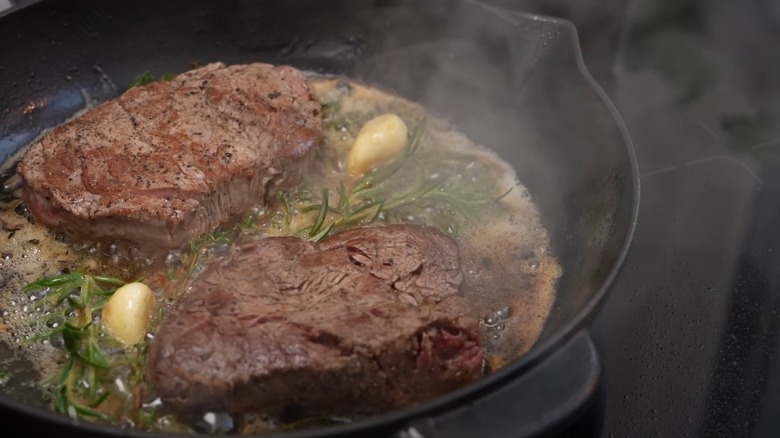
Cast iron does a remarkable job of holding heat. Once you have the right temperature, you need the right oil too. This is another reason why heating above 400 degrees Fahrenheit can ruin your steak, as it's past the smoke point of many oils. Burnt oil will make your steak bitter and unpleasant. Keeping your pan at the right temperature will greatly improve the flavor of the meat and the oil. This is especially important if you are finishing your steak with butter, which has a smoke point between 302 and 350 degrees Fahrenheit.
Another trick you may need to use is the reverse sear method. The whole point of a reverse sear is to get a perfectly cooked steak without overcooking any of it, including the exterior just below the crust. It's especially useful for thicker steaks in which the outer layers can cook much faster than the interior, or for any cut where you want an even doneness and a solid sear.
Finally, make sure you are letting your steak rest properly after cooking. You can still preserve the crust while letting the steak rest to redistribute the juices throughout the meat. Just rest it on the edge of a bowl for about five minutes per inch of thickness so that the juices don't saturate the crust formed by your cast iron. With proper temperature control, the right oil, a good sear, and resting time, your cast iron pan will produce a perfect steak for you every time.