

10 Underrated Shellfish To Include In Your At-Home Raw Bar
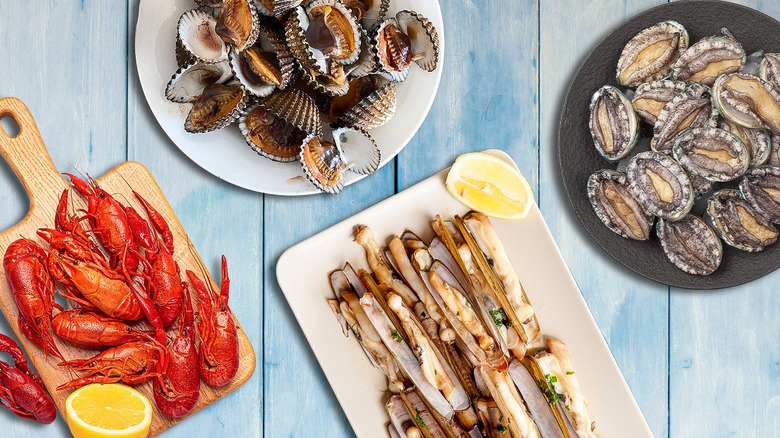
Raw bars don't begin and end with oysters and shrimp cocktail. No one is complaining about the classics, but there are thousands of shellfish varieties out there just waiting for our taste buds to explore. Despite the name, a raw bar isn't limited to uncooked seafood, but it does only focus on chilled shellfish. Cold lobster tail, freshly shucked littleneck clams, and scallop crudo are frequent raw bar specialties, but that's hardly scratching the surface.
Depending on the region, different shellfish will be easier to find, so the neighborhood fishmonger will always be the best place to start. "Look for what is seasonal, local, and perhaps a bit out of their comfort zone," suggests Kerry Heffernan, Culinary Director of NYC-based hospitality group, Crew. Experimenting with new shellfish will not only introduce new textures and flavors to your raw bar, but you'll also be doing your part to support responsible fishing practices. "Industry leaders are those who choose to distinguish themselves with creative interpretations of the most sustainable resources," Heffernan adds.
As a New England-raised islander, I have an affinity for seafood, especially served cold on a perfect summer day. Raw bars were prepared whenever there was a reason to celebrate, which sometimes was nothing more than "it's Thursday." In pursuit of crafting the most beautiful, idyllic at-home raw bar, I chatted with a handful of incredible chefs who specialize in seafood, asking the question, what are the most underrated shellfish to include in your raw bar? The answers were varied, with an overwhelming vote for razor clams and a deep appreciation for sea snails, but these ten shellfish were all deemed worthy.
Whelks
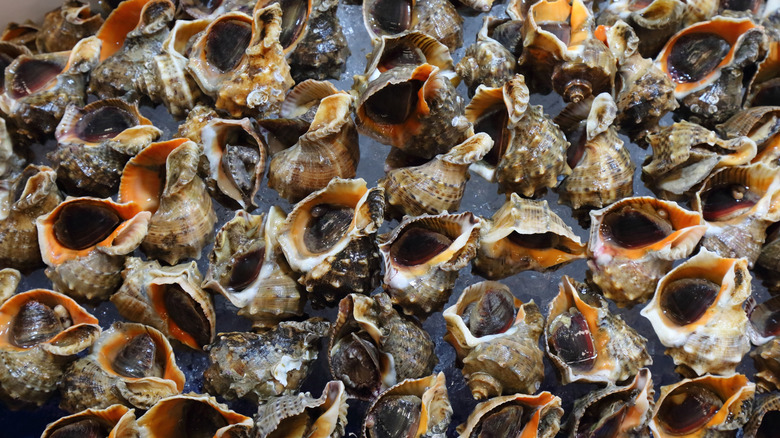
Being found in oceans all over the world, whelks have a place in nearly every cuisine. The large sea snails are sold by the pint in the U.K., typically boiled and eaten with malt vinegar, served as golbaengi muchim in Korea and tsubugai in Japan, but often dismissed in the U.S. When properly prepared, they have a chewy, satisfying bite and a briny-sweet flavor somewhere between a clam and octopus.
Kerry Heffernan recommends gently poaching whelks in court bouillon, a poaching liquid seasoned with wine, mirepoix, and herbs, before chilling and thinly slicing them. The flavoring makes them ideal for salads or even dipped in aioli. They're underutilized, but they're flavorful, sustainable, and can be really elegant if served well. The only downside is they're a bit tedious to prep. Before cooking, it's important to purge whelks by soaking them in salted water for a few hours. Once boiled, you'll have to pry open their spiral shells to get to the good stuff.
Periwinkles
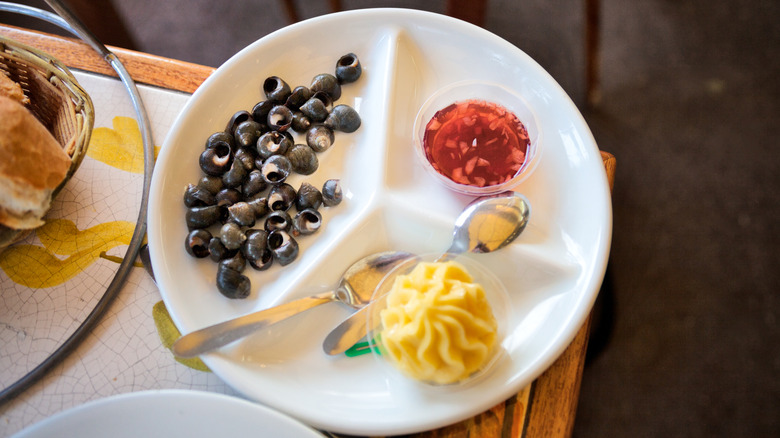
Periwinkles are often remembered as just a fellow tide pool discovery, but the tiny sea snails have more to offer in the kitchen. They're smaller than whelks, but each shell still holds one meaty bite. Slightly more delicate with a sweet flavor, periwinkles are welcomed on seafood towers. In Nova Scotia, they keep the preparation as bare bones as possible, simply simmered in salt water and eaten right out of the shell. Whereas in other regions, it's executed with a little more flair.
We know France has accepted snails as part of they're diet with escargot, but periwinkles are sea snails rather than land, and are typically prepared chilled like other raw bar standouts. They're called bigorneaux in Brittany, and served on ice with a side of herbed butter. It might feel defeating to put this much effort into such a tiny bite, but Kerry Heffernan claims it's worth it. "Periwinkles in particular are a delicacy in France, where extracting them from the shell is part of the fun, a bit like crawfish," shares Heffernan. Like whelks, they should be purged of sand before cooking and then boiled briefly until the meat firms up.
Marinated mussels

Steamed mussels are on practically every bistro menu out there, but chilled mussels are harder to come by. Dozens of tinned mussels can be found in grocery stores and specialty markets, with some marinated, some smoked, and some even pickled, but they're often overlooked when preparing seafood towers. In Spain, Italy, and coastal France, marinated mussels are commonplace, typically served chilled and cured in oil, vinegar, paprika, and aromatics. They're everyone's favorite tapa and pair beautifully with some salty chips and a crisp vermouth.
Chef Kerry Heffernan recommends a court bouillon again, this time poaching the mussels and serving them cold with a "squiggle of flavored mayonnaise like rouille." Larger mussels, such as green-lipped varieties from New Zealand or Prince Edward Island mussels, tend to work best due to their meatiness and resilience when chilled. Marinated mussels are a versatile addition to any raw bar, as they can be eaten alone, pierced with a toothpick, or paired with other briny nibbles like pickles and olives.
From a sustainability standpoint, mussels are one of the most eco-friendly seafood choices. They require no feed, help filter and clean their surrounding waters, and can be farmed with little environmental impact. For an easy upgrade to your raw bar, keep a tin of high-quality marinated mussels on hand — or better yet, make your own.
Razor clams
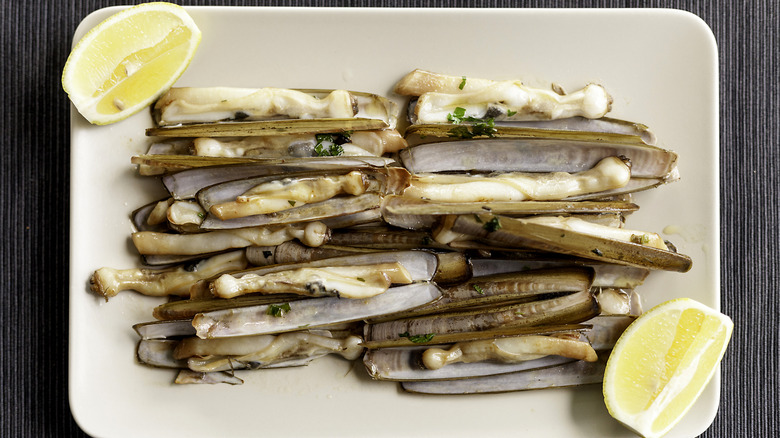
We see clams on restaurant seafood towers and specialty raw bars, but the variety is disappointingly limited. The most common clams you'll spot on a raw bar will be hard shells, and chances are they're littleneck, topneck, or cherrystone clams. As tasty as those succulent little mollusks are, there are endless other varieties that offer unique flavor profiles, one being the razor clam. Easily identified by their long, slender shells, razor clams are popular along the coasts of Spain, Portugal, Scotland, and parts of the Pacific Northwest. Unlike traditional clams, these are much sweeter with more of a bite.
Somewhere between a clam and a scallop, razor clams "hit this balance that other shellfish don't," as executive chef Paul Donnelly of Tuxedo Hospitality puts it. He praises their soft texture and versatility, noting that you should "flash sear them, grill over binchotan coal, [and] slice raw for crudo. When they are done right, they sound like a Hans Zimmer orchestra." Chef Kerry Heffernan is on the same page, serving them raw or ceviche-style, while chef Aidan Owens of San Diego's Herb & Sea prefers a spicier preparation with aguachile.
Abalone
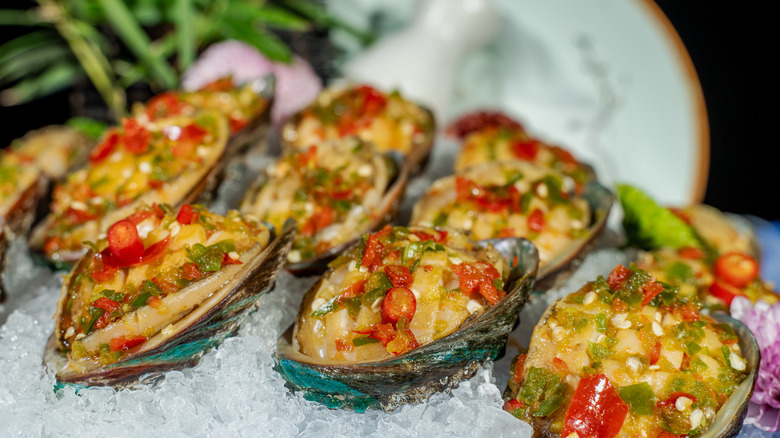
Abalone is another sea snail revered for its one-of-a-kind texture and deep, umami flavor. It's an East Asian delicacy that's said to bring good luck, particularly popular during Chinese New Year, but it's hardly appreciated enough in the States. Given that the valuable marine snails are harvested by hand, overfishing was imminent during their to popularity rise in the '70s and '80s. Laws have wavered surrounding abalone fishing over concern of extinction, but California now has a handful of sustainable abalone farms providing the gastropod to folks all over the country. With farms so close, it's a popular menu item at upscale Californian restaurants, often served on the shell.
Chef Aidan Owens praises its "salty texture and subtle earthiness," comparing it to wild mushrooms. The only drawback is the extensive prep work, but any chef would agree it's worth the extra effort. Cleaning abalone involves scrubbing the shell, removing the viscera, and tenderizing the muscle, typically by scoring and gently pounding it. Raw slices can be dressed with citrus and soy, while cooked abalone benefits from garlic butter, sake reductions, or even slow braising.
Gooseneck barnacles

Barnacles are often overlooked for their itty bitty size and "alien appearance" as Kerry Heffernan notes, but there is a surprising amount of meat hiding inside their exterior, and it's quite tasty. Yes, barnacles as in those little creatures stuck to the bottom of rusty boats, but we're talking about the larger stalked barnacle, the gooseneck. They're little crustaceans with buttery meat similar to lobster, but with an even higher price tag. In Spain and Portugal, where they're a delicacy known as percebes, farmers have to fight treacherous waves to harvest the barnacles off the rocky coast, so they're often associated with special occasions, like the caviar of barnacles. All the more reason to delight your guests by adding it to your raw bar.
If you can get past their unsettling look, the little barnacles are sweet and briny, with a texture somewhere in between a clam and a crab. To serve them, they're typically boiled in salted water (sometimes seawater) for just a minute or two, then peeled at the base and eaten in one bite. The succulent muscle holds more than enough flavor, so less is more when seasoning the delicacy. Half a lemon and some bay leaves are really all you need, and they'll taste especially clean after a few hours in the fridge. Ramekins of aioli tend to only appear with orders of fried fish, but serving chilled gooseneck barnacles alongside a creamy sauce will punch up the richness even further.
Gulf oysters

If you think fresh water oysters aren't a thing, just ask a New Orleans local, or, more specifically, you could just ask executive chef Ben Triola of The Chloe. He champions Gulf oysters as one of the most underrated shellfish out there. "They are frequently overlooked for East or West Coast varieties, but can offer a creamy-buttery flavor unique to the Gulf Coast," Triola told us. Their freshwater environment gives them a much milder taste, but most notably, they're way larger than what we're used to in the colder waters.
For anyone just tip-toeing into the world of oysters, Gulf oysters are an excellent place to start. These fatty oysters may not have that iconic brine that saltwater oysters are known for, but that just leaves more room for accoutrements. Louisiana chefs dress their raw oysters with the expected hot sauce and lemon wedges, but New Orleans gets creative with herb butters and cheese when chargrilling oysters. While adored in NOLA, Gulf oysters are found all along the Gulf of Mexico from Texas to Florida.
Cockles

Along the coasts of Europe and Asia, cockles are on nearly every menu. In the U.K., they're sold in paper cups with vinegar at seafood stalls, while in Korea, they star in winter dishes like kkoma muchim, blanched and dressed in spicy-sweet marinades with sesame, scallion, and chili. Cockles are especially prized in Korean cuisine, where they're marinated and served over barley rice with perilla leaves, seaweed, and soju or makgeolli. The explosion of sweet, spicy, and briny is a winning combination.
Eric Choi, executive chef and co-owner of C as in Charlie, only has good things to say about cockles. Between their "clean, sweet brininess" and soft chew, it's shocking that they're so often passed over for clams and mussels. "They shine in both warm and cold dishes, and their fast growth and low-impact harvesting make them a sustainable seafood choice," Choi adds, as if cockles needed any more selling. He recommends rinsing cockles in salted water before steaming or sauteing them, just until their shell pops open.
Crayfish
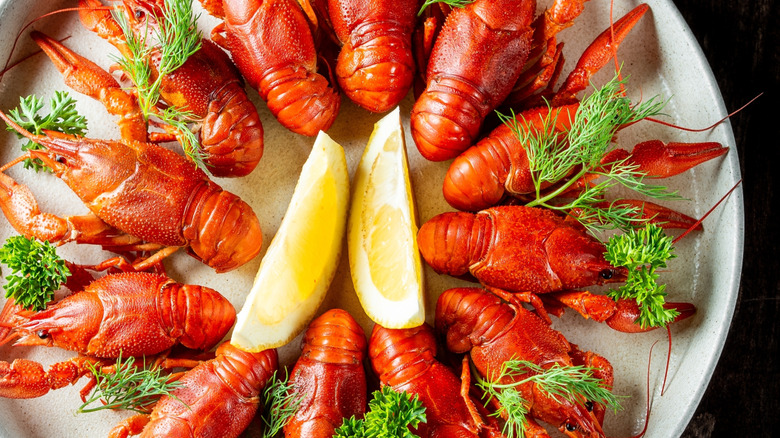
Crayfish, or at least the familiar red swamp crayfish, is another shellfish native to the South that is sure to impress everyone indulging in your raw bar. They're little freshwater lobsters, sometimes called crawfish or crawdads in the South, and are surprisingly underused outside of boils and etouffee. The small crustaceans offer a notably sweet meat, especially from the tail, that works wonderfully when tossed in olive oil, herbs, and a squeeze of lemon.
Americans typically associate them with Cajun and Creole cooking, but crayfish are a favorite across Europe and Asia. Swedes throw full-on crayfish parties and China reportedly consumes over 90% of the world's crayfish. They're boiled just like lobster, but typically with a seasoned broth. To serve crayfish on your raw bar, chill the perfectly cooked meat and then serve the tails with aioli, remoulade, or ponzu. If you are willing to get your hands dirty, don't squander the claw and body meat.
Soft shell crab
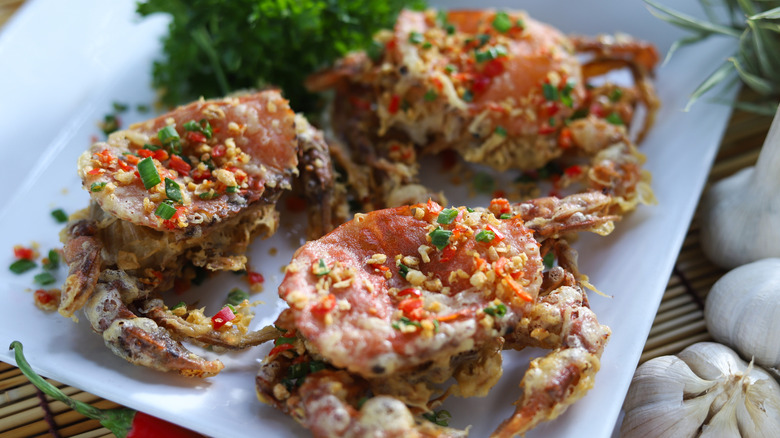
Soft shell crab is Baltimore's favorite shellfish, but doused in Old Bay seasoning isn't the only way to do it. The meat is sweet and tender, but the crab's biggest talking point is typically that the whole crustacean is edible — including the shell. Each Spring, blue crabs shed their hard outer shell and emerge with a delicate, paper-thin new one. For just a few months out of the year, fishermen are able to catch soft shell crabs during this molting phase, when the shell is supple enough to chew and swallow.
Oliver Lange, executive chef at NYC's Next Door, feels they are one of the most underappreciated shellfish options, noting their unexpected depth. "It's delicate, entirely edible, and brings both texture and flavor in a way that surprises people," says chef Lange. "It deserves far more attention outside of deep-fried versions in sushi rolls or sandwiches." He suggests lightly dusting them with rice flour and pan-frying until golden, serving them whole with citrus, or, if you somehow have some leftover post-raw bar soiree, as a crab burger with kimchi mayo and pickles. As delicious as soft shell crab is when fried crispy with steam swirling out of its shell, they're equally as tasty served chilled in a more delicate style. Citarella, which we voted one of NYC's finest fish proprietors, has a summery soft shell crab salad recipe topped with a lemon dill vinaigrette; perfect for the raw bar.