

How To Freeze Gravy Without Sacrificing Its Flavor
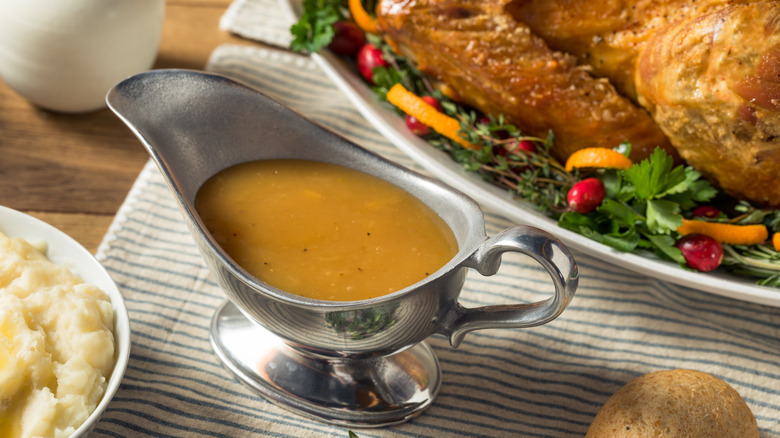
The response is the same whether everything is going great or you're taking stock of Thanksgiving leftovers once all the meat and sides are gone: it's all gravy, folks! It can be hard to accurately predict just how much gravy your guests are going to want to drown their mashed potatoes in, but luckily, if you have reserves it's easy to freeze them for another day.
There is a big difference in how long leftover gravy lasts in the fridge vs. the freezer. According to the FDA, gravy or "meat broth" can be safely stored in the fridge for one to two days, then the freezer for two to three months. Brothy or flour-thickened gravies generally freeze well, but note that cream- or milk-based gravies — like ones often used in recipes for biscuits and gravy — won't because the dairy can separate in an undesirable way when it thaws.
There are a lot of mistakes you need to avoid when making gravy, and there is also a lot to take consider when freezing it. To freeze gravy properly, let it sit out until it cools to room temperature, then transfer it to an airtight container or even a freezer bag or ice cube tray. To save space in your freezer and cut down on thawing time later, lay freezer bags flat when you put them in. And voilá! You'll be able to level-up any meal in the next couple months by smothering it in your favorite gravy.
How to bring your frozen gravy back to life
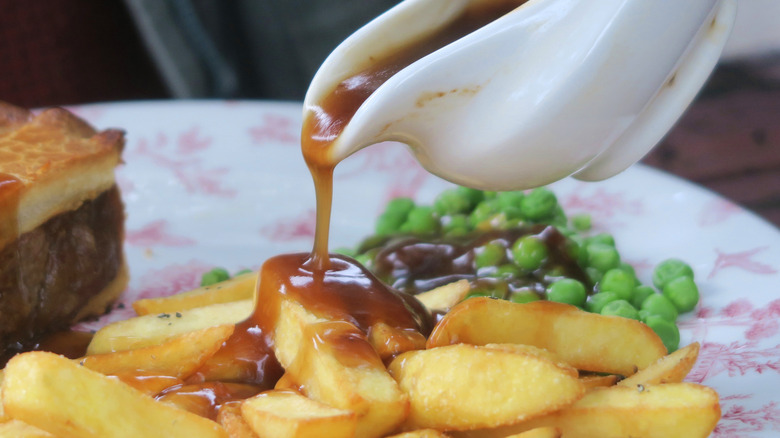
Once your gravy is frozen, the best way to reheat it while preserving its silken texture is to thaw it in the fridge for a few hours or overnight first. You can also thaw it by placing the container of frozen gravy in a bowl of cold water, and worst comes to worst, the defrost setting on your microwave is an option, too. No matter how you ultimately thaw it, the next step is to heat it slowly in a saucepan on your stove, whisking frequently and adding small amounts of water if needed to remove any lumps. The last step is to make sure it reaches 165 degrees Fahrenheit before serving.
Once you've thawed and reheated your gravy, you don't want to freeze it again, so try to only thaw what you're going to use. If it's been a questionable amount of time and you're wondering if your thawed gravy has gone bad, here are the signs of spoilage to look for: a sour or "off" smell, a slimy texture, visible mold, or dramatic discoloration. Some separation is normal, but you should be able to recombine the gravy as it cooks; if it remains separated even after whisking and stirring in some water, you may want to assess it for other signs of spoilage.