

The Chicken Of Tomorrow Contest Changed The Poultry Industry Forever
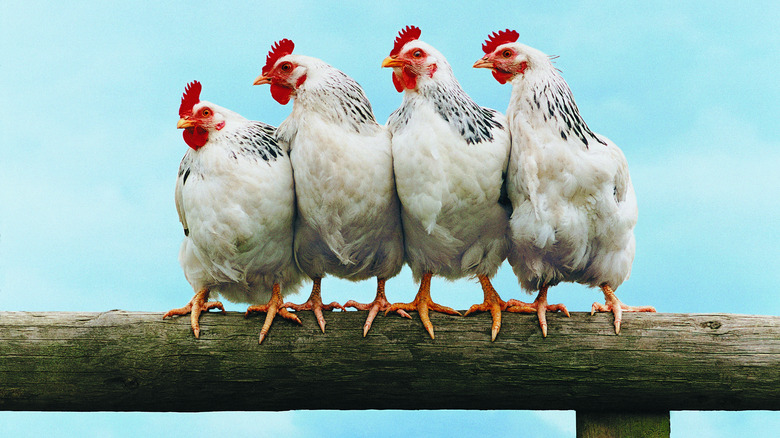
According to the USDA, the U.S. is currently the largest producer and second-largest exporter of poultry in the world. In 2021 alone, reports the National Chicken Council, the U.S. produced 9.132 billion chickens for meat. But, America wasn't always the industry giant it is today. In fact, Americans were devout red meat fans until about a century ago.
When WWII hit the U.S. domestic home front, a red meat shortage came with it. Suddenly, there was a huge uptick in consumer demand for chickens, which shined a brighter spotlight on the poultry industry than ever before. Prior to this war-induced poultry boom, the emphasis on chicken farming wasn't on meat at all: It was all about eggs. Things were looking awesome for U.S. poultry leaders ... until WWII started drawing to a close and food shortages began to ease. How was the industry going to hold on to its newfound popularity? The answer: Churn out impressive, high-quality meat.
For poultry breeders, consistency equals profitability. But, Punnett squares (which depict reproductive possibilities) are unpredictable. In traditional breeding, there's only a 25-75% chance you'll end up with an offspring with a specific genotypic trait you were trying to achieve. And that's with simplified assumptions. It's largely a dice roll. That's why, in 1948, the Great Atlantic & Pacific Tea Company (aka "A&P") teamed up with the USDA and Cooperative Extension to sponsor a never-before-seen type of contest, effectively commissioning a nationwide call for innovations in genetic engineering. Enter: the "Chicken of Tomorrow" contest.
A nationwide experiment gone right
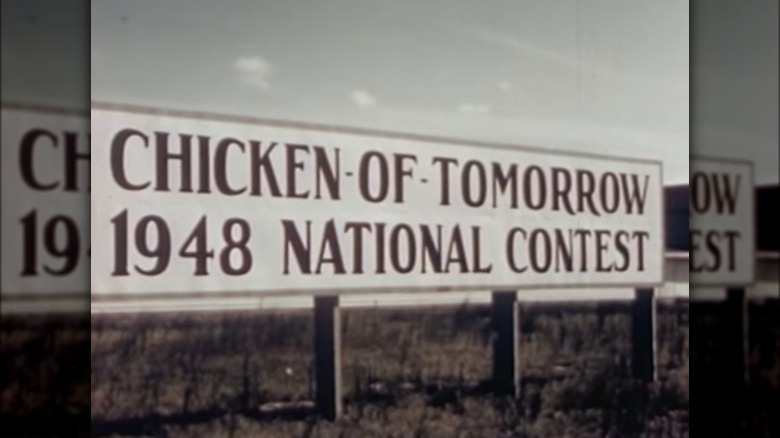
Poultry farmers around the country were challenged to strategically breed their birds into an ultimate superior meat-type chicken. Judging criteria included edible meat yield, economic production, how quickly the chickens were able to gain weight and on how much feed, uniformity of size, skin coloration, and fat distribution. The prize? $10,000 cash; adjusted for inflation, that's the equivalent of about $125,000 in 2023.
There was a series of state and regional contests in 1946 and 1947, with the national contest of 40 finalists in 1948. The finalists weren't judged as chickens, however — they were judged as eggs. Those eggs were delivered from farms all over the U.S. to a hatchery in Delaware, where they would be incubated under identical raising conditions in a controlled environment. The eggs were transported by train in the care of special handlers; other farmers personally delivered their eggs via private car.
After carefully monitored hatching, raising, and processing, the meats of the different chicken species were blind judged. Brothers Charles and Kenneth Vantress' hybrid flock won the highest score in the contest by crossing Red Cornish males with New Hampshire Red females. The Chicken of Tomorrow contest literally created new species of birds, revolutionizing the poultry industry at large on a fundamental scale. The industry was so jazzed about the results that A&P sponsored another competition in 1951. Since then, the rest is history. Supermarket chickens have never been the same.
The chicken of tomorrow, today
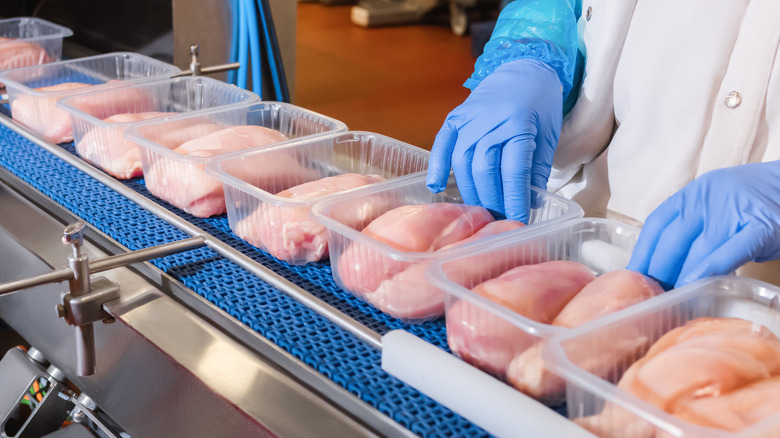
Per an official documentary by the National Chicken-of-Tomorrow Committee, William Dewey Termohlen, former chief of the USDA's poultry branch, was brought to rapture by the implications of the contest. "The success of the contest proves conclusively that it is possible to breed chickens with superior meat-type characteristics," Termohlen commented. The Vantress chickens demonstrated rapid growth at six weeks with a mortality rate under 7%, exceptionally resilient for poultry flocks of the time. Today, a mortality rate of around 5% is commonplace in the industry.
Prior to the 1920s, a typical broiler chicken would weigh between 2 and 4 pounds, eating 12 pounds of feed to reach maturity. Nowadays, the average broiler chicken weighs about 5 pounds and requires less than 10 pounds of feed to get there. Today, Cobb-Vantress, Inc. is a global poultry supplier with a presence in 130 countries. It's owned by household-name brand Tyson Foods and remains headquartered at the site of the 1951 "Chicken of Tomorrow" contest site in Arkansas.
According to the USDA, as of 2023, U.S. chicken availability has increased by over 100% since 1980, making the U.S. poultry industry marginally larger than the beef or pork industry. In 2021, American consumers put away an estimated 97 pounds of chicken per person, more than the foodies of any other country in the world – and the Chicken of Tomorrow contest is largely to thank for poultry's enduring popularity.