

Whatever Happened To Luncheonettes? Here's What Replaced Them
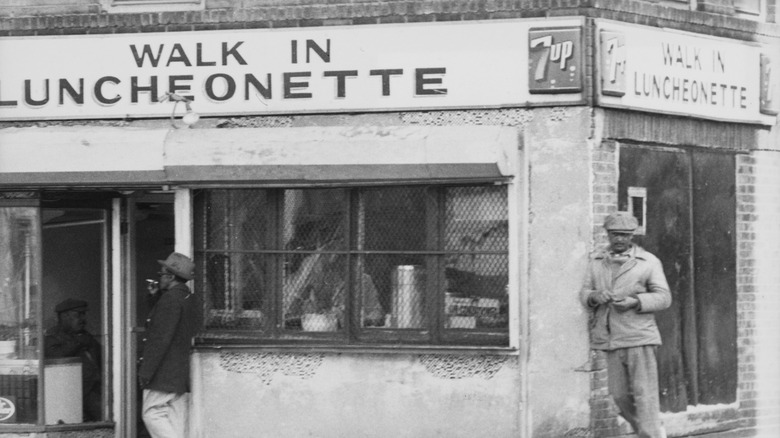
If you're younger than a baby boomer, it's unlikely you've ever sat on the chrome stool of a dime-store luncheonette as a server presents you with a $0.35 grilled cheese sandwich. Once, this dining experience was ubiquitous in America, though it has now all but vanished. As the name suggests, the luncheonette focused primarily on daytime meals, and was typically attached to another business, such as a department store or drugstore. What happened to these lunch counters? We must go back in time to find out.
Although the idea existed in the form of soda fountains and other likeminded operations, it wasn't until the 20th century that luncheonettes got popular. In 1923, Woolworth's unveiled its first luncheonette in New Albany, Indiana. Soon, more would be incorporated to offer affordable food during the Great Depression. These lunch counters became increasingly prevalent as women entered the workforce and shopped for the household. Of course, men enjoyed them too. In 1930s New York, luncheonettes were popular among the construction workers building Manhattan's early skyscrapers. So central were they to some communities that, on several occasions, they became the scene of pivotal '60s civil rights victories concerning segregation and anti-LGBT discrimination.
The decline of the luncheonette can be attributed to numerous factors. Diners, with their long opening hours, could cater to more than just the breakfast-and-lunch crowd and appealed to larger groups like families. Likewise, the explosion of fast food, which quickly spread into urban areas, offered further competition — though Woolworth's comfortably held its own against McDonald's well into the mid-'60s. Still, the last Woolworth's closed in 1997, and the few remaining mom-and-pop operations suffered the consequences of gentrification and, more recently, the COVID-19 pandemic.
A few old luncheonettes remain, but some can still be found nationwide
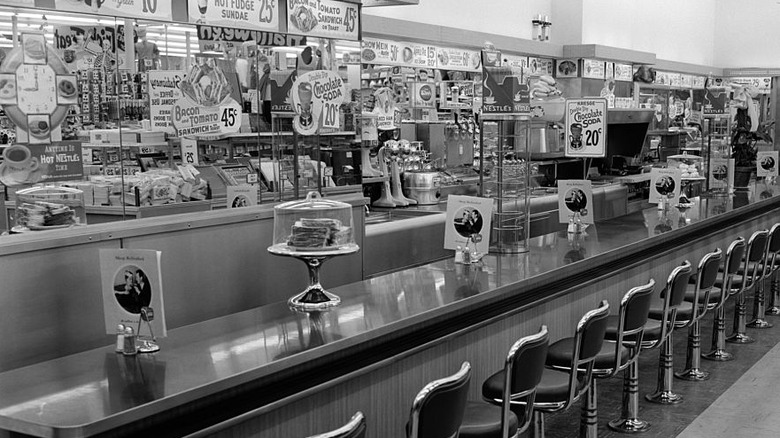
Much like the NYC automats iconic for their good food, better coffee, and inclusivity, luncheonettes are often regarded with nostalgic fondness by those fortunate enough to have experienced them. Online, some even hunt for the authentic recipe for the famed Woolworth's grilled cheese. (According to legend, it was responsible for the accidental origin of the tuna melt when a cook accidentally dropped some tuna salad on the sandwich.) Some lunch counters survive across the U.S., including the last operating Woolworth's luncheonette in America, which reopened in Bakersfield, California, back in 2025.
Over the past decade, there have been signs that the '60s-style luncheonette is making a comeback, with a spate of new restaurants consciously seeking to evoke the retro look and casual atmosphere of old school lunch counters. Ironically, given how late-night diners and takeout restaurants may have chipped away at those original businesses, the restricted opening hours could be welcomed by some luncheonette employees, who can close up in the afternoon rather than the late evening. This may indicate that there's more to the lunch counter's appeal than just nostalgia — but you probably shouldn't get your hopes up for the return of a $0.05 coffee.