

What Does Dunkin' Do With Leftover Food?
Few societal problems provoke as emotive a response as that of food waste. Amidst an international affordability crisis, when millions of Americans are experiencing food insecurity, the thought of perfectly edible food going into the dumpster or a landfill can inspire some hard questions. Dunkin' — which over the course of almost 80 years in business has grown from a single coffee and donut shop to a fast food franchise of over 10,000 U.S. locations — has made several large-scale attempts to tackle food waste but has nevertheless faced its share of controversy.
In 2020, Dunkin' — formerly Dunkin' Donuts until a 2019 rebrand — donated, alongside its supply chain management company, over 205,000 pounds of food and over 4,360 gallons of dairy during the COVID-19 pandemic. Specifically, the coffee-and-donut brand donated to Feeding America, which works to combat food insecurity nationwide. The following year, Dunkin' announced several new initiatives to lessen food waste within the company, stating that "what our brand does today will matter tomorrow."
Dunkin' has instituted an End of Day Donation Program through which surplus food from Dunkin' outlets can be given to area-specific non-profit hunger relief organizations, unless restricted by local regulations. However, though Dunkin' does encourage its franchisees to take part, this program is voluntary, meaning it is up to the owner of each location. Dunkin' also encourages franchisees to participate in its composting program, so that its coffee grounds and other organic waste can be disposed sustainably. In New York City, for instance, franchisee Pam Danbusky prevented roughly 47,600 pounds of compostable waste from heading to the landfill between 2020 and 2021.
Controversy remains over how much Dunkin' food goes in the trash
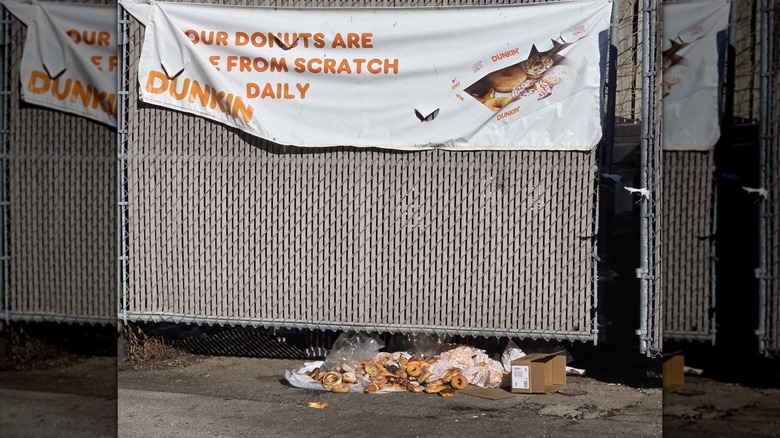
Despite the company's efforts to minimize food waste, Dunkin' has nevertheless faced criticism over how much of its product can end up in the trash. In 2025, a Reddit user posted a photo of a pile of uneaten pastries sitting before a Dunkin' dumpster. The poster said that they had asked the drive-thru personnel if Dunkin' had any "programs or measures in place to not waste such food." However, the user was told that employees could get into trouble if they donated it.
The fear that employees may suffer repercussions if they give away food without the franchisee's permission may be well-founded. Former Dunkin' employee Bryan Johnston was also shocked by the amount of food that staff had to throw away and posted a video on Instagram revealing how he and his co-workers disposed of the leftover food items. According to another clip, Johnson was fired by Dunkin' after he revealed he sometimes contributed this food to the homeless (via Instagram). "They would rather just throw away the food at the end of the day instead of paying an employee a couple more man-hours to bring the food to a donation center," he later told Bored Panda.
The U.S. Department of Agriculture (USDA) estimates that between 30% and 40% of the country's food supply goes to waste. In 2010, that was the equivalent of roughly 133 billion pounds of food, worth $161 billion. According to data from the USDA's now cancelled annual food insecurity survey from 2024, 47.9 million Americans live in households experiencing food insecurity.