

Grover Cleveland's Favorite Food Was A Comfort Dish Found In The Servants' Hall
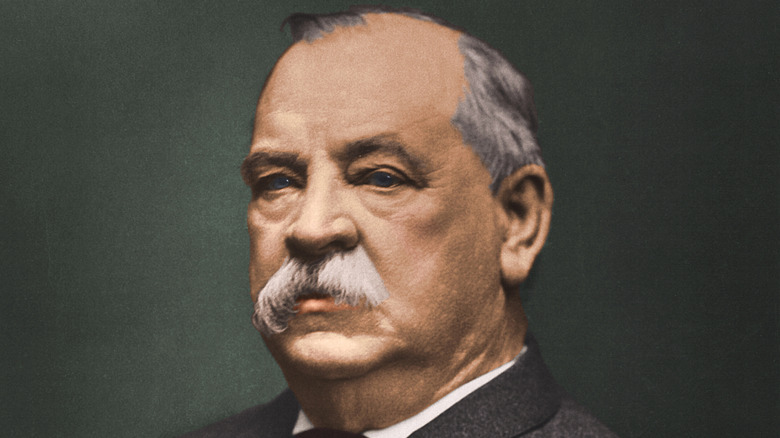
Grover Cleveland is not generally among who we think of when considering presidents with impact on American history. Mostly he's a pop trivia fact, the only guy who won two nonconsecutive terms before Donald Trump. The first comeback kid, if you will. However, no part of American history is devoid of happenings. Take, for example, how in 2019 Cleveland's history was exhumed in a debate on tariffs. Trump departed from their shared history to (kind of) argue for raising tariffs, akin to Cleveland's 1888 opponent. A proponent of lower tariffs for a lower cost of living, Cleveland lost to Benjamin Harrison. Cleveland held his reputation as a president of hearty stock, however, and no anecdote shows it more powerfully than one involving the very agrarian corned beef and cabbage.
Cleveland was known as a man of simple tastes. In the book "Grover Cleveland: The American Presidents Series," Henry F. Graff writes that Cleveland was austere. He didn't serve wine at White House dinners unless guests were present, and often eschewed ostentatious food. In the most famous instance, Cleveland sent his valet to trade his dinner for what was being served in the White House service quarters; a plate of corned beef and cabbage, which Cleveland historically said was the best food he'd had in months.
Scratch-made corned beef isn't a high brow food but offers unparalleled comfort. It is the type of simple foods Cleveland is said to have craved: "I must go to dinner," writes Graff of Cleveland, "but I wish it was to eat pickled herring, Swiss cheese and a chop at Louis' instead of the French stuff I shall find."
A chop at Louis'
Prior to becoming president, Cleveland was governor of New York, and prior to that, the mayor of Buffalo (among other roles). He came up in the city as a lawyer, and according to an obituary in the New York Times, was encouraged to go into politics by one Louis Goetz. Goetz was the owner of a restaurant which served as a common hangout for the future president.
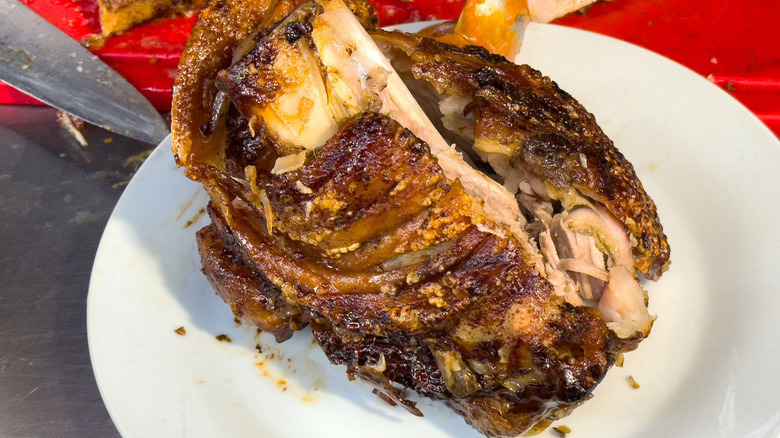
Copies of Louis' menu seem lost to history, so we can't confirm what type of chops Cleveland hankered for. Still, reporting from Buffalo Stories shows that the 22nd and 24th president's taste for corned beef and cabbage was more a characteristic desire for comforting and rustic foods than it was a one-off hunger. At Louis', Cleveland would often eat pig's knuckle (underrated as one of the best meats for smoking) and sauerkraut, served with beer and set at a secluded table in Goetz's restaurant. Irish-American invention or a rural German essential, either dish could fit the bill for Cleveland's favorite food.
Goetz's restaurant served the hungry diners of Buffalo for over a decade after Cleveland died in 1908. It was sold in 1921. The historic building lived on for some time. From the 1920s on, it became a well-known name in Buffalo's dining scene: Laube's.
Laube's Old Spain
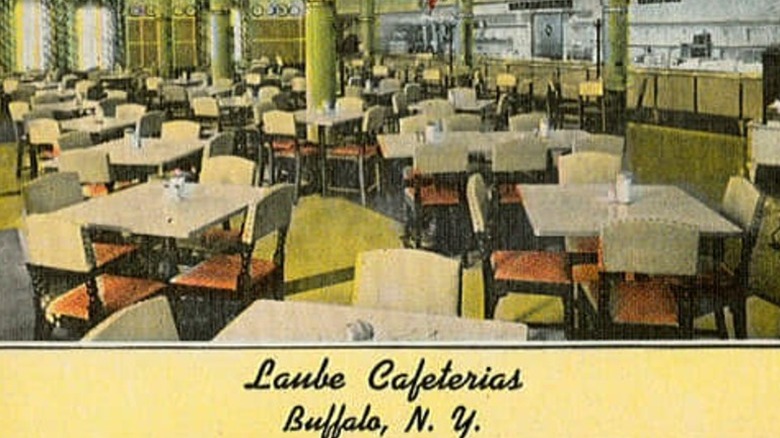
Apart from being the site of numerous card games a former president played there, Laube's cafeteria doesn't have much connection to Grover Cleveland. Still, anyone with an interest in vintage Buffalo restaurants will know the name on its own right. Laube's Old Spain Restaurant was a popular place to eat on Main Street Buffalo until the mid-1960s. The restaurant was known for a classic menu with sophisticated foods priced for everyday consumption: prime rib, chicken a la king, and cold lobster.
Its less showy namesake, Laube's Cafeteria, had its heyday in the 1930s-40s. The building, once located at the the intersection of Pearl, West Eagle, and Niagara, has been described as a Buffalo novelty for being an early adopter of balcony seating. It was the kind of staple American cafeteria that filled out downtowns with a focus on affordability and quality, maintaining cloth napkin service almost to the end of its 46-year run.
If the cafeteria menu was anything like that of Laube's Old Spain, then veal parmesan, shrimp a la Newburg casserole, and double cut pork chops with applesauce staples. Perhaps these chops would have satisfied Grover Cleveland. These days, a family court now stands where the building was demolished.