

The Cultural Difference Between Cava And Prosecco

You probably know the feeling — it's a special occasion, you've been handed a crystal flute of sparkling wine, and amidst the toasts and the revelry, you can't help but wonder precisely what you're drinking. Well, you're not alone. While it is commonly understood that only wine produced in the Champagne region of France can be designated as such, distinguishing cava and prosecco, the two other best-known sparkling wines in the world, may seem more confusing.
It is worth knowing the difference between the Spanish cava and Italian prosecco, however, not just for a fuller appreciation of the wine itself, but of the distinct cultural histories of two great wine-making nations. The next time you are sipping some bubbles on New Year's Eve or a friend's birthday, this will help you know whether what's in your glass either has its roots in ancient Rome or was the response to a plague that almost destroyed European viniculture.
Cava's popularity boomed in the wake of disaster
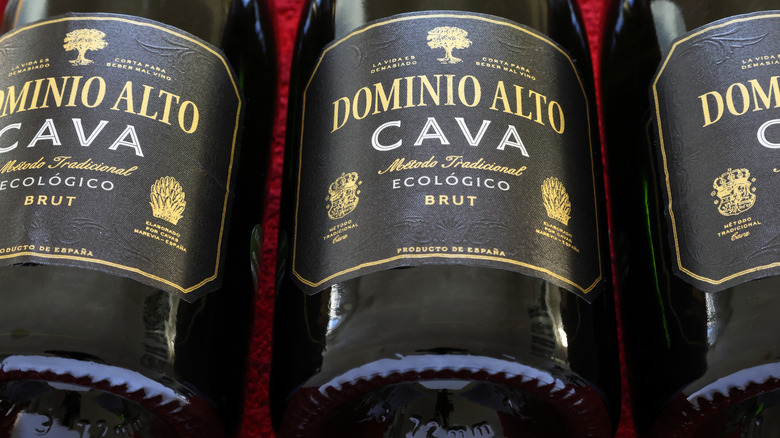
First bottled in 1872, cava — the only sparkling wine with an official Designation of Origin in Spain – is a relatively recent invention, but it soon became a very necessary one, thanks to one of the worst calamities in winemaking history. In 1887, Catalonia's Penedés vineyards became infested with phylloxera, an aphid-like insect that French scientists would aptly name "the devastator."
Accidentally brought from the United States to Europe with imported live grape vines, phylloxera attacked vines at the root, spread with astonishing speed, and would eventually lead to the destruction of roughly two-thirds of Europe's vineyards. With their red grapes wiped out, some Catalan vintners decided to replace them with local white grape varieties and apply the "méthode champenoise" (the traditional champagne method) to the new wine, which soon became a success.
In 1959, the wine was officially named cava, and over the next 30 years, legislation to protect and regulate its production would be put in place. Today, the Comtats de Barcelona in northeastern Catalonia produces more than 95% of the nation's cava and is divided into five subzones that reflect the area's distinct microclimates, allowing for the growth of different kinds of grapes. However, the wine is also made in the Ebro Valley, Requena, and Almendralejo.
Modern prosecco has a legacy stretching back 2000 years
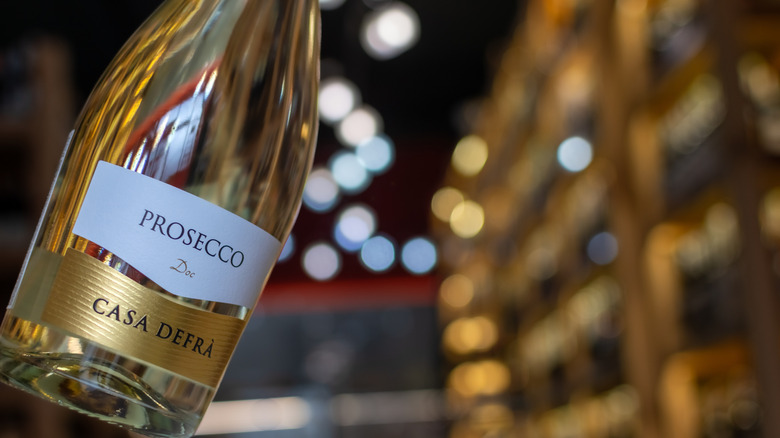
In his "Natural History" (completed around 77 CE), the ancient Roman author Pliny the Elder wrote that the Roman empress Livia Drusilla, wife of Augustus, credited her long life to drinking Pucinum, a wine made from grapes "grown on a bay of the Adriatic" — what we today know as Italy's Prosecco country. Yet, while this region has seemingly produced wine for 2000 years, it would take some time for it to become what we now recognize as prosecco.
The name "prosecco" would emerge in 1593 from a village near Trieste. Fynes Moryson, a visiting Englishman, recalled Pliny's references to Pucinum, and after trying the local sparkling wine, wrote that it had recently been renamed as "prosecho" (which may be the historical spelling, or perhaps the pronunciation of someone who'd been drinking quite a bit of it).
Aside from its place of origin and the grape it is primarily made from – simply referred to as the prosecco until 2009, but now called the glera — what most distinguishes prosecco is the method of its production. Cava and champagne are made using the aforementioned "méthode champenoise," the difficult and expensive process in which wine undergoes a secondary fermentation inside the bottle. Modern prosecco, however, is made using the "Martinotti method", which instead uses large, pressurized stainless steel tanks for the second fermentation. In addition to being faster and easier than the alternative, some argue that the process better preserves the unique characteristics of the glera grape.