

Does Homemade Cajun Seasoning Need Salt?
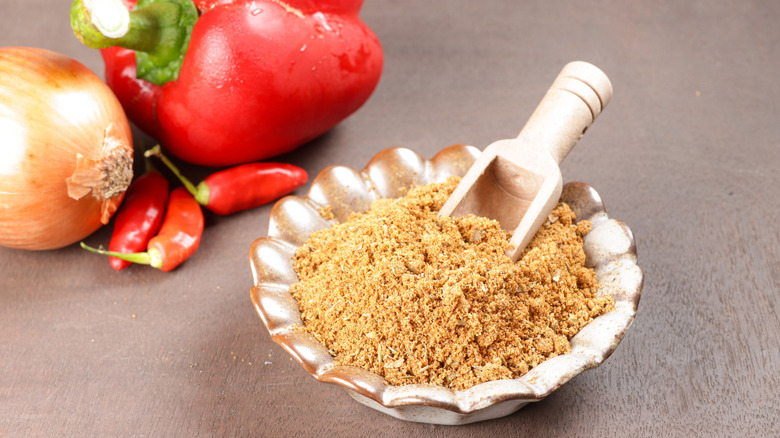
Originating in Louisiana, Cajun seasoning (which isn't the same as Creole seasoning) is known for its signature bold and spicy flavor. While it's easy to grab a pre-made blend at the grocery store, making Cajun seasoning at home allows you to have more control over the heat level and overall flavor profile. But, of course, taking the DIY route raises some important questions. For starters, what ingredients really go into a homemade Cajun seasoning blend, and is salt one of them?
We spoke with Chef Melvin "Boots" Johnson, chef and owner of Harlem Biscuit Company and Boots & Bones Smokehouse, at the New York City Wine & Food Festival who gave us the 411 on how to make the perfect cajun spice mix. Johnson's been making the same Cajun seasoning since 1991. According to the chef, the perfect Cajun seasoning blend should include black pepper, white pepper, cayenne pepper, paprika, garlic, onion, ground thyme, and, yes, salt.
But the ratio of ingredients is just as important as the ingredients themselves. To give your seasoning blend that classic Cajun quick, Johnsons recommends using "equal parts of white, black, and cayenne pepper." Next, he makes sure to "double up on the paprika," noting that he occasionally opts for the smoked variety. The remaining ingredients (garlic, onion, ground thyme, salt, and any other ingredients you may want to add) should be added in equal parts to the rest of the blend.
Mistakes to avoid when making Cajun seasoning at home

While you should definitely include salt in your Cajun seasoning, you'll want to beware of using too much. Even when salt is measured in equal parts alongside your other spices, it can easily overpower the blend if you're not careful. Johnson points to over-salting the spice blend as a common mistake many chefs make, warning against using garlic salt or other seasoned salts as they can introduce too much salt to the mixture and throw off the flavor balance.
And the type of salt you use matters just as much as the amount. Johnson warns that you shouldn't use a salt that's too coarse as it'll prevent you from "getting an even coating of the salt" throughout your Cajun mixture. Instead, Johnson recommends using a finer iodized salt. "I use a regular iodized salt, so the granules are smaller," Johnson shares, "so it actually mixes in with all the other spices evenly."
Once you've whipped up the perfect Cajun blend, how you use it is just as important. While the mix of spices may be the same, the intensity of the spices changes depending on what you pair with it. "If you put it on chicken, it's going to be stronger, because it's so hot," Johnson says. "If you put it on a steak, it's going to be not as strong, but it's going to be a little more heartier, because the meats are more dense." At his own restaurant, Johnson uses Cajun seasoning to blacken fish but uses it sparingly. The chef notes that since he knows "it's going to be hotter," he opts for less seasoning to avoid overwhelming the dish.