

The Type Of Bagged Spinach You Really Don't Need To Wash
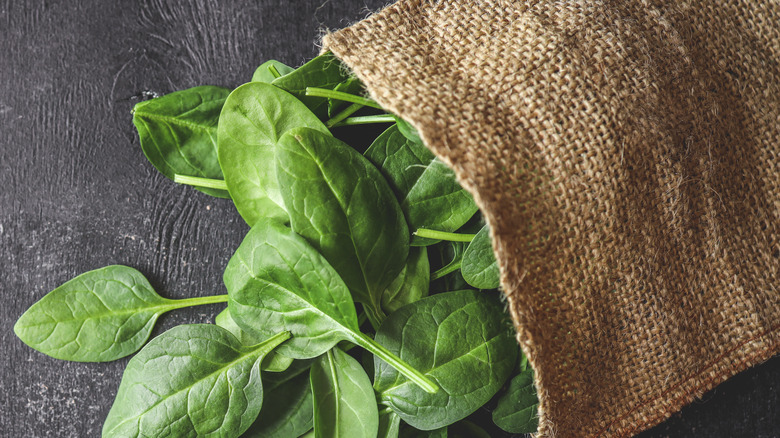
When grabbing a bag of fresh spinach from the store, it's tempting to treat all of it the same: Just rip open the bag, toss it into a bowl, and eat at will. But from a food-safety point of view, is that really a good idea? As it turns out, that question comes with a "yes, but" answer. To get a clear-cut perspective on which bagged lettuces are actually ready for consumption, we asked an expert in the industry, Reyna Graves, a Merchandising Buyer for Sprouts Farmers Market.
According to Graves, ready-to-eat spinach is indeed good to go, with one caveat. "Yes, bags of spinach are considered ready to eat," she explains, "if it says 'washed' on the packaging." She notes that Sprouts works closely with farmers near its stores, ones who commit to organic, non-GMO products and sustainable practices. That ensures the season's freshest produce, but when the product is packaged and "ready to eat," like bagged spinach, it must be thoroughly washed and labeled as such. That means you can literally eat it straight from the bag.
Look for terms such as "washed," "pre-washed," "triple-washed," and "ready to eat," signaling the spinach has gone through controlled washing in a facility that follows specific food-safety rules. You may think it never hurts to wash ready-to-eat spinach again, but if you choose to do so, take care that it doesn't come into contact with unclean surfaces or cooking utensils in your home. That could cause cross-contamination, defeating the benefits of buying spinach in bags.
What's so bad about unwashed spinach?
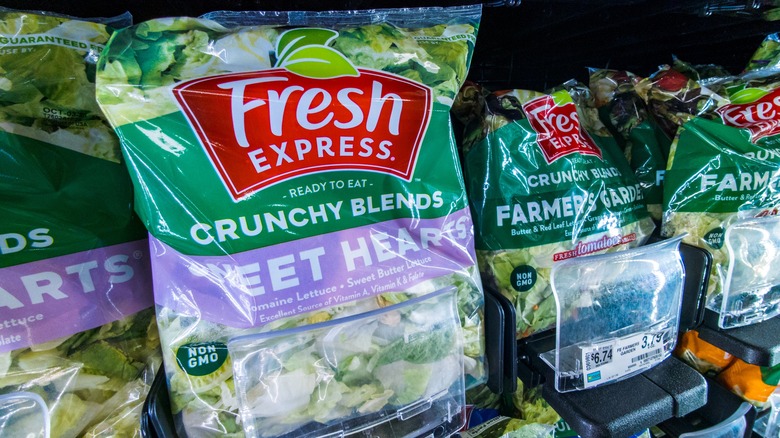
What's the big deal with unwashed produce? As it turns out, spinach and other leafy greens are one of the top foods linked to foodborne illness outbreaks. That's at least partially because these types of greens often get eaten raw, plus they have lots of surface area for germs to hang out on. Public-health investigations and recalls repeatedly find E. coli, Salmonella, and Listeria in packaged salads and greens, sometimes spanning multiple states at the same time.
While vegetables and fresh greens are a vital part of healthy diets, no washing can fully guarantee they're completely free of germs. But there are steps you can take to minimize the risk and potentially prevent further growth of bacteria. Once raw leafy greens, including spinach, are cut and bagged, they're considered a food that requires time and temperature control to remain safe. Bags marked as washed or ready-to-eat are processed and chilled with that in mind, so purchase bags with the furthest best-by or expiration dates.
Make sure bagged spinach, or any other leafy greens, have been refrigerated in the store, as well as in your home, at temperatures between 35 and 40 degrees Fahrenheit. Bacteria can start multiplying on fresh foods in as little as 20 minutes above 40 degrees Fahrenheit, so refrigerate within two hours at most, or one hour if exposed to 90 degrees Fahrenheit or higher. And remember, it doesn't have to stay raw; check out these 12 tips for cooking with spinach.