

The Vintage French Cookware That Could Be Highly Valuable
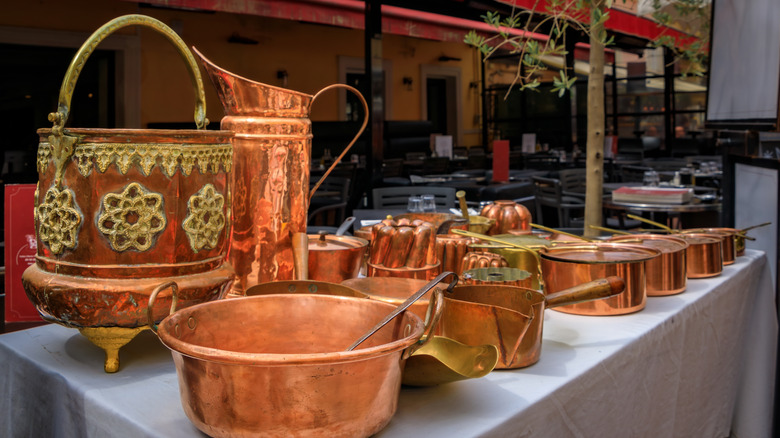
It's easy to think that old pots and tarnished pans are kitchen relics of yesteryear, hardly worth shelling out money to acquire. But there's one category that could change your perspective, namely vintage French copper cookware. Copper is the crucial factor, for reasons both nostalgic and practical. This kitchenware has recently risen in desirability and value — notably because of its age, rather than in spite of it.
Copper cooking vessels, old or new, garner devotion from professional and home-kitchen chefs alike, not only for its golden-glow beauty but for the functionality. That includes things like superior thermal conduction, which facilitates quick, even heating and temperature control. Copper allows cooking precision and heat retention for a wide variety of food preparations, including finicky stovetop procedures such as caramelizing sugar without burning it, creating a delicate béarnaise sauce, or slow-cooking a red-wine beef bourguignon stew. The same principle applies to copper bowls for whipping up soufflés.
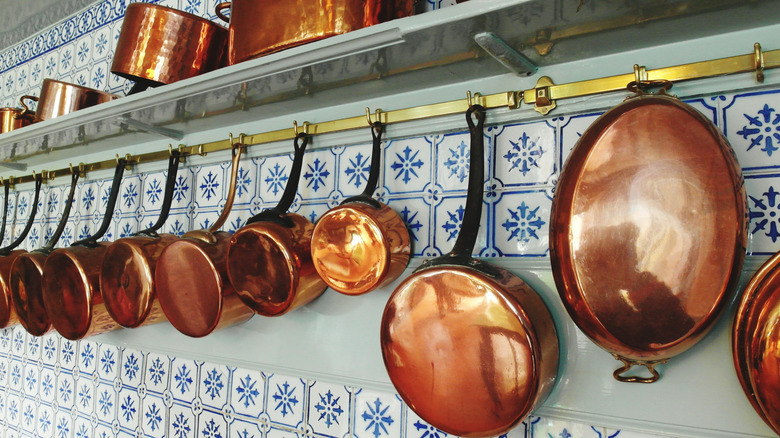
Obviously, manufacturers still make functional copper pans — so why the fuss and collection-power of vintage versions, particularly ones from France? A major thing setting French copper apart from others is the country's long history of combining culinary artistry and metalworking craftsmanship, creating beauty and warmth in kitchens. Visitors to Claude Monet's home in Giverny often comment on the painter's famous kitchen, where polished copper pans line blue-tiled walls. That, plus sturdy, handmade composition, is what collectors, including the late French-cooking chef Julia Child, seek in vintage French copper cookware — and what commands prices as high as hundreds or thousands of dollars.
Buying and selling French copper cookware
The romance of nostalgic pieces can quickly dissipate when price tags appear. It's true that vintage French copper doesn't come cheap, though prices do vary widely, depending on condition, characteristics, rarity, or luck. Heavier pieces are ideal, preferably from 2 millimeters to 3 millimeters thick, lined with tin instead of other metals, and bearing a maker's stamp. A "Made in France" identifier was required by the 1960s.
For American collectors, the hunt often begins online, where vintage French copper is widely traded but rarely at thrift-store prices. On eBay, Etsy, and Poshmark, well-preserved "Made in France" tin-lined saucepans can sell for under $100, or several hundred dollars for larger stockpots. For example, a recent eBay listing for a rare French Dehillerin, stamped, heavy-copper pan with fresh tin sold for $795 plus shipping. Matching sets and truly rare or 19th-century pieces sometimes climb into the four-figure range on reseller sites like 1stDibs. Examples include a French Arte Populaire Padelle copper pan priced at $4500, and a set of French copper egg poacher-slash-escargot pans for $2800.
It also helps to seek specific French brands like Dehillerin or Mauviel in Normandy, which was producing elegant, heavy-gauge, high-performance copper cookware for grand Parisian restaurants almost 200 years ago. Mauviel carries on the same traditions today, employing 70 craftsmen who carve, hand-hammer, and assemble each stamped piece in a collection that now includes 1300 cooking utensils. Brands like that are a good bet for vintage collecting, but seek the company's older tin-lined pieces, instead of one with modern-use metals.