

9 Delicious Halloween-Time Treats From Around The World
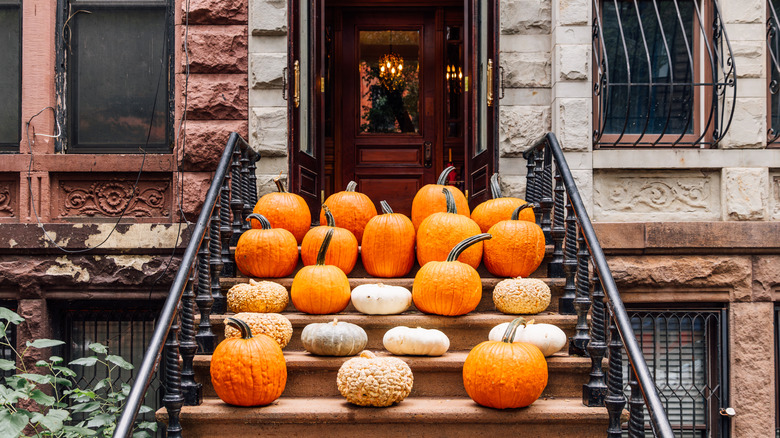
For many, the Halloween season is a time for embracing wacky costumes, carving pumpkins, and bringing out the spooky decorations. What's arguably one of the best things about this time of year, however, is the selection of foodie treats associated with it. As the nights draw in, you might already be leaning into the cozy fall-inspired baking. And, on October 31st, an evening of trick-or-treating will likely leave you with a pretty hefty stash of candy. Different corners of the world have their own set of food-based traditions, with some treats prepared to celebrate Halloween itself, and others honoring the days that follow — All Saints' Day and Dia de los Muertos (Day of the Dead), or All Souls' Day, depending on where you are.
If you're in the US, you've probably tucked into a candy apple, or picked up a bag of candy corn. But, there are also plenty of lesser-known Halloween-time food items that are equally worth trying. From spiced cakes steeped in history, to hearty breads and satisfying puddings, this season is the perfect time to indulge in something comforting. So, let's explore some of the tempting creations that make the spooky season special.
Soul cakes
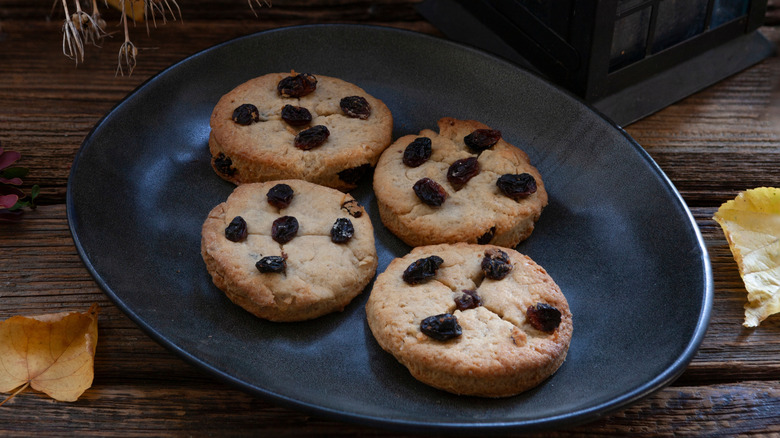
Dating back to the Medieval period, soul cakes originated in England, where they were closely associated with the Christian celebrations of All Saints' Day and All Souls' Day. These buttery, raisin-studded bakes sit somewhere between a bun, a biscuit, and a scone, with individual recipes differing somewhat. However, the common theme is the inclusion of spices, often nutmeg and cloves.
In the 17th century, soul cakes would be handed out to beggars on November 2nd, who knocked on doors and offered a musical performance in exchange for the sweet treat. This event was referred to as "souling", and it certainly bears resemblance to modern-day trick-or-treating. Amazingly, there are records of an original 1604 soul cake recipe, written by Lady Elinor Fettiplace, though it certainly leaves a lot to the imagination. Her instructions include no quantities, and while they mention flour, sugar, spices, ale barm (a form of liquid yeast), butter, and dried fruit, there's debate amongst historians over whether eggs were also included.
With the earliest recipe being so vague, there have been many iterations of soul cakes over the years. You'll see modern versions featuring add-ins like grated apple, oats, or Greek yogurt, and whilst some cakes are thinner and more short bread-like, others yield a cakier texture.
Barmbrack
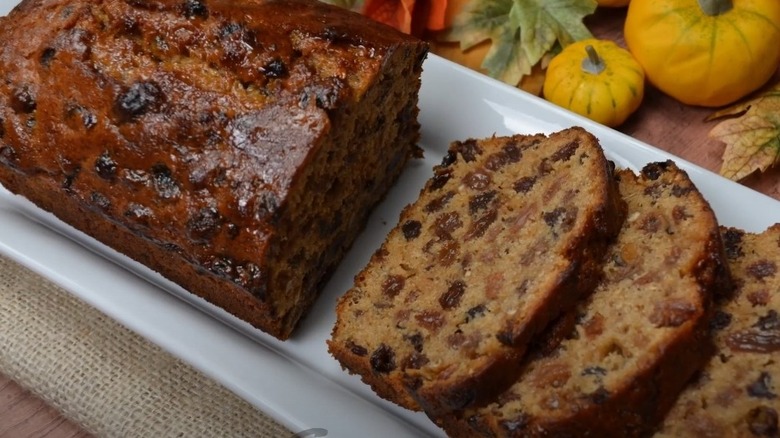
Barmbrack is a traditional Irish fruit loaf that's packed with rich flavors. It gets its name from the frothy by-product of the beer fermentation process called "barm", with which it was traditionally made. Though it serves as a staple year-round in Ireland, this bread gets a symbolic twist around Halloween-time. The idea is to bake various items into the loaf, to be discovered by those tucking into it. Each object is thought to tell a specific fortune. For example, find a coin in your slice, and this signifies a wealthy year ahead, whilst a ring could mean marriage is around the corner. However, the cloth was one to be avoided, since this indicated bad luck and poverty.
In recent years, the addition of such symbols has become less popular (likely due to the chocking hazards they present!), but the bread is still a popular Halloween-time treat. To make it, you'll prep the dried fruits a day ahead, soaking raisins and sultanas in black tea with sugar and citrus zest. These are then stirred into a spiced batter, with everything baked in a loaf pan until risen and gloriously golden brown. Sliced and spread generously with butter, barmbrack makes for a fantastic accompaniment to a steaming mugful of English breakfast tea on a chilly Autumnal afternoon.
Candy apples
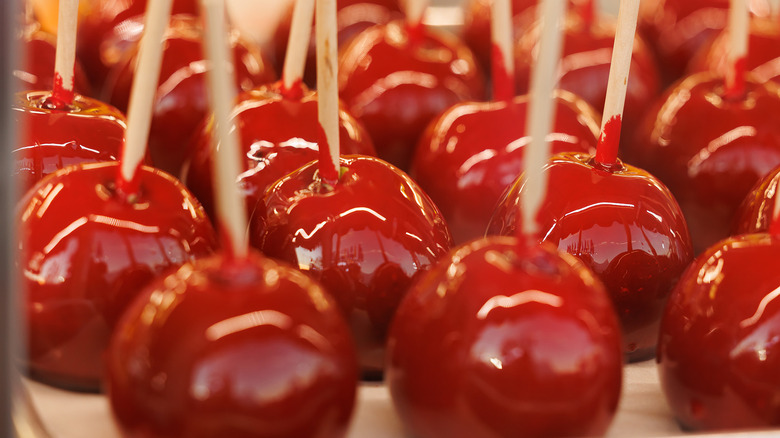
These fun festive treats hold nostalgia for many Americans, with their glossy-sweet appeal spanning multiple generations. But, you might be surprised to learn that the first candy apples were not invented for eating purposes. In fact, they were created as a marketing ploy by a New Jersey candy maker, William W. Kolb. Around the Christmas of 1908, Kolb was hoping to boost sales of his red cinnamon candy, and came up with a unique way to showcase it. The candy-dipped apples sat proudly in his shop window, but little did he know that customers would be more intrigued by the coated apples than the candy itself. They fast became a hit across the nation, and throughout the 20th century, candy apples gradually started to hold more association with Halloween than Christmas.
It was once common for trick-or-treaters to receive these crisp, glazed apples, but in the 1960s, rumors of needles and razor blades being lodged in the fruits began to stir. Understandably, this led to a decline in the treat's popularity. However, you'll still find them across America and beyond throughout the Halloween season today. Candy apples are wonderfully easy to whip up at home, too. Just poke a sturdy stick into each apple, dip them in a simple syrup mixture that's been heated to 300 degrees Fahrenheit (the hard crack stage), and let them sit on a baking sheet until hardened. You can also add a few drops of red food coloring into the syrup for a vibrant finish.
Candy corn
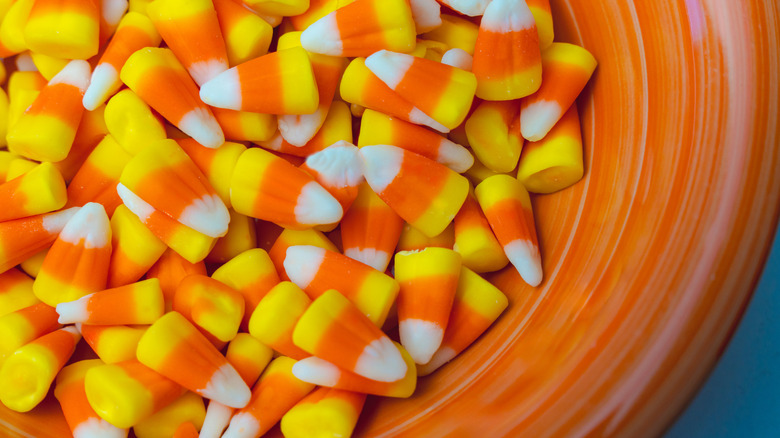
Love it or hate it, candy corn is perhaps the most Halloween-ified treat in the United States. Inspired by the sweet, sunny kernels on an ear of corn, these bite-sized sweets were first produced in the 1800s. Allegedly, their original name was "chicken feed", and the chewy delights were produced seasonally, from late summer to the end of fall. By the 1950s, candy corn had become a Halloween favourite, finding its way into trick-or-treat stashes across America.
Early manufacturing of candy corn was far more laborious than it is today. Before the invention of modern-day machinery, workers would carefully hand-pour the yellow, orange, and white mixtures into molds. Today, machines automate the process, producing thousands of candy corn pieces in just a few minutes. The type of candy used to make this treat is called mellowcreme — a partially-set mixture of sugar and corn syrup. The inclusion of gelatin also plays a key role in the overall texture, which can be described as firm, waxy, and marshmallow-like.
While its readily available in pre-made form, you can absolutely try your hand at making candy corn at home. The simplest approach is to create a dough by heating sugar, powdered milk, corn syrup, and butter. This is split this into three parts, with one dyed yellow, and another orange. Rolled into thin ropes which get flattened together to create a long, tri-colored strip, the dough can then be cut into individual triangles.
Kabocha pudding
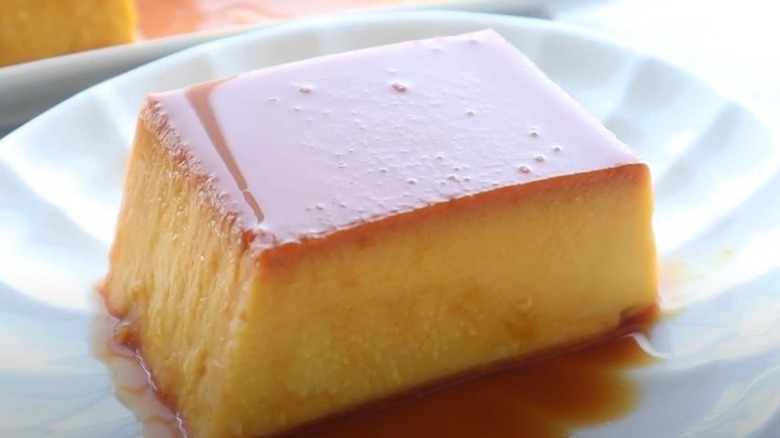
Fall is pumpkin's time to shine as a cooking and baking ingredient, but in Japanese cuisine, there's a tasty seasonal treat made with the squash's smaller, greener cousin. Kabocha squash has a sweet, nutty flavor, sometimes described as a cross between a pumpkin and a sweet potato, and it lends itself especially well to desserts.
It wasn't until the 1970s that Halloween celebrations first began taking place in Japan, and kabocha pudding is a relatively new addition to the country's food scene. This tempting dessert is made with milk, cream, sugar, and eggs, which are blended up with the cooked and pureed squash. The mixture is then baked in a large pan or individual ramekins until set, yielding a firm-yet-wobbly, pudding-like texture. Some recipes also include rum or vanilla, or feature a sticky layer of caramel sauce.
You can find kabocha squashes at many large grocery stores, such as Trader Joe's and Whole Foods. They're often available at Asian grocery stores and farmer's markets too. So, if pumpkin-based treats are typically your go-to during the Halloween season, it might just be time to try something new.
Buñuelos de viento
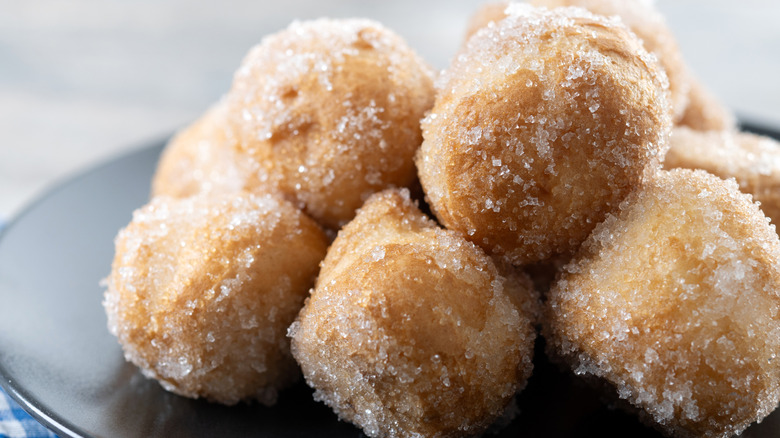
Crisp, doughy, and totally irresistible, buñuelos de viento are one of Spain's most popular Halloween-time sweets. They're made with an olive oil- and egg-enriched dough, which is portioned into balls, and deep-fried until golden all over. The fritters can then be rolled in granulated sugar, or piped with a selection of fillings, such as custard, jam, or whipped cream.
These satisfying treats were also introduced to Central and South America by Spanish migrants, and you'll find multiple variants of the original Spanish version in other areas. For example, in Mexico, buñuelos de viento are typically cooked in a special rosette-shaped iron, and served around Christmas time. Head to Puerto Rico, and you'll find savory versions of the treat, filled with ham and cheese, whilst the Columbian versions are made with curds. As well as being a Halloween staple, buñuelos de viento are also often enjoyed during the vibrant Carnival festivities in Spain and beyond.
Pan de muerto
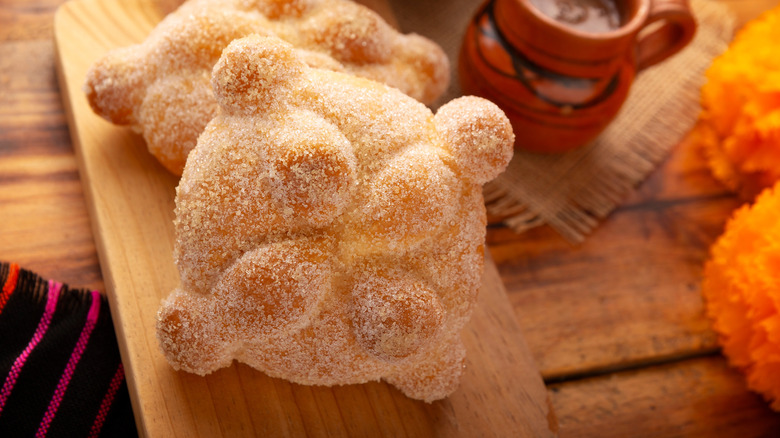
This Mexican sweet bread has strong links to Dia de los Muertos, or Day of the Dead — a celebration that honors and commemorates the deceased. Pan de muerto, which somewhat morbidly translates to "bread of the dead", holds deep symbolism in Mexican culture. It's thought to have originated during pre-Hispanic times, with evidence suggesting links to human sacrifice. One legend tells of a bread being prepared with ground amaranth and the blood of the sacrificed, with the loaf being offered to the gods. When the Spanish first colonized Mexico, pan de muerto took on a less sinister form, being made with a sweet, wheat-based dough. But, as a nod to its morbid roots, the bread would often be painted red, to represent the sacrificial blood.
Modern pan de muerto recipes typically call for a yeasted, enriched dough, that's flavored warming spices like cinnamon and anise, as well as citrus zest. Once this has been shaped into one large loaf, or several small breads, bone-shaped pieces of dough are traditionally added on top as a final decoration before baking. The resulting bread is beautifully golden and crisp on the outside, boasting a tender, fluffy crumb within. Pan de muerto can be finished with a sweet orange glaze, or simply brushed with butter and sprinkled with sugar, transforming it into a dessert-worthy treat.
Huesos de santo
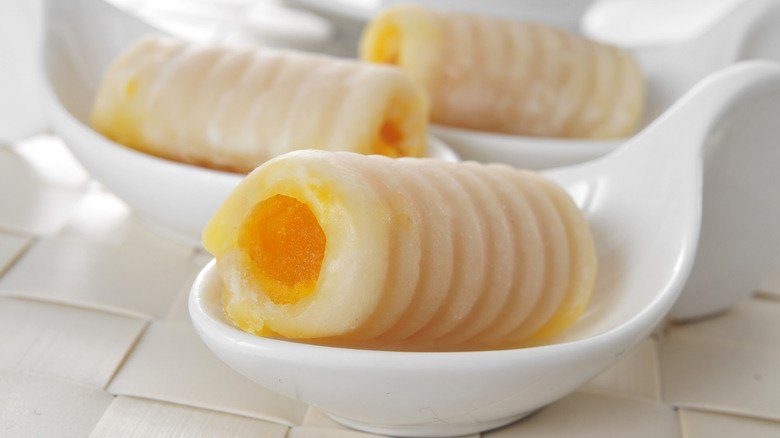
Another Spanish treat with strong ties to Catholic celebrations, huesos de santo (aka saint's bones) are indeed crafted with the intention of resembling marrow-filled, human bones. The outer layer consists of marzipan, and inside there's a syrupy filling made with egg yolks. As gruesome as the concept may be, these sweet creations are undeniably tasty. You'll find them in bakeries and confectionary shops across Spain over the Halloween period, though they're traditionally enjoyed on All Saints' Day, with the intention of remembering those who have passed.
Step one in crafting these nutty delights is grinding blanched almonds until they reach a flour-like consistency. The ground nuts are the mixed with a warm sugar and water solution, to form a marzipan dough. Once chilled, this gets rolled out and cut into squares, which are each shaped into a hollow tube with the help of a trusty wooden spoon handle. For the filling, sugar syrup is gently heated with egg yolks until thickened, then piped into the middle of the each tube. And, for the final touch, each "bone" is scored with a fork to create a ridged appearance.
Guaguas de pan
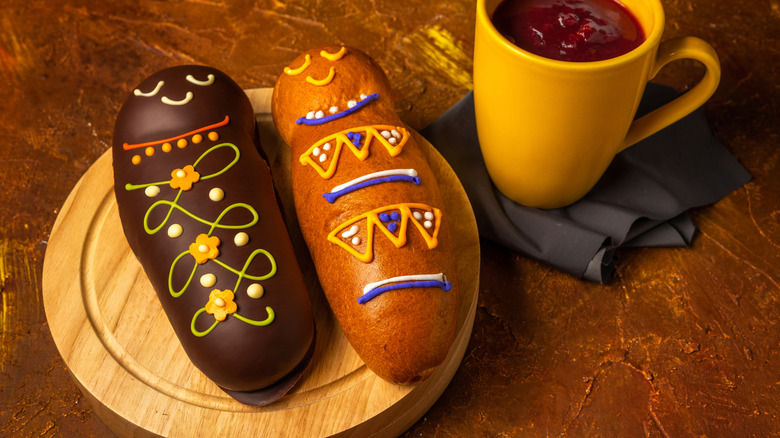
In Ecuador, Day of the Dead (or Día de los Difuntos) is celebrated on November 2nd. And with the festivities comes a charming bread-based treat. Guaguas de pan (which translates to bread babies in English) are crafted to look like swaddled babies, and adorned with colorful decorations. The breads have their roots in indigenous Ecuadorian culture, and were originally prepared as an offerings to the dead. The tradition continued throughout the 19th century, but in the form of inedible guaguas, that served only as grave decorations. Today, guaguas de pan are most definitely designed to be eaten, and you won't have to go far to find one if you're in Ecuador in late October or early November.
These yeasted breads are fluffy in texture, with a sweet taste similar to that of brioche. The dough itself is sometimes flavored with orange, almond, or anise, and there's the option to fill the bread with something sweet post-baking, too. This could be with chocolate, dulce de leche, or jam. Guaguas de pan are typically enjoyed alongside colada morada — a vibrant purple drink made with various fruits, blue corn flour, and spices.