

15 Mistakes Everyone Makes When Eating At A Steakhouse
Dining at a steakhouse can be a truly memorable experience. The food is consistently top notch, the experience is decidedly upscale, and the ambiance is warm and welcoming. And since a single steak can set you back $60 (or more for Wagyu and dry-aged), most of us indulge in the steakhouse experience once or twice a year. Since we relegate fine dining to special occasions, we should try to make the experience as flawless as possible. While some steakhouses come off snooty and pretentious, most aim to present a formal-yet-friendly atmosphere. They may seem frigid and full of rules, but steakhouses tend to be quite inviting. If that hasn't been your experience, perhaps you were the problem. Sure, things could go wrong, it's a restaurant after all, but if you follow proper steakhouse etiquette, you'll be on the amenable side every time. If you've ever felt snubbed or scoffed at, perhaps it was your decorum.
I've been a food writer for almost 30 years, so I have plenty of tips and suggestions when it comes to steakhouse dining. I'm not pretentious, and I'm certainly not highbrow, but I know how to follow the rules after years and years of experience. And to ensure you coast through your future steakhouse adventures with ease, I reached out to steakhouse expert Scott Weiner of Fifty/50 Group and partner of The Alston in Chicago for pro tips. Read on to make sure you avoid these common mistakes — take ownership of your role as a courteous customer, and you'll immediately notice the difference in the hospitality you receive.
Not listening to your server
Servers are more than order-takers and plate-delivery systems for your food. Especially at a steakhouse when they're often filled with knowledge about the menu, daily specials, and ability to meet dietary restrictions. Scott Weiner of The Alston in Chicago says, "Think of servers as your personal culinary concierge, dedicated to making your evening unforgettable." He adds, "While servers are certainly knowledgeable about our daily specials, their expertise extends far beyond that." He explains that servers offer insight into the chef's culinary vision, describe the unique flavor profiles of the different steaks, and share stories about where the food comes from, whether that's a local farmer, or specialty purveyor.
When the server arrives, look up and be attentive. Ask for recommendations. If you have your phone in your hand, put it down. Ignoring the server gives the impression that they offer little value to you. A steakhouse is meant to be an experience, often a long one, so sit back, relax and enjoy the show. At the end of the day, good service is only possible with your willing participation.
Not dressing appropriately

Not all steakhouses have a dress code, but most do, and it's typically semi-formal or formal. Don't risk walking up to the host's stand to learn you're grossly underdressed. It's bad form and awkward. Before you get ready to go, check the restaurant's website or make a quick phone call to ask about the required attire. I hate to state the obvious, but tank tops, T-shirts, and sneakers are not acceptable.
So what should you wear? Most steakhouses appreciate a polished look, one that's smart-casual, or business casual. For women, that means a nice dress, or stylish blouse and skirt, or dressy trousers with a nice-looking top. For men, choose a nice pair of slacks and a dress shirt, or Oxford button-down shirt. A blazer is optional but a nice touch. If you're craving a good steak but would rather wear something more casual (say jeans and a collarless shirt), head to a steakhouse chain instead.
Not specifying how you want your steak
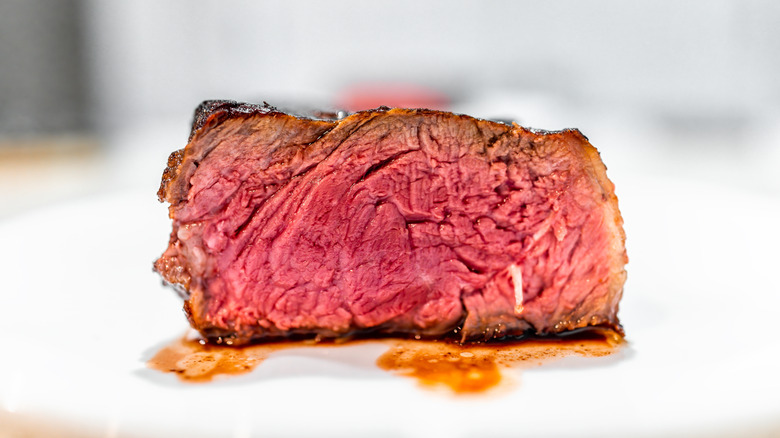
You're the boss of your steak, so you should order it the way you want it — whether that means bloody rare or well-done. But you should also know how to order the steak, so it comes out the way you expect. Steakhouse restaurant terms for doneness include "rare", "medium-rare," "medium", and "well-done". Rare meat is very red and cool inside, medium-rare is pink and the meat is warm, medium is slightly pink, and medium-well is cooked through, with virtually zero pink left (if any).
Once you select your cut of meat (filet mignon, ribeye, T-bone, NY strip, etc.), tell your server exactly how you want it cooked. Truth is, if you tell your server you want your steak well-done, they may suggest a different cut of meat (one that will stay juicy), or something else on the menu. Rare is often best for leaner steaks like top sirloin, medium-rare is ideal for steaks with more marbling, such as ribeye, medium is great for thicker steaks like porterhouse, and medium-well is best reserved for a NY strip. Some restaurants won't even guarantee the quality of your steak if you order it well-done, so, as stated above, ask your server; they usually know best.
Using too much steak sauce
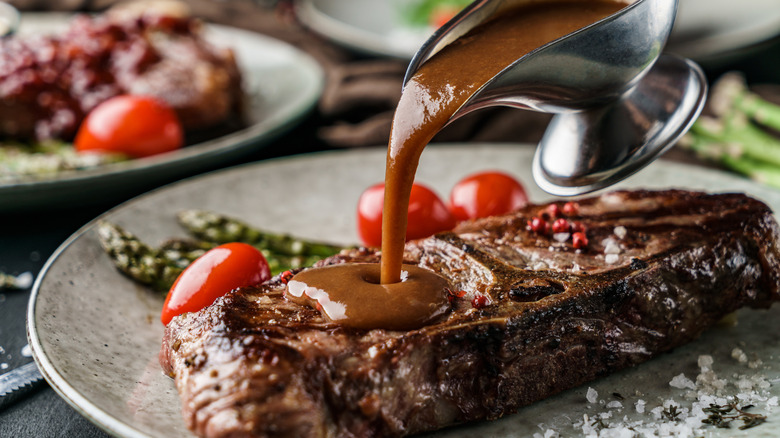
First off, if you're at a fine dining establishment, you most likely won't be offered a bottle of A1, nor should you ask for it. Here's why. Steakhouses pride themselves on their quality meat selection, serving the best cuts of steak, each aged for maximum flavor. Steak sauces like A1 are incredibly strong-flavored and will mask the inherent delectable flavor of the meat. Dousing a perfectly aged, flawlessly cooked steak with bottled sauce is almost sacrilegious, and downright disrespectful to the chef. Weiner adds, "We encourage guests to taste the steak on its own first to appreciate its quality."
Most high-end steakhouses offer their own house made sauces, specifically crafted to compliment the meat. Some offer creamy Béarnaise sauces, tangy garlic butter sauces, fiery peppercorn sauces, and those that are vinegary and full of herbs, like chimichurri. Weiner asserts that steakhouse sauces can often be the "crown jewel of the menu." Once you choose your steak and tell the server how you would like it prepared, ask for sauce suggestions. A steakhouse server will undoubtedly know the ideal pairing.
Cutting up the entire steak before your first bite
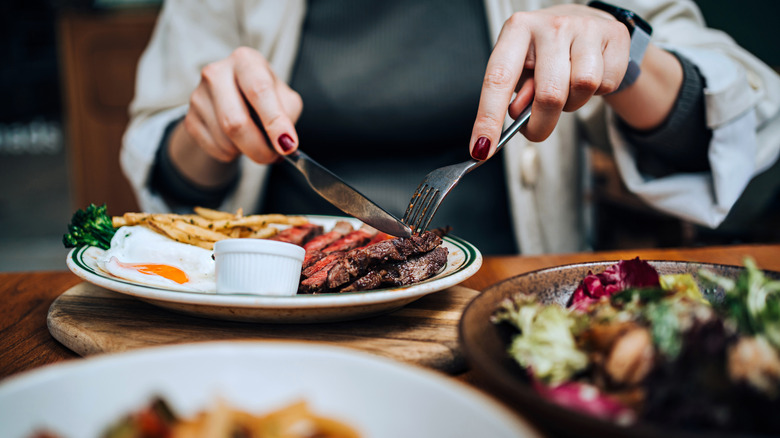
This mistake isn't solely about etiquette; it's about the quality of each bite. When you cut up your entire steak as soon as it arrives, the meat immediately starts to get cold, and the flavorful juices run out. You want those beefy juices in the meat, not on your plate. It's also not enjoyable for other diners to watch you saw into your steak like a barbarian. Or worse yet, a helicopter mom. Here's the protocol: when your steak arrives, use your fork and knife to cut a bite-size piece. Place the steak in your mouth and savor.
We don't need to get nit-picky, but for the ultimate in politeness, have the fork in your left hand and the knife in your right, with your index finger pointed down the edge. Cut one bite of steak and then put the knife on the plate. Transfer the fork to your right hand and take the bite. Vice versa if you're left-handed. Do not cut the next piece of steak until you've finished chewing and are ready for another bite.
Using the wrong utensils
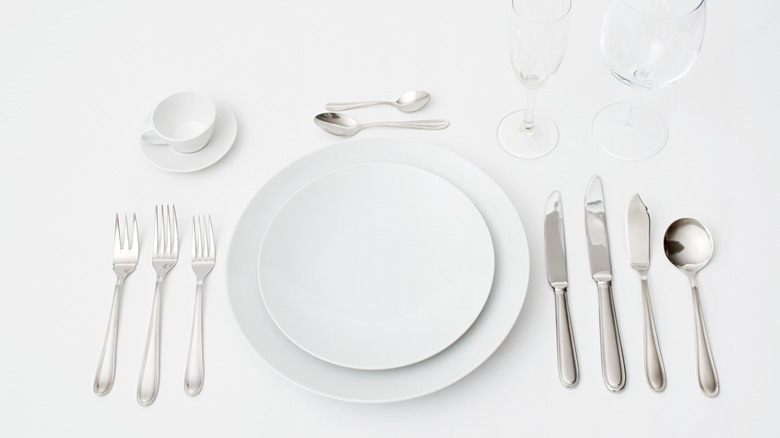
If you remember this one basic rule, you'll be set for life: When the restaurant sets the table, they place the utensils in the order they will be used, from the outside in. So, the outermost spoon will be for soup, and the outermost fork will be for salad (assuming you're eating a salad before the steak). If you remember that, you'll never grab the wrong utensil again. Simply start from the outermost fork or knife and work your way in. Not getting soup? No problem, simply move to the next utensil in line (note that when dining at a steakhouse, if you don't order soup, the spoon will likely be taken away by the server anyway).
In addition, use the utensils as they were intended to be used. Use the knife for cutting your steak, not for pushing the meat onto the fork. And when you're in between bites, or finished with the meal, rest your knife and fork on your plate, not the table. Why? It's not only considered bad restaurant etiquette if you place your used silverware directly on the table, but it's deemed unsanitary. In summary, start using your utensils from the outside in, and don't put them on the table once you've picked them up — ever.
Keeping the utensils in your hand
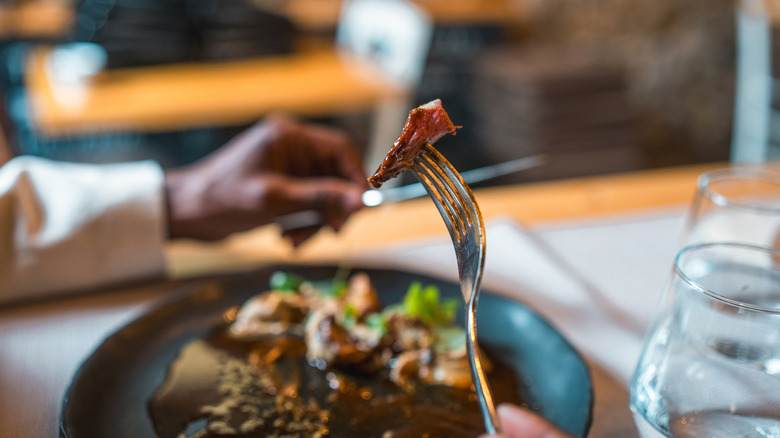
When dining at a steakhouse, don't be the storyteller gesturing with the fork and knife in your hand. It's not just impolite, but you also risk knocking over fine stemware filled with an expensive bottle of vino. And you could be flinging leftover bits of food in the air (and at others).
Once the food is in your mouth, rest your utensils on the plate. Where the utensils sit on the plate doesn't really matter, as long as they're not on the table. You can create a fork-and-knife triangle around the food you're eating, or you can rest the fork and knife together along the side of the plate.
There's another benefit to putting your utensils down between bites – it slows you down. This is a steakhouse, not a fast-food joint, so chew and savor each bite before moving on to the next.
Chewing on the steak bone
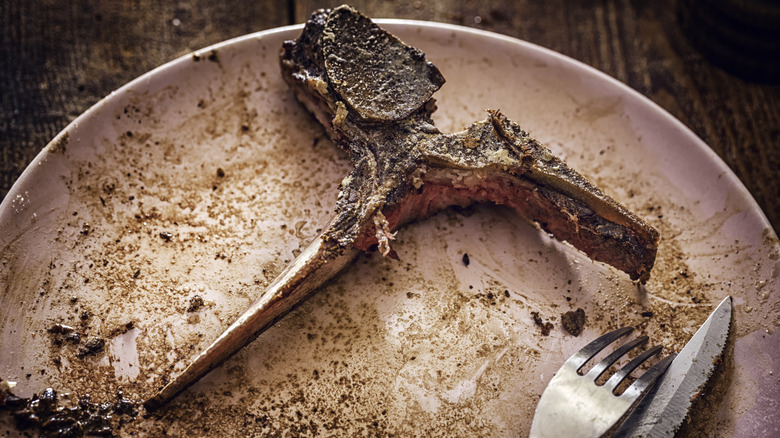
Perhaps this one should go without saying, but you never know. As delicious as bone-in steaks can be, the bone is not meant to be lifted off the plate. Steakhouses provide forks and knives for a reason, so there's no need to eat with your hands. If you want every last speck of the meat from your ribeye or T-bone, use your fork and knife to gently cut it away, while leaving the bone on the plate. For more stubborn little tidbits of meat, use your fork to tactfully scrape them away and then transfer the pieces to your mouth via the fork. Please don't gnaw on the bone at the table.
Remember, steakhouses are considered formal establishments, and eating with your hands is not considered fine dining. And let's not forget your dinner guests and other patrons of the restaurant; they likely won't find caveman manners very appetizing.
Hiding chewy pieces in your napkin
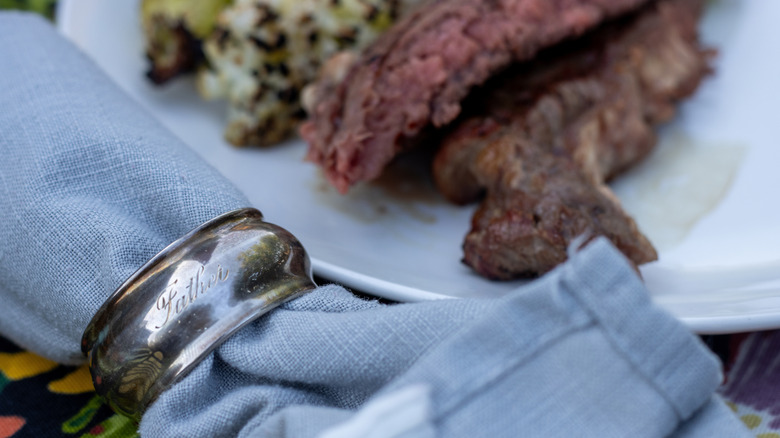
Yes, people actually do this. It doesn't matter how fine the meat at the restaurant is, steak often comes with gristly bits. We shouldn't feel obligated to eat those rubbery pieces, but we should also know how to dispose of them. Many folks think it's proper to bring the napkin to the mouth, discard the unsavory sinew, and then return the napkin to the table, or worse yet, the lap. This is not appropriate. First, the piece may fall on the floor to the disgust of other diners. Second, it's not polite to your server who will ultimately have to clean out your napkin.
The correct way to remove the gnarly gristle is to discreetly take the piece out of your mouth with your fingers and rest it in the upper left corner of your plate. If you would rather not use your fingers, you can use the same utensil you used to get the food in your mouth in the first place — your fork. If you would prefer not to look at chewed connective tissue on your plate for the remainder of dinner, cover it up with another piece of food. Or perhaps a dinner roll.
Eating before everyone has been served
As tempting as it may be to dive into your food as soon as it lands, wait until everyone at the table has been served before eating. This shows patience, decorum, and respect for the other guests at the table. When dining with a larger group, it's polite to wait for the host or guest of honor to begin eating. Once they start noshing, that signals everyone else that it's appropriate to dig in.
Of course, there are some exceptions to this situation. For example, if someone's steak isn't cooked to their liking and the food gets sent back, your food will get cold if you wait. In scenarios where the quality of the food will be compromised by waiting, it's acceptable to start eating before all plates are down. Don't abuse this exception and use the excuse "my food is getting compromised" if you're simply impatient.
Rushing through dinner
It's very American to be in a hurry, even at mealtime. But a visit to a steakhouse isn't solely about the food, it's also about the ambiance and pace. Most fine dining restaurants prioritize longer dining experiences, which is why they limit the number of diners they serve each day. They want you to sit back, relax and enjoy the moment, as long as it takes. Yes, the food will likely be deliciously tempting, but fight the urge to rush through dinner. It's important to appreciate every morsel of that perfectly cooked steak, and every last sip of fine wine. This is the time to chill out and enjoy your friends and family.
If you have trouble slowing down, focus on eating slowly and steadily, and eat in sync with the other guests at the table. If everyone at the table happens to be in a rush, then all bets are off.
Not saving leftovers
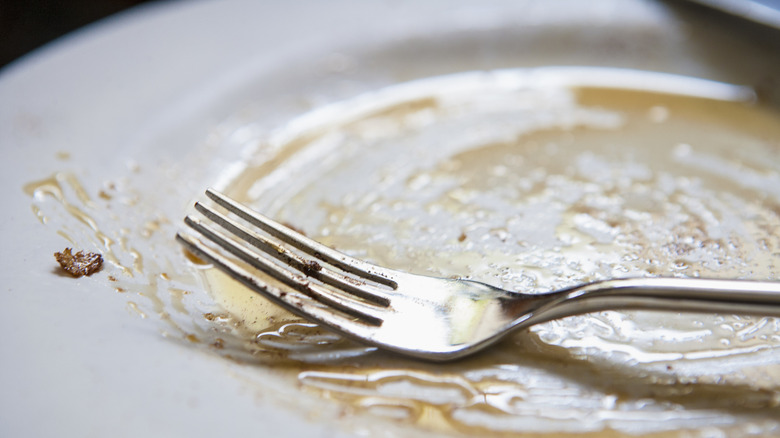
This might seem like an odd mistake to make, especially if you were thrilled with what you ordered and cherished every bite but, turns out, the chef might see it differently. The chef has likely painstakingly prepared your meal in an effort to show off his/her culinary skills. Respect for the chef's work would likely mean an empty plate, correct? Not necessarily. When a plate is licked clean, so to speak, it may give the impression that not enough food was served. And scraping up every scrap with bread or another food sponge can be unappealing to other diners. Leaving one tiny bite on the plate at fancy restaurants is a polite gesture, as it indicates that the meal was delicious and you are satisfied.
But let's be honest, if you've just doled out $75 for the perfect steak and want to eat every last speck, go for it. Or perhaps leave a little piece of bread behind. The best practice for fine dining is to leave your plate as clean as desired, but never messy.
Putting your napkin on the table
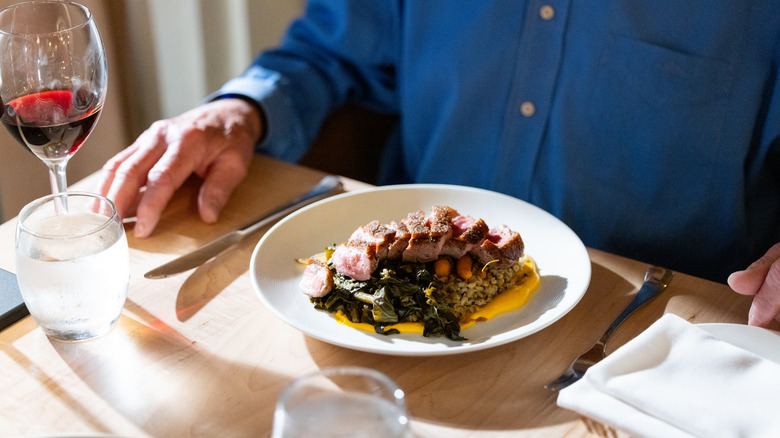
As soon as you sit down at the table of a steakhouse, put the napkin on your lap. End of discussion. Keep the napkin on your lap for the entirety of the meal, except when gently dabbing your mouth (dab, don't wipe). If you've politely touched up your mouth, fold the napkin and place it back on your lap. If there are any stains on the napkin (not uncommon when red wine and steak are involved), refold it below the table and out of sight of your tablemates, so the stains are hidden.
Need to use the restroom? No problem, you are not chained to the table by your napkin. Excuse yourself, loosely fold the napkin and place it on your chair. Do not put the napkin on the table or your plate; it's impolite and unsanitary. Once the meal is finished, loosely fold your napkin and place it on the left side of your plate. In summary, there are two times when the napkin is on the table — when you arrive and when you leave.
Smelling the cork
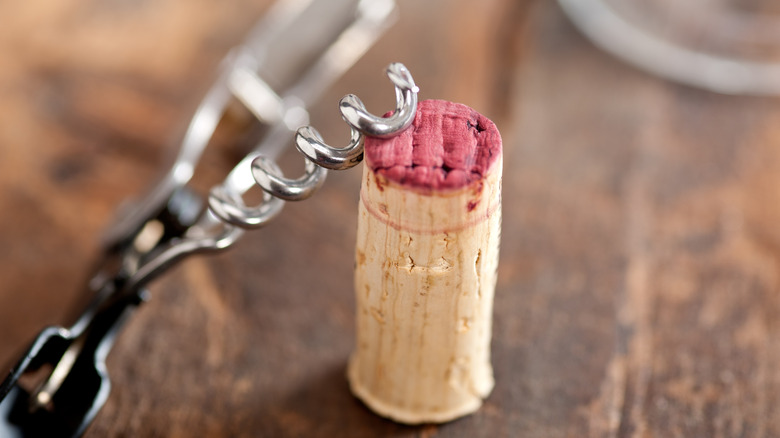
We get it, you ordered a fancy bottle of wine and want to make sure it's suitable for you and your guests. And maybe you want to show off a little in the process. Back in the day, the cork was presented to show the consumer that the estate or winery on the bottle matched what was inscribed on the cork, to alleviate any fears of wine fraud. These days, folks assume the cork holds the key to the quality of the wine — and smelling it will alert you of cork taint (a musty basement smell), which would indicate that the wine was equally musty. In truth, the cork smells like a combination of the wine and the organic material of the cork.
Weiner explains, "While smelling the cork is a common practice, it's not the most effective way to determine the quality of the wine as it generally just smells like cork." He adds, "A better approach is to examine the cork for any signs of drying or cracking and to smell the wine in the glass to check for any off aromas." In short, smelling the wine itself is the best way to tell if it's flawed. When in doubt, a fine steakhouse will have sommeliers on hand to guide you.
Not being courteous of the atmosphere

The steakhouse experience is a marriage of high-quality fare and a sophisticated environment. The mood is quiet, and the atmosphere is chic. And as mentioned, for most people, it's a special occasion, a once or twice a year event. For that reason, be mindful of your surroundings. Treat the staff with courtesy and respect. Chew quietly, with your mouth closed. Do not talk with food in your mouth. If you need to take a call, excuse yourself and step outside (and put your napkin on your chair). Don't banter loudly or disrupt the setting. Engaging in polite conversation will show respect for your dining companions, as well as those seated around you.
The restaurant bill will likely be high for everyone in the restaurant; it would be a shame if one loud group of people with poor manners ruined that experience for everyone else.