

Why Baking A Sample Cookie Is So Important For A Consistent Batch
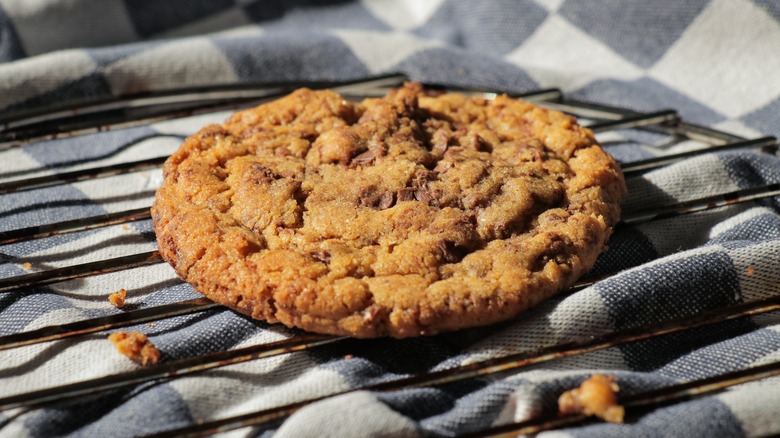
Whether it's nonna's famous peanut butter cookies or Crumbl's cookies of the week, one thing we know for sure is that cookies are fun to eat. You can dunk them in milk, pair them with your favorite ice cream, or simply enjoy them by themselves. However, cookies aren't as joyous to make from scratch; especially since everything from inaccurately measuring your ingredients to rushing through the baking process can turn your cookies into a less-than-desirable mess. Hence, baking a sample cookie is a foolproof way to rectify those user errors and ensure you always make a perfect batch of cookies.
It's no secret that one of the most common cookie baking mistakes everyone runs into is baking cookies at the wrong temperature. Luckily, a sample cookie can prevent that from happening. All you have to do is place one singular cookie onto a properly lined baking sheet. Then, bake it for the recommended amount of time you would bake a full tray of cookies. Once it's baked, carefully examine your cookie.
If your sample cookie failed to expand during the baking process, that means you need to lower the oven temperature by a few degrees. You want your cookies to spread just enough so they evenly bake and develop a desirable, chewy texture. However, if your sample cookie looks like a deflated, puddle of sadness, consider increasing the oven temperature. You want to make that change because extremely thin cookies lack everything that makes cookies delicious. Although finding the perfect baking temperature for your cookies might seem a little tedious, it will save you from producing a burnt or underbaked dessert that no one wants to eat.
Three helpful oven tips to keep in mind while baking cookies
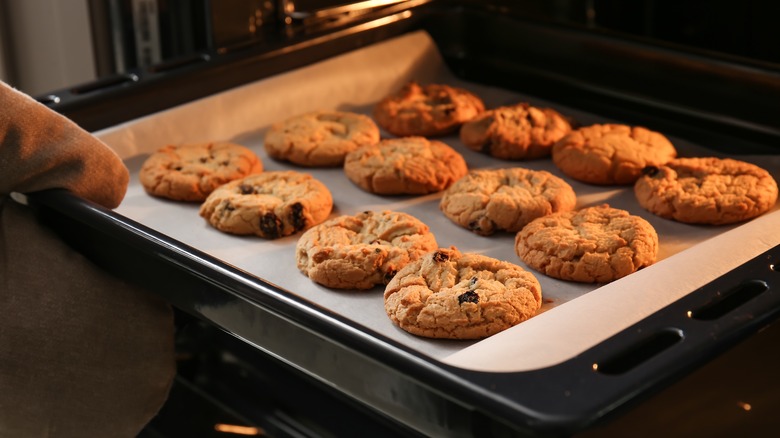
Due to various factors, like faulty parts and repeatedly opening and closing the oven, it's normal for the internal temperature to differ from the set temperature on your oven. In fact, the internal temperature can be off by nearly 60 degrees Fahrenheit. So how do you fix that? Well, one of the easiest ways to stabilize your oven temperature is to use a pizza stone. By keeping this stone at the bottom of your oven, it helps the internal temperature stay consistent throughout.
If you don't have a pizza stone, you might be wondering if you can trust your oven's built-in thermometer? The answer is yes and no. Yes, the temperature displayed is accurate for the area the thermometer is in. However, that temperature doesn't reflect every area of your oven. So, you're better off buying a good quality oven thermometer instead. This will allow you to place the thermometer directly in front of your cookies, so you can know exactly what temperature they're baking at.
Once you adjust to your oven's temperature inconsistencies, you have the freedom to play around with the temperature to achieve different cookie textures. The secret to making cookies that are chewy yet crispy is to utilize a simple oven trick: Increase your oven temperature by 10 degrees Fahrenheit. To achieve this, you should use a sample cookie, the best way to nail the perfect consistency without ruining an entire batch of cookies. Just remember that you run the risk of burning your cookies the higher the temperature gets. As simple as it is, baking with the right temperature will guarantee that you bake delectable cookie recipes that your family will love and have cookies you'll be proud to serve at any party or cookie swap.