

Aldi Vs Lidl: How The Two Chains Compare
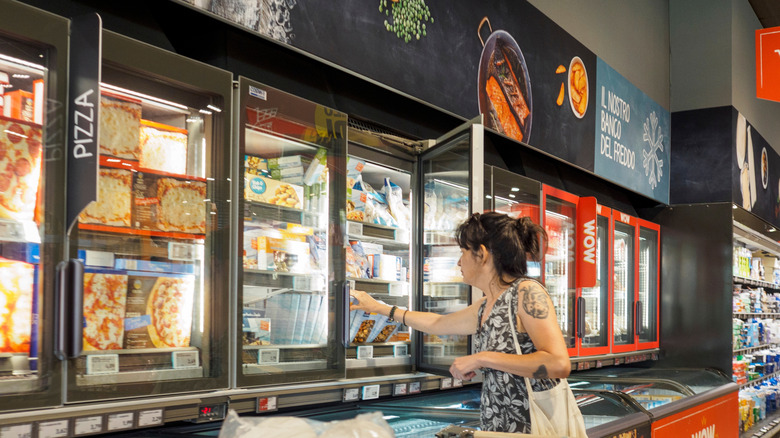
You might have heard that Aldi and Lidl are related. Like, literally. Many believe that the founders were brothers, and after an argument, one got Aldi, and the other Lidl. We're sorry to say, while this would be a dramatic and interesting origin story for the two chains, it's not true. But these two retailers do have plenty in common. In fact, Aldi and Lidl may not be brothers by blood, but they are similar, with near-on identical business models.
Both have weird and wonderful middle aisles, both emphasize private label products over brand names, and both are hyper-focused on saving you money. They also have similar roots and were founded in the same country. Spoiler alert, it's Germany, but you probably knew that already.
Sure, there are some differences between them (Aldi's expansion in the U.S. is going considerably better than Lidl's, for example), but these two discount retailers seem to have more that unites them than divides them. Want to find out how the two chains compare? Let's dive in.
Both have German roots
Aldi's roots stem back to a small shop in Essen, Germany. Two brothers (real brothers this time), named Karl and Theo Albrecht, returned from World War II to their mother's grocery store and decided to build it into a retail giant. If you were looking for drama, this is where the tale of two divided brothers comes in. In the 1960s, Aldi had hundreds of stores, but the Albrechts still weren't happy. They couldn't agree on a cigarette policy, and the argument spiraled to the point where the chain split in two. Theo took on Aldi Nord, and Karl took on Aldi Süd.
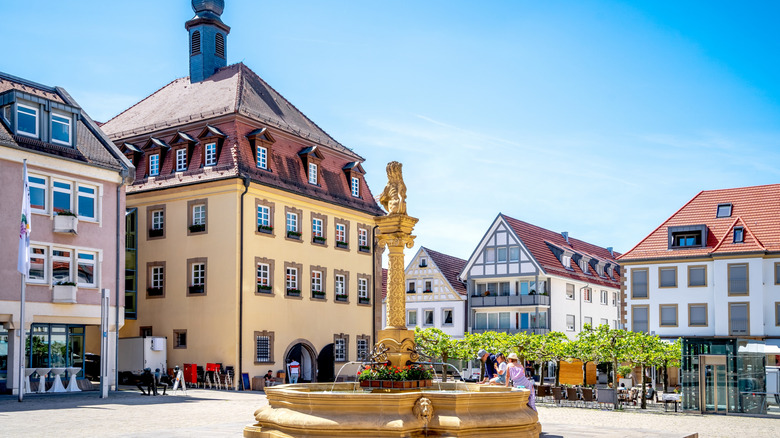
Lidl also began in Germany; its roots stem all the way back to the 1930s, when it was a food wholesale company in the city of Neckarsulm. It was quite a while before it became the retailer we know today, though. Founder Dieter Schwarz, who took over the wholesale business from his father Josef, didn't open the first Lidl retailer in Germany until the early 1970s. Expansion was quick; there were more than 450 Lidl stores by the late 1980s.
Aldi has a much bigger presence in the US, but Lidl is growing
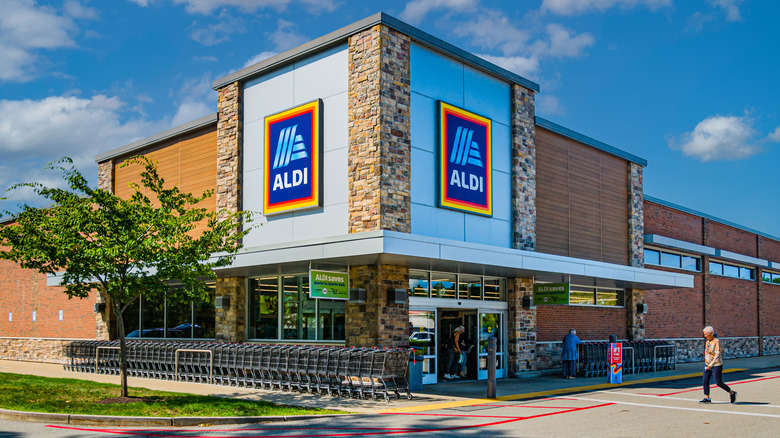
After their argument in the 1960s, Theo and Karl went in different directions. We're not just talking metaphorically here, but geographically. Aldi Nord opened stores in northern Germany, as well as countries like Belgium, France, Luxembourg, the Netherlands, and Spain. Aldi Süd runs the stores in southern Germany, and it has also expanded into several international markets, including Australia, the U.K., and the U.S.
This could all change in the future; in 2025, there were rumors about a potential merger between Nord and Süd. But for now, when we're talking about Aldi in America, we're talking about Aldi Süd. And this half of the chain has expanded rapidly in the U.S. As of early 2026, there are more than 2,600 Aldi locations across the country, and there are more on the horizon. By 2028, the discount retailer is hoping to have 3,200 U.S. locations.
Now, Lidl. The chain opened its first store in the U.S. in 2017, but less than a decade later, it has just under 200 stores in the country. That's considerably fewer stores than Aldi, but it is expanding. And in 2025, data from Placer.ai revealed that overall grocery visits to the chain had grown by 4.9% year over year. Despite its limited growth so far, this means that it's still outpacing the traditional grocery market in the U.S (alongside Aldi and Trader Joe's).
Both are budget-focused chains
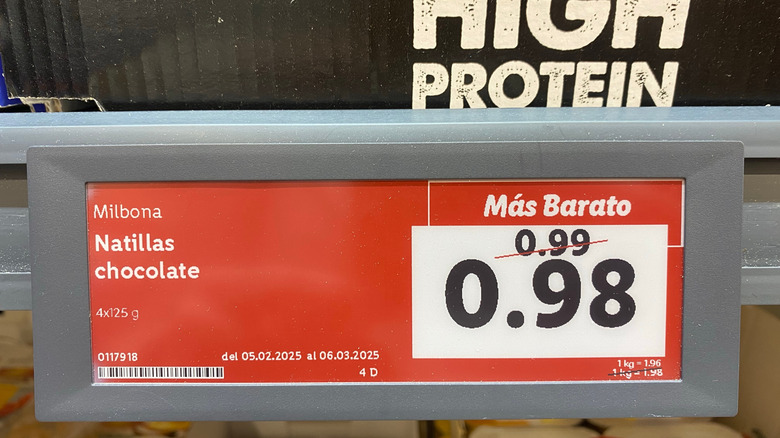
Being budget-friendly is central to both Lidl and Aldi. They both place utmost importance on providing customers with products that are considerably cheaper than versions you'll find in other mainstream grocery stores.
In the U.K., where both Lidl and Aldi have a huge presence (both have around 1,000 stores in the U.K.), the two chains are constantly competing for the title of the cheapest supermarket. According to an extensive study by Which?, for 10 months in 2025, Aldi was the cheapest, but Lidl took the crown for the other two months.
Surveys in the U.S. have come up with similar results. According to Consumers' Checkbook, when it examined the prices of major grocery stores in seven metro areas, it found that Aldi's were around 20 to 40% lower than the average store, while Lidl's were around 15 to 20% lower.
Aldi and Lidl both focus on private label products
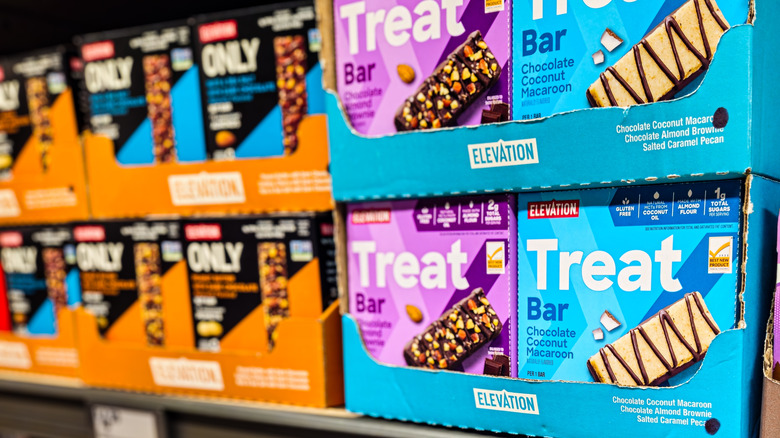
If you're wondering how, exactly, Lidl and Aldi manage to keep their prices so low, a huge part of it is avoiding branded products. Private label ranges are cheaper for grocery stores because they don't have to go through any external companies to produce them. These ranges also often don't require the same amount of marketing or research and development, either, which helps stores pass savings onto the consumer.
Most grocery stores offer private label ranges. Walmart has several, including bettergoods, Marketside, and Great Value; Kroger has lines like Simple Truth and Private Selection; and Target has options like Good & Gather and Market Pantry. But the key difference between these retailers and Aldi and Lidl is that they also offer a heck of a lot of branded products, while the German discount retailers are far more selective. In fact, 80% of Lidl's products are private label, while Aldi's offering is more than 90% own-brand.
Both got a major boost thanks to the 2008 financial crash
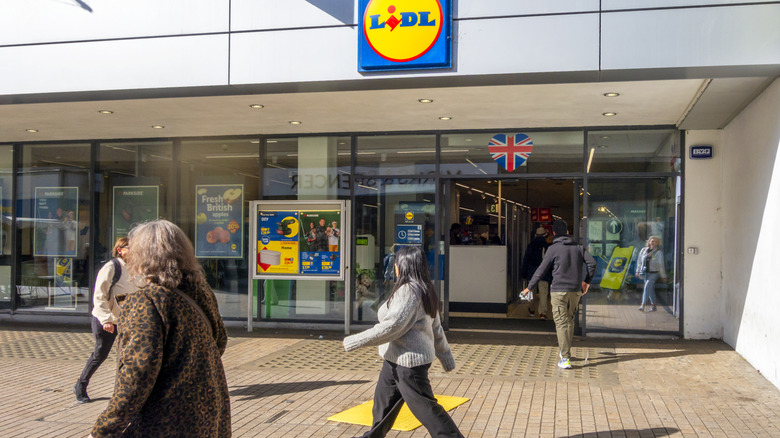
In 2008, the global economy suffered a major blow. Things were already on tricky ground after the 2007 mortgage crisis, but when the Lehman Brothers investment bank collapsed in September 2008, things went from bad to worse. A huge recession (which would later be called The Great Recession) followed, and it impacted millions of people. Households had to tighten their budgets, which meant making sacrifices on the weekly shop. Thankfully, though, there were two knights in shining armor ready to help people buy more groceries for less.
Aldi and Lidl were two of the few companies that actually benefited from the global economic crisis. In the U.K., Aldi reported a jump in sales and a boost in its earnings in 2008. In fact, its operating profit nearly doubled. Lidl's sales also rose as a result of the crisis. In June 2008, the U.K. economy was already struggling, even though it was pre-Lehman Brothers collapse, but Lidl reported a sales increase of nearly 13%.
Now, history seems to be repeating itself. As Aldi, in particular, experiences astronomic growth in the U.S., it's no coincidence that the country is also grappling with an ongoing affordability crisis.
Both have a middle aisle full of discounted non-food items
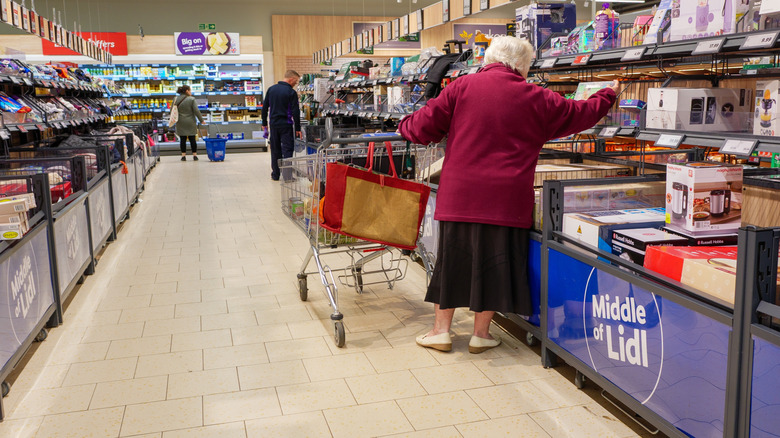
If you've ever popped into Aldi for a few fridge staples and walked out with a kayak, you're not alone. Customers all over the world have reported finding weird and wonderful things in Aldi's middle aisle (nicknamed the "aisle of shame"), which is basically a row in the middle of the store that offers pretty much anything and everything but groceries. One Reddit user said they went into their local Aldi to grab milk, and when they got to their car, they realized they didn't have the milk. Instead, they got a squatty potty, of course. Other finds listed by Redditors include a cardboard hot dog stand for cats, leggings with pockets, a pop-up tent, a sewing machine, and an inflatable sprinkler shaped like a unicorn.
Aldi started the middle aisle concept, but Lidl caught on quickly. It prides itself on stocking its middle aisle with new, fun, and interesting goodies every single Monday. Again, Redditors list finding everything from inflatable canoes to gazebos to chainsaws in the middle aisle of Lidl. One shopper even said they found a trumpet in their local Lidl, which led to them joining a jazz band. We're not making this up.
These fun and slightly weird stories actually explain exactly why Lidl and Aldi keep their middle aisles. You never know what you're going to stumble across, and that element of curiosity helps to lure more consumers through the doors.
Aldi and Lidl both like to run promotional themed weeks
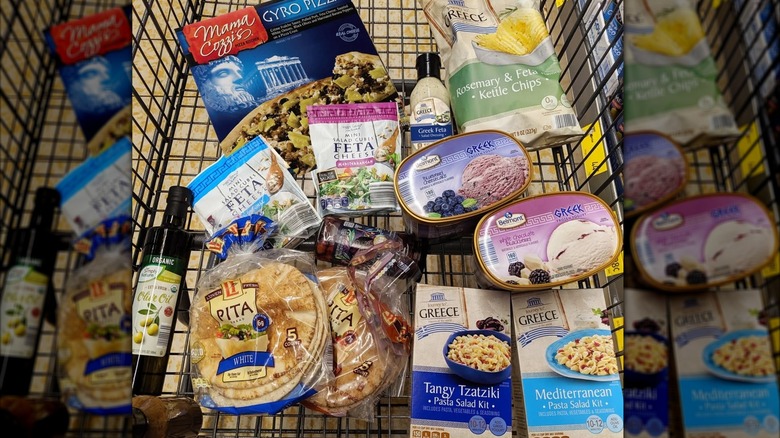
Aldi and Lidl both like to keep shoppers engaged and interested in fun, creative ways. The ever-changing middle aisle is one example of this, as are their extensive ranges of private-label products. But another way these two German-founded discount giants help keep their customers happy and excited to shop at their stores is with special promotional themed weeks.
In January 2026, for example, Lidl celebrated Greek week in the U.S. This involved running several special offers on Greek products, including olive oil, grilling cheese, and stuffed vine leaves. Back in September 2025, Aldi celebrated German week, bringing in 50 German products, like cheese spaetzle and apple strudel, for customers to enjoy. The promotion is much-loved in the U.S., so Aldi brings German week back twice a year — once in the spring and then again in the fall. But themed weeks are not just an American thing. In June 2025, for example, Australian Aldi stores celebrated Best of British week, and in September, U.K. Lidl customers were treated to Iberian week.
Lidl's stores tend to be bigger than Aldi's
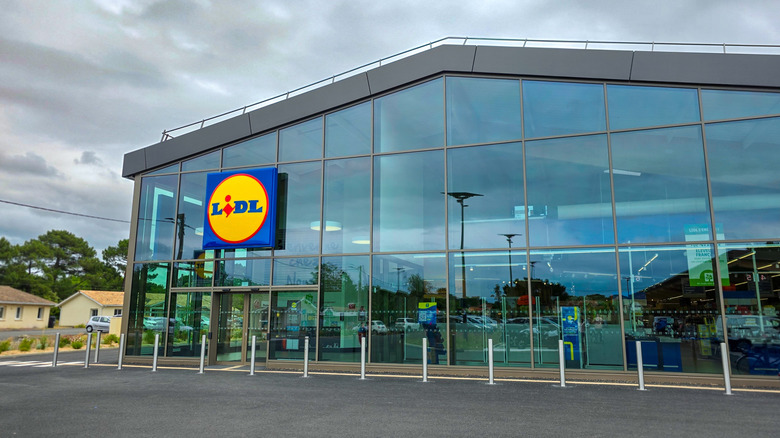
Lidl might have a smaller presence in the U.S. in terms of locations, but its stores are actually bigger in terms of square footage. While the average Aldi store is around 10,000 square feet, Lidl's stores can measure up to 21,000 square feet. And that means more room for bargains. In fact, while Aldi stores tend to offer around 1,300 products, Lidl's stock totals around 4,000 items in the U.S.
But Lidl's product count still pales in comparison to the average grocery store. In 2025, Walmart's online listings totaled around 420 million. Granted, this isn't the amount it actually stocks in store, but its average location is significantly bigger than both Lidl and Aldi, coming in at around 100,000 square feet. Its Supercenters are even bigger, at an average of 200,000 square feet.
According to Lidl, its size and product range are smaller than other major chains for efficiency reasons. Keeping things refined helps it to control prices more effectively, and also helps it maintain the quality of its products.
Both have won awards for their wine selections
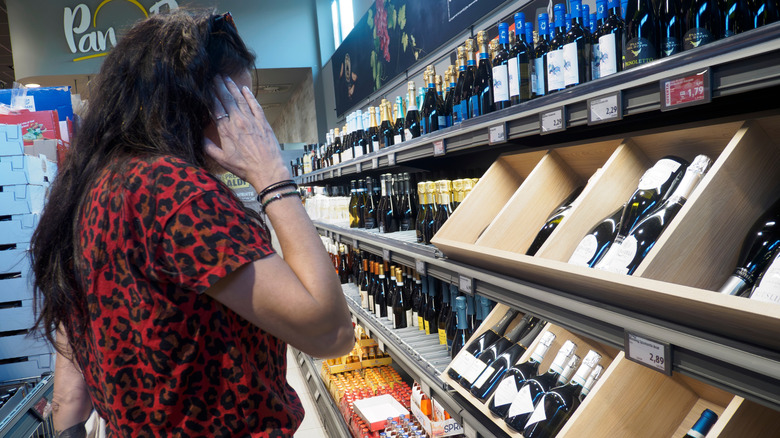
If you want a cheap bottle of wine, you probably already know that Lidl and Aldi can deliver. But actually, these discount retailers don't just offer budget-friendly wine, they both also offer pretty good quality tipples, too. And they've got the awards to prove it.
In fact, in 2021, the Sommeliers Choice Awards awarded Lidl's Bordeaux Superieur with its silver medal, praising its tasting notes of red cherry and strawberries and its easy drinkability. Lidl also lists its Corte alle Mura Chianti Riserva in its award-winning wine collection in the U.S., alongside its Australian Merlot. As for Aldi, in 2017, its Exquisite Collection Cotes de Provence Rosé was named as one of the best in the world in a blind taste test for the International Wine Challenge's Great Value Awards. In 2025, Aldi's South Point Estate Pinot Grigio was given a gold medal at the Melbourne International Wine Competition.
But even the non-award-winning wines at Aldi and Lidl can be pretty good; both are frequently praised by wine experts for their top quality selections. In 2024, a sommelier ranked Aldi's private-label wines for Tasting Table. The winning bottle? The Specially Selected Willamette Valley Pinot Noir.
Both have in-store bakeries, although Lidl's are more established
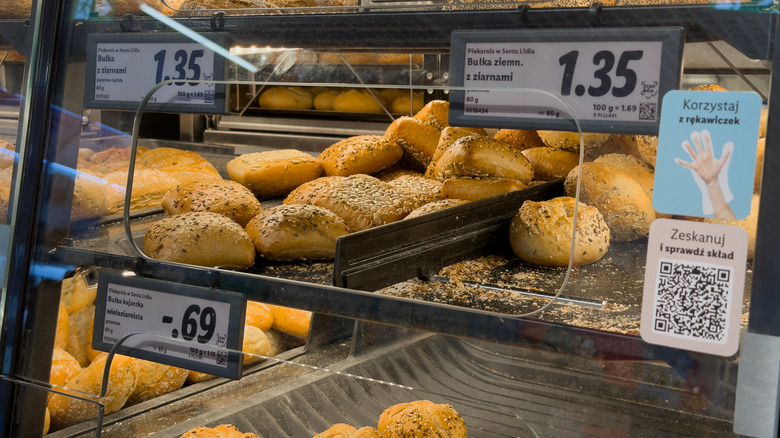
Aldi might have paved the way for the middle aisle, but Lidl was well ahead on the in-store bakery. In fact, in 2011, Lidl started installing bakeries for all its stores across the U.K. By 2012, Lidl also started integrating bakeries into the rest of its European locations. After it expanded to the U.S., the retailer, of course, brought the bakeries, too.
Lidl's bakeries are still one of the biggest reasons why shoppers love the chain. The biggest draw is the impressive range; Redditors say they love snapping up everything from goat cheese focaccias to pizza slices to pastel de nata when they shop at Lidl.
Aldi has been slower to introduce in-store bakeries, but it is starting to roll them out to select locations. In 2025, Aldi had installed bakeries in 25 of its U.K. stores, and shoppers at a store in Batavia, Illinois, noticed a new, fresh bakery department that same year. In response, the chain confirmed that it had started to experiment with bakeries in some of its U.S. locations.