

The US State With Booze Rules So Strict, Even Your Pour Is Monitored
Alcohol laws vary quite a bit across the U.S., with some states being much more restrictive than others. For example, in Indiana, while you can buy beer at grocery and convenience stores, if you want it cold, you'll have to go to the liquor store. In Virginia, on the other hand, restaurants must ensure — and be able to prove — that the percentage of their gross sales coming from drink sales are at or below 55% or else risk fines and potential revocation of liquor licenses. But there's only one state where even bartenders themselves don't have free license with their bottles, and it might be exactly the one you'd expect: Utah.
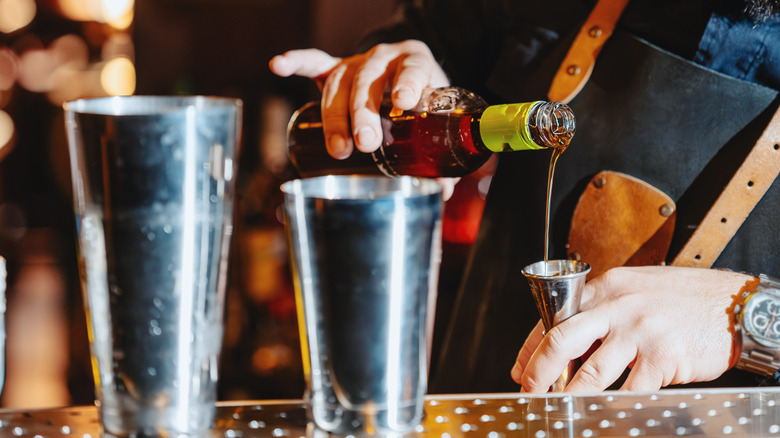
Generally, the pour of liquor in your glass is up to the discretion and recipe of the mixologist. In Utah, however, bartenders are required to use a special calibrated device to ensure that a pour of liquor comes out at exactly 1.5 ounces. They are quite serious about this, mandating that all bottles use these devices, and that the devices themselves have a margin of error of less than one sixteenth of an ounce for a one-ounce pour — or about a third of a teaspoon.
In addition to the strict metering of pours, no cocktail in Utah may contain more than 1.5 ounces of the primary liquor — think gin in a Tom Collins — and 2.5 ounces of liquor total. While this obviously outlaws drinks like a Long Island Iced Tea, the limitations also necessitate changes to common cocktails that rely on 2-ounce pours, like an Old Fashioned or Gimlet, forcing Utah bartenders to downsize the drink or mix two different liquors.
Utah liquor laws past and present
Utah is no longer a majority Mormon state, with recent estimates showing only about 42% of the population as members of the Church of Latter Day Saints, but not long ago that number was much higher. The proximity to the Mormon church, which doesn't even technically allow coffee, much less alcohol, is responsible for the state's strict liquor laws — and the popularity of root beer in Utah. In turn, the shift away from the church is likely responsible for some loosening of laws in recent years.
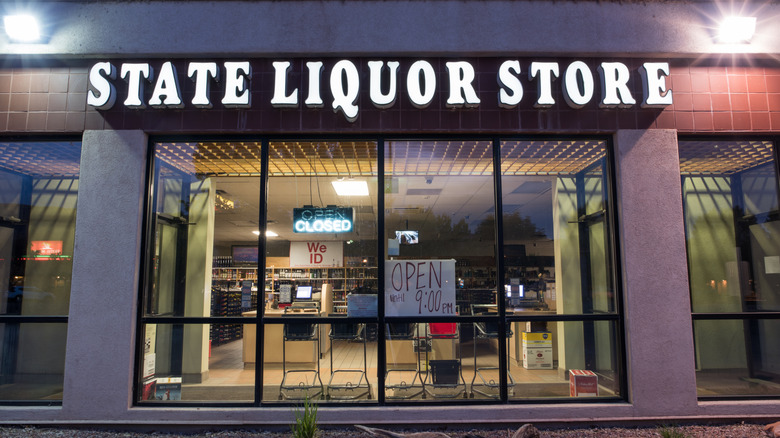
Not long ago in Utah liquor could only be served to members of private clubs, and beer was restricted to 3.2% alcohol by weight. Both of these restrictions have now been lifted, meaning that now patrons of Utah bars can order a cocktail with a closely-monitored pour, and beer up to 5% alcohol by volume can be ordered at bars and purchased at grocery stores. That said, for stronger beers, as well as wine and hard liquor, customers still need to head to one of the state-run liquor stores, and Utah is still one of the states where happy hour is banned. Utah also has the strictest limit of any state for driving under the influence (DUI) charges. In every other state the legal limit for driving is a blood alcohol concentration (BAC) below 0.08%, whereas in Utah that number is just 0.05% — a reduction from the norm that only took effect in 2018.
For the most part, Utah's alcohol laws seem to be trending closer to the rest of the country, though for now the Beehive State is still keeping a careful grip on everything from where you can buy your favorite beers to exactly how much liquor a bartender can put in your Old Fashioned.